How a chain reaction builds
Definition
Chain reaction
A chain reaction is a sequence of fission reactions in which neutrons released by one fission cause further nuclei to undergo fission.
- Each fission of a uranium-235 nucleus throws out two or more neutrons, and those neutrons are what makes a chain reaction possible.
- If one of them is absorbed by another uranium-235 nucleus, that nucleus becomes unstable and splits in turn, releasing more neutrons and more energy.
- The reaction is therefore self-sustaining: once it has started, it supplies its own trigger and needs nothing from outside.
- Not every neutron goes on to cause a fission, because some escape from the edge of the fuel and some are absorbed by nuclei that do not split.
- What matters is therefore the average number of neutrons from each fission that go on to cause another fission, and everything about running a reactor comes down to holding that number where it is wanted.
Keeping the reaction steady
- If more than one neutron per fission causes a further fission, the number of fissions grows with every generation, so the rate of energy release rises faster and faster and the reaction runs away.
- If fewer than one does so, each generation is smaller than the one before, so the reaction dies out and the reactor shuts itself down.
- If exactly one does so, each generation is the same size as the last, so the number of fissions per second stays constant and energy is released at a steady rate.
- That last case is a controlled chain reaction, and it is the condition a power station holds its reactor in for months at a time.
- A steady rate of fission gives a steady rate of energy transfer, which is what allows a turbine and generator to run at a constant output.
Key Idea
- The whole principle of control is holding the average at one neutron per fission going on to cause the next fission.
- Above one the output climbs, below one it falls, and at one it stays where it is.
The moderator
Definition
Moderator
A moderator is the material in a reactor core that slows down fission neutrons so that they are more likely to be absorbed by fissile nuclei.
- The neutrons that come out of a fission are moving extremely fast, and a fast neutron is very likely to shoot past a uranium-235 nucleus without being captured.
- Left as they are, too few of them would be absorbed, so the chain reaction would not keep going.
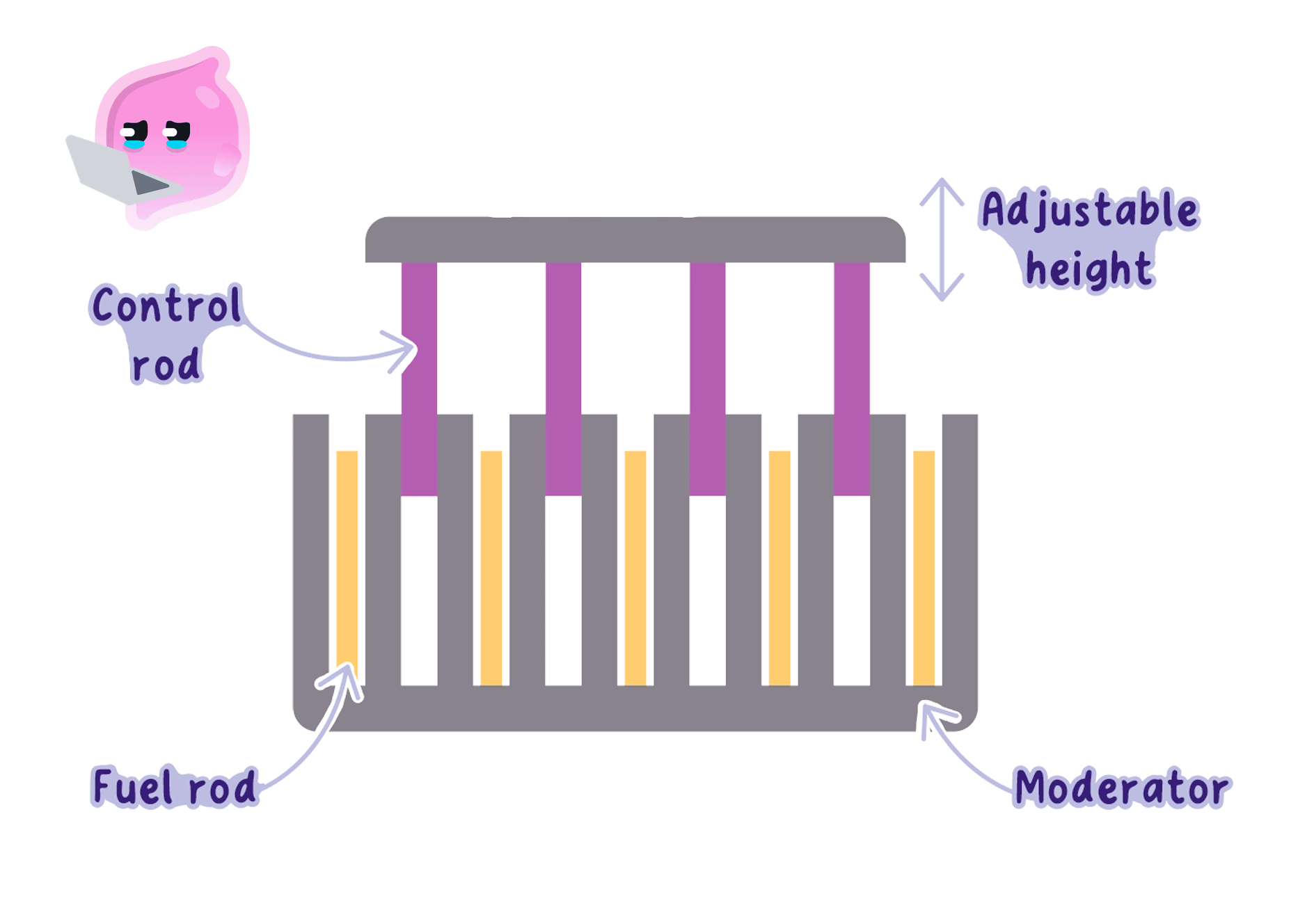
- The fuel rods are therefore surrounded by a moderator, usually blocks of graphite or a tank of water, filling the space between them.
- A neutron leaving a fuel rod collides many times with the nuclei of the moderator, and it transfers some of its kinetic energy at each collision.
- After enough collisions the neutron is travelling slowly, and a slow neutron spends far longer passing a nucleus, so it is much more likely to be absorbed.
- Slowed neutrons that wander back into a fuel rod are therefore absorbed by uranium-235 nuclei, and the chain reaction is sustained.
- The moderator slows neutrons down and does not absorb them, which is the single most important thing to keep straight in this topic.
The control rods
Definition
Control rod
A control rod is a movable rod in a reactor core that absorbs neutrons so that the rate of fission can be regulated.
- Control rods are made from a material that absorbs neutrons strongly without splitting, such as boron or cadmium.
- They hang between the fuel rods and can be raised and lowered by motors while the reactor is running.
- Every neutron a rod absorbs is one that can no longer reach a uranium-235 nucleus, so the rods set how many neutrons are left to keep the reaction going.
- Lowering the rods further in absorbs more neutrons, so fewer fissions happen each second and the rate of energy release falls.
- Raising the rods further out absorbs fewer neutrons, so more fissions happen each second and the rate of energy release rises.
- Detectors in the core measure the neutron level continuously and the rod position is adjusted automatically, which holds the average at one neutron per fission causing the next.
- In an emergency the rods are dropped fully into the core, absorbing so many neutrons that almost none reach a fuel nucleus and the chain reaction stops.
Example
Why rod position matters so much
- In a reactor each fission of uranium-235 releases on average 2.52.52.5 neutrons.
- For a steady output, exactly 111 of those must go on to cause another fission.
- So on average 2.5−1=1.52.5-1=1.52.5−1=1.5 neutrons from each fission have to be removed, by absorption in the control rods, by absorption in other material, or by escaping from the core.
- Suppose the rods are raised slightly, so that 1.11.11.1 neutrons per fission now cause a further fission instead of 111.
- After 202020 generations the number of fissions per second has been multiplied by 1.120=6.71.1^{20}=6.71.120=6.7.
- A change of one tenth of a neutron per fission therefore raises the power output almost sevenfold, which is why the rod position is monitored and corrected automatically all the time.
From fission to electricity
Definition
Coolant
A coolant is the fluid pumped through a reactor core that transfers thermal energy away from the fuel.
- The energy released by the controlled chain reaction raises the thermal energy of the fuel rods, so the core becomes extremely hot.
- A coolant, usually water under high pressure or carbon dioxide gas, is pumped through the core and heated as it passes the fuel rods.
- The hot coolant flows to a heat exchanger, where it transfers thermal energy to water in a completely separate circuit before returning to the core.
- Keeping the two circuits separate matters, because the coolant has been through the reactor and must not be allowed to carry radioactive material out to the rest of the station.
- The water in the second circuit boils, producing high-pressure steam.
- The steam is directed onto the blades of a turbine and makes it spin.
- The turbine shaft turns a generator, which transfers energy electrically to the National Grid through transformers.
- The used steam is condensed back to water in a condenser cooled by river or sea water, and pumped round to be boiled again.
- The reactor is only the source of thermal energy, so from the heat exchanger onwards a nuclear station works in exactly the same way as a coal or gas station.
The products are radioactive
- The daughter nuclei left after a fission have too many neutrons for nuclei of their size, because they inherited a neutron-rich mixture from the much larger uranium nucleus.
- Those nuclei are unstable, so they undergo radioactive decay and emit ionising radiation, which is why the products of nuclear fission are radioactive.
- Used fuel taken out of the core is therefore intensely radioactive, and some of the isotopes in it stay active for a very long time.
- Parts of the reactor structure also become radioactive over the years, because their nuclei absorb neutrons and become unstable.
- Used fuel is therefore moved by remote handling behind thick shielding, and it is this radioactivity that creates the waste and decommissioning problems a nuclear station has to plan for.
Exam technique
Reactor questions worth full marks
- Name the component and give its action in the same sentence: the moderator slows the neutrons, the control rods absorb the neutrons.
- When you describe control, say which way the rods move, then what happens to the number of neutrons, then what happens to the rate of fission, then what happens to the energy output.
- For the electricity chain, name every stage in order and do not jump from the reactor to the generator; coolant, heat exchanger, steam, turbine and generator are separate marking points.
- Write thermal energy rather than heat energy, and say that the generator transfers energy electrically rather than that it makes electricity.
- If a question asks about the principle of a controlled chain reaction, the phrase the examiner wants is that on average one neutron from each fission goes on to cause another fission.
Common Mistake
- Do not swap the two jobs over; the moderator slows neutrons and the control rods absorb them, and reversing this loses every mark in the question.
- Do not say the moderator slows the reaction down; it makes the chain reaction possible by making neutrons more likely to be absorbed.
- Do not say lowering the control rods speeds the reaction up; lowering them in absorbs more neutrons, so the reaction slows.
- Do not write that the reactor generates electricity directly; it heats a coolant, and a turbine and generator are still needed.
- Do not say the steam that turns the turbine has been through the core; it is boiled in a separate circuit at the heat exchanger.
- Do not describe the used fuel as safe once it has been removed from the reactor; the fission products are radioactive.
Self review
- Explain how the neutrons released by one fission can start a chain reaction.
- State the condition that makes a chain reaction controlled rather than growing or dying out.
- Explain why a moderator is needed and how it works.
- Describe what happens to the rate of fission when the control rods are lowered further into the core, and explain why.
- List, in order, the stages between fission in the core and electricity reaching the National Grid.
- Explain why the daughter nuclei produced by fission are radioactive.
