Nuclear reactions as energy sources
Definition
Nuclear reaction
A nuclear reaction is a change to the nucleus of an atom.
- A chemical reaction only rearranges the electrons on the outside of atoms, so every nucleus is exactly the same before and after it.
- A nuclear reaction changes the nucleus itself, so the number of protons or neutrons is different afterwards and the atom can end up as a different element.
- A nucleus is written as ZAX^{A}_{Z}\text{X}ZAX, where AAA is the mass number, the total number of protons and neutrons, and ZZZ is the atomic number, the number of protons.
- Nuclear reactions release enormously more energy per atom than chemical reactions, which is why a few kilograms of nuclear fuel can do the work of thousands of tonnes of coal.
- Three kinds of nuclear reaction can be used as a source of energy, and you need to be able to recall all three.
- Nuclear fission, in which a large nucleus splits into two smaller ones.
- Nuclear fusion, in which small nuclei join to make a larger one.
- Radioactive decay, in which an unstable nucleus emits an alpha particle, a beta particle or a gamma ray.
- Of these three, the one you must be able to explain in detail is the fission of uranium-235.
The uranium-235 nucleus
- Uranium-235 is written as 92235U^{235}_{\ 92}\text{U} 92235U, so it holds 929292 protons and 235−92=143235-92=143235−92=143 neutrons.
- That is one of the largest nuclei found in nature, and the more protons a nucleus contains the harder it is to hold together, because every proton repels every other proton.
- A uranium-235 nucleus is therefore only just stable, and absorbing one extra neutron is enough to tip it over the edge.
- A nucleus that will split after absorbing a neutron in this way is described as fissile.
- Most natural uranium is uranium-238, which is not fissile in the same way, so reactor fuel is processed to raise the proportion of uranium-235 it contains.
The fission of uranium-235
Definition
Nuclear fission
Nuclear fission is the splitting of a large unstable nucleus into two smaller daughter nuclei, with the emission of two or more neutrons and a release of energy.
Definition
Daughter nucleus
A daughter nucleus is one of the two smaller nuclei formed when a large nucleus splits during nuclear fission.
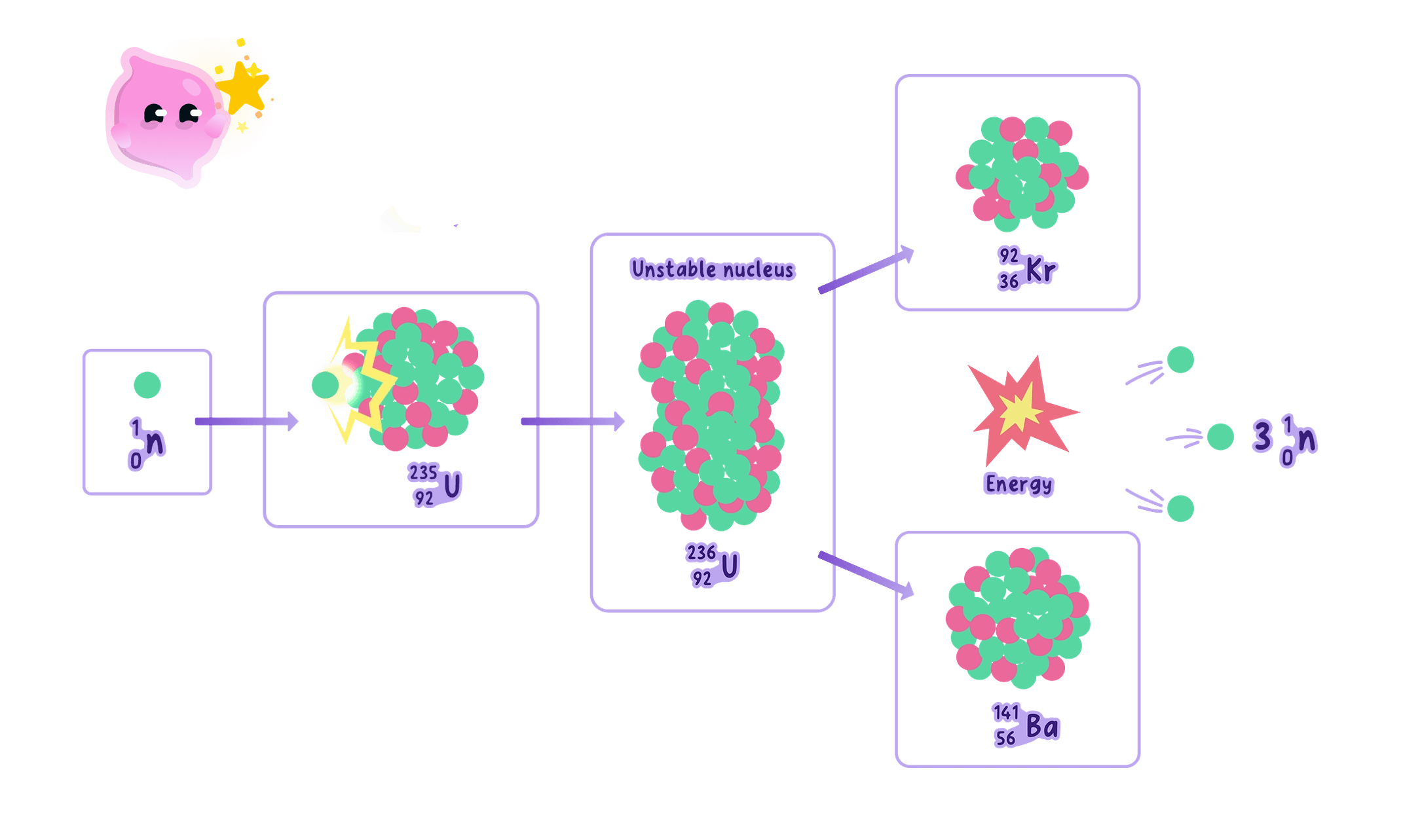
- A slow-moving neutron reaches a uranium-235 nucleus and is absorbed by it rather than bouncing off or passing through.
- The nucleus now has one more neutron, making it 92236U^{236}_{\ 92}\text{U} 92236U, and this new nucleus is highly unstable.
- Within a tiny fraction of a second the unstable nucleus splits into two smaller daughter nuclei.
- At the same instant two or more neutrons are thrown out, because a large nucleus needs proportionally more neutrons to hold it together than the two smaller ones do.
- A large amount of energy is released, mostly as the kinetic energy of the two daughter nuclei flying apart, with some carried away as gamma radiation.
- The fast-moving daughter nuclei collide with surrounding atoms and are slowed down, so that kinetic energy ends up as an increase in the thermal energy of the fuel.
- In words, the whole process is U-235 nucleus+neutron→two daughter nuclei+two or more neutrons+energy\text{U-235 nucleus}+\text{neutron}\rightarrow\text{two daughter nuclei}+\text{two or more neutrons}+\text{energy}U-235 nucleus+neutron→two daughter nuclei+two or more neutrons+energy.
- One possible split is 92235U+01n→ 56141Ba+3692Kr+3 01n^{235}_{\ 92}\text{U}+^{1}_{0}\text{n}\rightarrow{}^{141}_{\ 56}\text{Ba}+^{92}_{36}\text{Kr}+3\,^{1}_{0}\text{n} 92235U+01n→ 56141Ba+3692Kr+301n, and both the mass numbers and the atomic numbers balance across the arrow.
- The two daughter nuclei are not equal halves, and the same nucleus can split in many different ways, so barium and krypton are only one of the possible pairs.
- This kind of fission is described as induced, because a neutron has to arrive and trigger it, unlike radioactive decay, which happens on its own.
Key Idea
- A complete description of the fission of uranium-235 names three products: two daughter nuclei, two or more neutrons and energy.
- It also names the trigger: a neutron is absorbed first, and the nucleus becomes unstable before it splits.
Where the energy comes from
- Add up the masses of everything produced by one fission and the total is very slightly less than the mass of the uranium nucleus and the neutron that went in.
- That missing mass is the source of the energy released, so the reaction does not create energy from nothing.
- The fractional loss of mass is tiny, but because so many nuclei are involved the energy adds up to an enormous amount from a very small mass of fuel.
- One fission of uranium-235 releases roughly a million times as much energy as burning one carbon atom, which is the reason a nuclear station needs so little fuel.
Example
Balancing a fission equation
- A uranium-235 nucleus absorbs a neutron and splits into strontium-90, one other nucleus and three neutrons, and the missing nuclide has to be identified.
- The unbalanced equation is 92235U+01n→3890Sr+ZAX+3 01n^{235}_{\ 92}\text{U}+^{1}_{0}\text{n}\rightarrow{}^{90}_{38}\text{Sr}+^{A}_{Z}\text{X}+3\,^{1}_{0}\text{n} 92235U+01n→3890Sr+ZAX+301n.
- Mass numbers must balance, so 235+1=90+A+3235+1=90+A+3235+1=90+A+3, which gives A=236−93=143A=236-93=143A=236−93=143.
- Atomic numbers must balance, so 92+0=38+Z+092+0=38+Z+092+0=38+Z+0, which gives Z=54Z=54Z=54.
- The element with atomic number 545454 is xenon, so the missing nuclide is 54143Xe^{143}_{\ 54}\text{Xe} 54143Xe.
- The balanced equation is 92235U+01n→3890Sr+ 54143Xe+3 01n^{235}_{\ 92}\text{U}+^{1}_{0}\text{n}\rightarrow{}^{90}_{38}\text{Sr}+^{143}_{\ 54}\text{Xe}+3\,^{1}_{0}\text{n} 92235U+01n→3890Sr+ 54143Xe+301n, and checking gives 90+143+3=23690+143+3=23690+143+3=236 and 38+54=9238+54=9238+54=92.
Exam technique
Describing fission for marks
- Write the stages in order and do not skip the middle one: a neutron is absorbed, the nucleus becomes unstable, it splits, neutrons are emitted, energy is released.
- Use the word nucleus throughout, because saying that the atom splits is not accepted.
- Write two or more neutrons rather than a fixed number, unless the question or the equation in front of you gives one.
- Always state that energy is released, since a description of the particles alone leaves out a marking point.
- In an equation question, balance the mass numbers first and the atomic numbers second, then use the periodic table to name the element from its atomic number.
Common Mistake
- Do not write that the atom splits; it is the nucleus that splits, and the electrons are not part of the reaction.
- Do not say the neutron knocks the nucleus apart on impact; it is absorbed first, and the nucleus becomes unstable before it splits.
- Do not say the nucleus splits into two equal halves; the two daughter nuclei are usually of quite different sizes.
- Do not count the emitted neutrons as the daughter nuclei; they are separate products.
- Do not confuse fission with radioactive decay; decay happens without anything triggering it and does not produce two daughter nuclei of similar size.
- Do not confuse fission with fusion; fission splits a large nucleus while fusion joins small ones.
Self review
- State the difference between a nuclear reaction and a chemical reaction.
- Name the three nuclear processes that can be used as sources of energy.
- State how many protons and how many neutrons there are in a nucleus of 92235U^{235}_{\ 92}\text{U} 92235U.
- Describe, in order, what happens when a uranium-235 nucleus undergoes fission.
- Complete the equation 92235U+01n→ 56144Ba+ZAKr+2 01n^{235}_{\ 92}\text{U}+^{1}_{0}\text{n}\rightarrow{}^{144}_{\ 56}\text{Ba}+^{A}_{Z}\text{Kr}+2\,^{1}_{0}\text{n} 92235U+01n→ 56144Ba+ZAKr+201n by finding AAA and ZZZ.
- Explain where the energy released by a fission reaction comes from.
