What happens in nuclear fusion
Definition
Nuclear fusion
Nuclear fusion is the joining of small nuclei to create a larger nucleus, with a loss of mass that is accompanied by a release of energy.
- In fusion, two small nuclei come together and merge into a single larger nucleus, so the number of particles bound into one nucleus goes up rather than down.
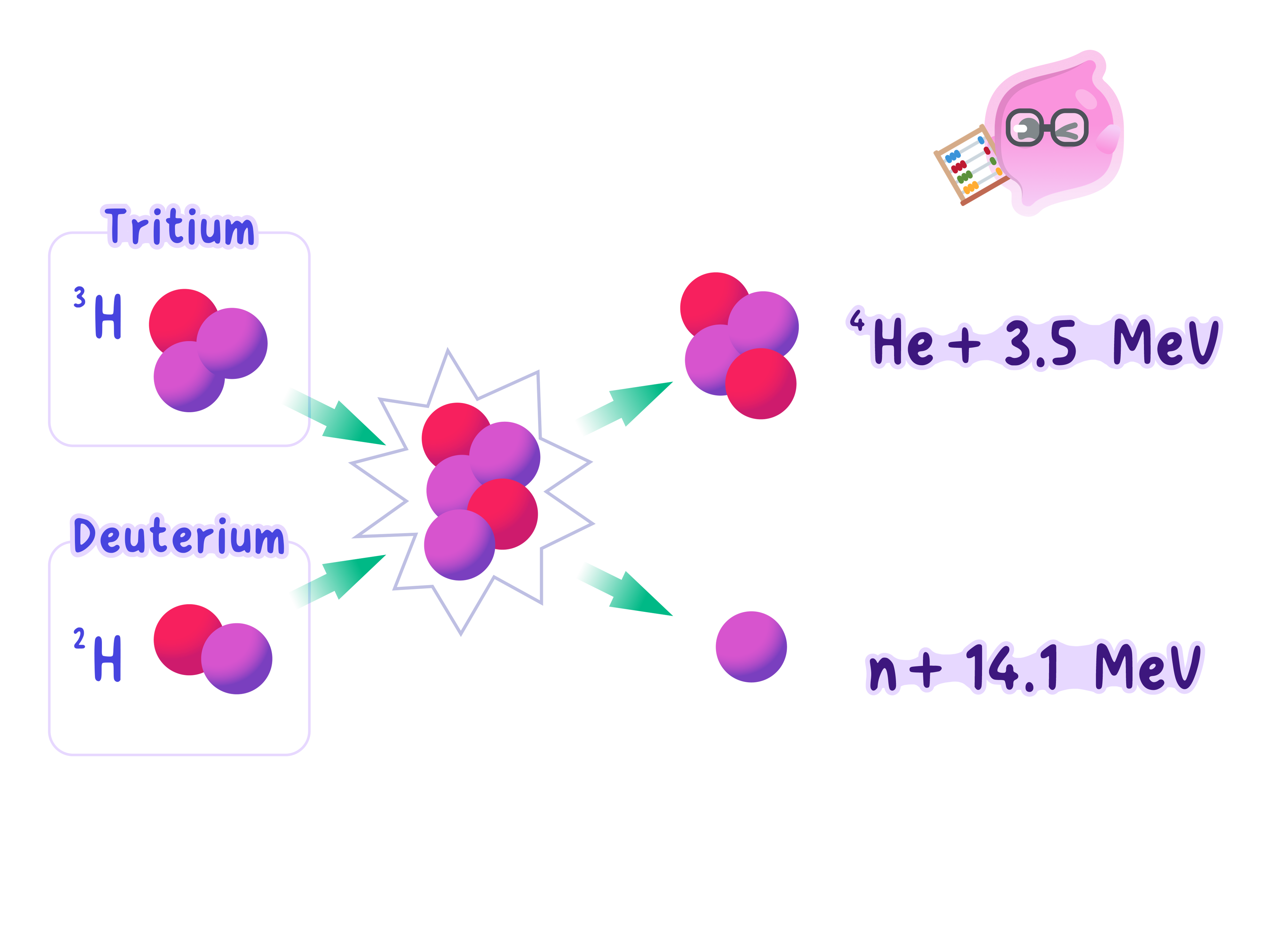
- The reaction most often used as an example joins two isotopes of hydrogen: deuterium, 12H^{2}_{1}\text{H}12H, which has one proton and one neutron, and tritium, 13H^{3}_{1}\text{H}13H, which has one proton and two neutrons.
- Written as a nuclear equation this is 12H+13H→24He+01n^{2}_{1}\text{H}+^{3}_{1}\text{H}\rightarrow{}^{4}_{2}\text{He}+^{1}_{0}\text{n}12H+13H→24He+01n.
- Both sides balance, because the mass numbers give 2+3=4+12+3=4+12+3=4+1 and the atomic numbers give 1+1=2+01+1=2+01+1=2+0.
- The larger nucleus created here is helium-4, and a spare neutron is left over that carries away most of the energy released.
- Fusion of small nuclei releases energy, and this holds for nuclei up to about the size of iron; joining nuclei larger than that would take energy in rather than give it out.
The loss of mass
- Weigh everything before the reaction and everything after it, and the total mass afterwards is very slightly smaller.
- No particles have gone missing, since the number of protons and the number of neutrons are both unchanged; it is the mass itself that has decreased.
- That loss of mass is where the released energy comes from, so mass and energy are two forms of the same thing rather than two separate quantities.
- The fraction of mass lost is extremely small, but the energy that appears is very large, which is why fusion releases more energy per kilogram of fuel than any chemical reaction and more even than fission.
- A full description of fusion therefore needs three linked statements: small nuclei join, a larger nucleus is created, and a loss of mass is accompanied by a release of energy.
Key Idea
- Fusion creates a larger nucleus from smaller ones.
- The products together are slightly lighter than the nuclei that went in, and that loss of mass is accompanied by the release of energy.
Example
Balancing a fusion equation
- Two deuterium nuclei fuse to form a helium-3 nucleus and one other particle, which has to be identified: 12H+12H→23He+ZAX^{2}_{1}\text{H}+^{2}_{1}\text{H}\rightarrow{}^{3}_{2}\text{He}+^{A}_{Z}\text{X}12H+12H→23He+ZAX.
- Balancing the mass numbers gives 2+2=3+A2+2=3+A2+2=3+A, so A=1A=1A=1.
- Balancing the atomic numbers gives 1+1=2+Z1+1=2+Z1+1=2+Z, so Z=0Z=0Z=0.
- A particle with mass number 111 and no charge is a neutron, so the equation is 12H+12H→23He+01n^{2}_{1}\text{H}+^{2}_{1}\text{H}\rightarrow{}^{3}_{2}\text{He}+^{1}_{0}\text{n}12H+12H→23He+01n.
- Adding the masses before the reaction gives 2×2.0141=4.02822\times2.0141=4.02822×2.0141=4.0282 atomic mass units.
- Adding the masses afterwards gives 3.0160+1.0087=4.02473.0160+1.0087=4.02473.0160+1.0087=4.0247 atomic mass units.
- The loss of mass is 4.0282−4.0247=0.00354.0282-4.0247=0.00354.0282−4.0247=0.0035 atomic mass units, and it is this missing mass that is released as energy.
Fusion in stars
- A star is a vast ball of gas that is mostly hydrogen, and in its core hydrogen nuclei fuse to form helium.
- Every one of those reactions involves a small loss of mass, so every one releases energy, and an enormous number of them happen every second.
- The energy released keeps the core extremely hot and eventually works its way out to the surface, from where the star radiates it away as light, infrared and other electromagnetic radiation.
- Fusion is therefore the energy source for stars, including the Sun, and all the energy arriving at the Earth as sunlight was released by fusion in the Sun's core.
- Because mass is lost in each reaction, the Sun is very slowly getting lighter as it shines, even though it is losing only a tiny fraction of its mass over its whole lifetime.
- Fusion in stars also builds the heavier elements, so the carbon, oxygen and nitrogen in your body were made inside stars that existed before the Sun.
Fusion compared with fission
Definition
Nuclear fission
Nuclear fission is the splitting of a large unstable nucleus into two smaller daughter nuclei, with the emission of two or more neutrons and a release of energy.
- Fusion and fission are both nuclear reactions, so both change the nuclei of atoms rather than rearranging their electrons.
- Both release energy, and in both cases the energy comes from a small loss of mass between the particles going in and the particles coming out.
- The difference that defines them is the direction of the change: fusion joins small nuclei into a larger one, whereas fission splits one large nucleus into smaller ones.
- The fuels are at opposite ends of the periodic table: fusion uses the lightest nuclei, such as isotopes of hydrogen, while fission uses the heaviest, such as uranium.
- Fission has to be started by a neutron being absorbed, whereas fusion happens only where nuclei are already being driven together under extreme conditions.
- The products differ too: the daughter nuclei from fission are radioactive, while the helium produced by fusion is a stable, harmless gas.
- Where each one is found also differs: fission is what runs nuclear power stations on the Earth today, and fusion is what powers every star.
Exam technique
Describing and comparing fusion
- For a description of fusion, give all three points: small nuclei join, a larger nucleus is created, and the loss of mass is accompanied by a release of energy.
- Use the word nuclei, not atoms, because it is the nuclei that join and the electrons play no part.
- For a compare question, write one clear similarity and then the key difference in the same sentence structure, for example that both release energy but fusion joins nuclei while fission splits one.
- If the context is a star, say explicitly that fusion is the energy source for stars, since that statement is often a mark on its own.
- In an equation question, balance the mass numbers and the atomic numbers separately, and remember that a neutron is written 01n^{1}_{0}\text{n}01n.
Common Mistake
- Do not confuse the two words; fusion joins small nuclei and fission splits a large nucleus.
- Do not say that energy is created from nothing; a small amount of mass is lost and that loss is accompanied by the release of energy.
- Do not say particles disappear during fusion; the protons and neutrons are all still there in the products.
- Do not write that the Sun burns hydrogen; burning is a chemical reaction and could not supply anything like the energy a star radiates.
- Do not say fusion needs a neutron to start it; that is fission, and the two are triggered in completely different ways.
Self review
- Describe nuclear fusion in three linked statements.
- Write the balanced equation for the fusion of deuterium and tritium.
- Explain where the energy released by a fusion reaction comes from.
- Explain why fusion is described as the energy source for stars.
- Give one similarity and three differences between nuclear fusion and nuclear fission.
- State which kinds of nuclei are used as fuel in fusion and which in fission.
