Beta decay in unstable nuclei
Definition
Beta particle
A beta particle is an electron emitted from the nucleus of an unstable atom.
Definition
Positron
A positron is a particle with the same relative mass as an electron and a relative charge of +1.
- A nucleus is held together by the balance between the strong nuclear force pulling all the nucleons together and the electrostatic repulsion pushing the protons apart.
- When a nucleus holds too many neutrons or too many protons for that balance to hold, it is unstable and it will eventually decay.
- Beta decay is the route an unstable nucleus takes when its problem is the ratio of neutrons to protons rather than its total size, so no nucleons are thrown out of the nucleus at all.
- Instead, one nucleon changes identity inside the nucleus, and a small light particle is created and thrown out to carry away the charge.
- There are two versions of this, and which one happens depends on which nucleon the nucleus has too many of.
- A nucleus with too many neutrons turns a neutron into a proton and emits an electron, which is called beta-minus decay and written β−\beta^-β− decay.
- A nucleus with too many protons turns a proton into a neutron and emits a positron, which is called beta-plus decay and written β+\beta^+β+ decay.
- The two emitted particles are antiparticles of each other, so they have the same very small relative mass but opposite relative charge.
Beta-minus decay
Definition
Beta-minus decay
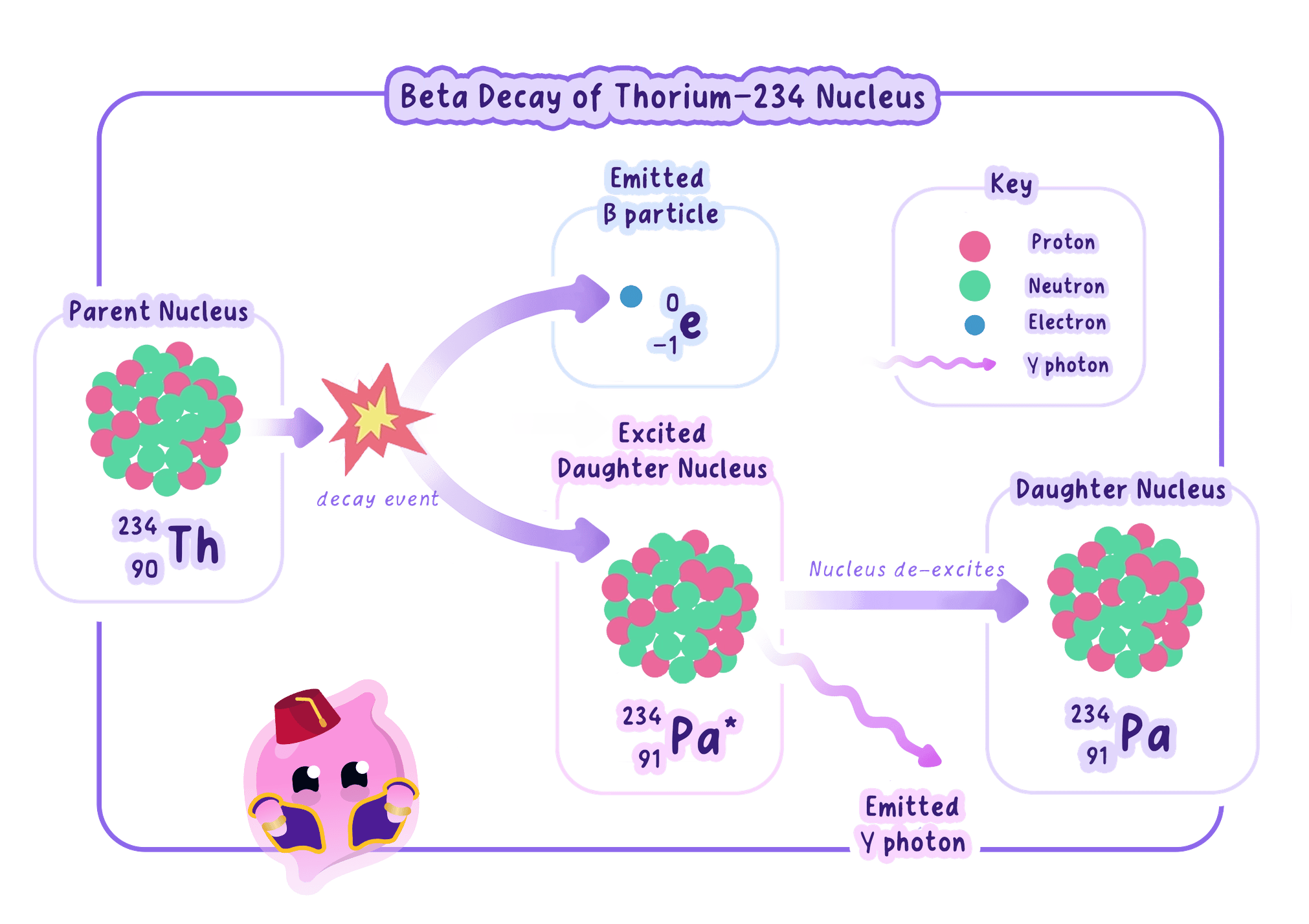
Beta-minus decay is the decay of an unstable nucleus in which a neutron becomes a proton and an electron, and the electron is emitted from the nucleus as a beta-minus particle.
- Inside a neutron-rich nucleus, a single neutron changes into a proton and an electron, and the electron is immediately expelled from the nucleus.
- In words, the change to the nucleon is neutron→proton+electron\text{neutron} \rightarrow \text{proton} + \text{electron}neutron→proton+electron.
- Using particle symbols, the same change is n→p+e−\text{n} \rightarrow \text{p} + \text{e}^-n→p+e−.
- Written with mass numbers and charges, so that both quantities can be seen to balance, the change is 01n→11p+−10e_{0}^{1}\text{n} \rightarrow _{1}^{1}\text{p} + _{-1}^{0}\text{e}01n→11p+−10e.
- The emitted electron is the beta-minus particle, and in a nuclear equation it is written as −10e_{-1}^{0}\text{e}−10e or −10β_{-1}^{0}\beta−10β.
- Both symbols carry the same information: a mass number of 000, because an electron contains no protons or neutrons, and a charge of −1-1−1, because it carries one electron charge.
- The electron that leaves is created in the nucleus at the moment of decay, and it is not one of the electrons that was orbiting the atom beforehand.
- Beta-minus emitters are common among the heavy nuclei produced in reactors and among the daughter products of long decay chains, because those nuclei are typically left neutron-rich.
Example
Carbon-14 decaying by beta-minus emission
- Carbon-14 is written 614C_{6}^{14}\text{C}614C, so it has 666 protons and 14−6=814 - 6 = 814−6=8 neutrons.
- Eight neutrons to six protons is a neutron-rich mixture for such a light nucleus, so this nucleus decays by β−\beta^-β− emission.
- One neutron becomes a proton, so the proton count rises from 666 to 777 while the total nucleon count stays at 141414.
- An element with 777 protons is nitrogen, so the daughter nucleus is 714N_{7}^{14}\text{N}714N.
- The decay is written 614C→714N+−10e_{6}^{14}\text{C} \rightarrow _{7}^{14}\text{N} + _{-1}^{0}\text{e}614C→714N+−10e, with the emitted electron shown as a product.
- Nothing was ejected from the nucleus except that electron, so the same fourteen nucleons are present throughout.
Beta-plus decay
Definition
Beta-plus decay
Beta-plus decay is the decay of an unstable nucleus in which a proton becomes a neutron and a positron, and the positron is emitted from the nucleus.
- Inside a proton-rich nucleus, a single proton changes into a neutron and a positron, and the positron is immediately expelled from the nucleus.
- In words, the change to the nucleon is proton→neutron+positron\text{proton} \rightarrow \text{neutron} + \text{positron}proton→neutron+positron.
- Using particle symbols, the same change is p→n+e+\text{p} \rightarrow \text{n} + \text{e}^+p→n+e+.
- Written with mass numbers and charges, the change is 11p→01n++10e_{1}^{1}\text{p} \rightarrow _{0}^{1}\text{n} + _{+1}^{0}\text{e}11p→01n++10e.
- The emitted positron is written +10e_{+1}^{0}\text{e}+10e or +10β_{+1}^{0}\beta+10β, with a mass number of 000 and a charge of +1+1+1.
- A positron is a form of antimatter, so once it has left the nucleus it travels only a very short distance through matter before it meets an ordinary electron and the pair is annihilated.
- Because a positron is destroyed so quickly, beta-plus emitters are much harder to keep and store than beta-minus emitters, and they are usually made artificially.
Example
Fluorine-18 decaying by beta-plus emission
- Fluorine-18 is written 918F_{9}^{18}\text{F}918F, so it has 999 protons and 18−9=918 - 9 = 918−9=9 neutrons.
- Nine protons to nine neutrons leaves this nucleus proton-rich compared with the stable isotope fluorine-19, so it decays by β+\beta^+β+ emission.
- One proton becomes a neutron, so the proton count falls from 999 to 888 while the total nucleon count stays at 181818.
- An element with 888 protons is oxygen, so the daughter nucleus is 818O_{8}^{18}\text{O}818O.
- The decay is written 918F→818O++10e_{9}^{18}\text{F} \rightarrow _{8}^{18}\text{O} + _{+1}^{0}\text{e}918F→818O++10e, with the emitted positron shown as a product.
- The positron leaves almost at once and is annihilated, so what remains in the sample is oxygen-18.
Comparing the two beta decays
- Both decays start with an unstable nucleus, change one nucleon into the other kind of nucleon, and emit one light particle from the nucleus.
- The differences all follow from which nucleon changes.
- In β−\beta^-β− decay a neutron is the nucleon that changes, so the neutron count falls by one and the proton count rises by one.
- In β+\beta^+β+ decay a proton is the nucleon that changes, so the proton count falls by one and the neutron count rises by one.
- The emitted particles differ only in the sign of their charge, which is what the minus and plus in the two names record.
- Neither decay ejects a nucleon from the nucleus, which is what separates beta decay from alpha decay and from neutron emission.
- Neither decay can be triggered or prevented, because which nucleus decays and when is settled by chance alone.
Exam technique
Describing a beta decay for full marks
- Name the nucleon that changes and the nucleon it becomes, because a description that only names the emitted particle has left out the change inside the nucleus.
- Say that the light particle is emitted from the nucleus, since the mark is for the emission and not just for the particle existing.
- Write β−\beta^-β− decay as a neutron changing into a proton with an electron emitted, and β+\beta^+β+ decay as a proton changing into a neutron with a positron emitted.
- Match the sign to the particle every time: minus goes with the electron, −10e_{-1}^{0}\text{e}−10e, and plus goes with the positron, +10e_{+1}^{0}\text{e}+10e.
- Use the word nucleus rather than atom or particle when you say where the emission comes from, because the looser word is not credited.
Common Mistake
- Do not describe the beta-minus particle as an electron that has escaped from an orbit, because it is created inside the nucleus when a neutron changes.
- Do not write that a positron is an emitted proton, because the proton stays in the nucleus as a neutron and the positron is a separate new particle.
- Do not give a beta particle a mass number of 111, since its mass number is 000 and only protons and neutrons are counted in a mass number.
- Do not let the mass number change in a beta decay, because the total number of nucleons is unchanged by either process.
- Do not confuse a positron with a positive ion, because an ion is an atom that has lost or gained electrons and is far more massive.
Self review
- What happens to a neutron during β−\beta^-β− decay, and which particle is emitted?
- What happens to a proton during β+\beta^+β+ decay, and which particle is emitted?
- Give the mass number and the charge of a positron.
- Why does neither beta decay eject a nucleon from the nucleus?
- Write the particle equation for the nucleon change in β+\beta^+β+ decay.
- Explain why the electron emitted in β−\beta^-β− decay is not one of the atom's orbiting electrons.
