The two numbers that describe a nucleus
Atomic number
The number of protons in the nucleus of an atom.
Mass number
The total number of protons and neutrons in the nucleus of an atom.
Daughter nucleus
A daughter nucleus is the nucleus left behind after a parent nucleus has decayed.
- A nucleus is written in the form ZAX_{Z}^{A}\text{X}ZAX, where X\text{X}X is the chemical symbol, AAA is the mass number and ZZZ is the atomic number.
- The atomic number is the count of protons, and it alone decides which element the nucleus belongs to, so any decay that changes ZZZ changes the element.
- The mass number is the count of protons plus neutrons, so the neutron count of a nucleus is always A−ZA - ZA−Z.
- Every radioactive decay removes something from the nucleus or converts one nucleon into another, so every decay leaves AAA and ZZZ changed in a way fixed by what was emitted.
- The nucleus that is left behind after a decay is the daughter nucleus, and the nucleus that decayed is called the parent nucleus.
- Because both numbers are conserved across a decay, working out the daughter is a matter of subtracting the mass number and the charge of the emitted particle from the parent.
Alpha decay
Alpha particle
An alpha particle is a particle made of two protons and two neutrons emitted from an unstable nucleus, and is equivalent to a helium nucleus.
- An alpha particle is a tightly bound group of two protons and two neutrons, identical to a helium nucleus, and it is written 24α_{2}^{4}\alpha24α or 24He_{2}^{4}\text{He}24He.
- Alpha decay happens in very heavy nuclei, where the electrostatic repulsion between a large number of protons makes the whole nucleus too large to hold together.
- Ejecting an alpha particle removes four nucleons at once, which is the fastest way for such a nucleus to shed both size and positive charge.
- The alpha particle carries away a mass number of 444, so the mass number of the nucleus falls by 444.
- It also carries away a charge of +2+2+2, so the atomic number falls by 222.
- Since the atomic number has changed, the daughter nucleus is a different element, two places back in the periodic table.
- In general form, alpha decay is ZAX→Z−2A−4Y+24α_{Z}^{A}\text{X} \rightarrow _{Z-2}^{A-4}\text{Y} + _{2}^{4}\alphaZAX→Z−2A−4Y+24α.
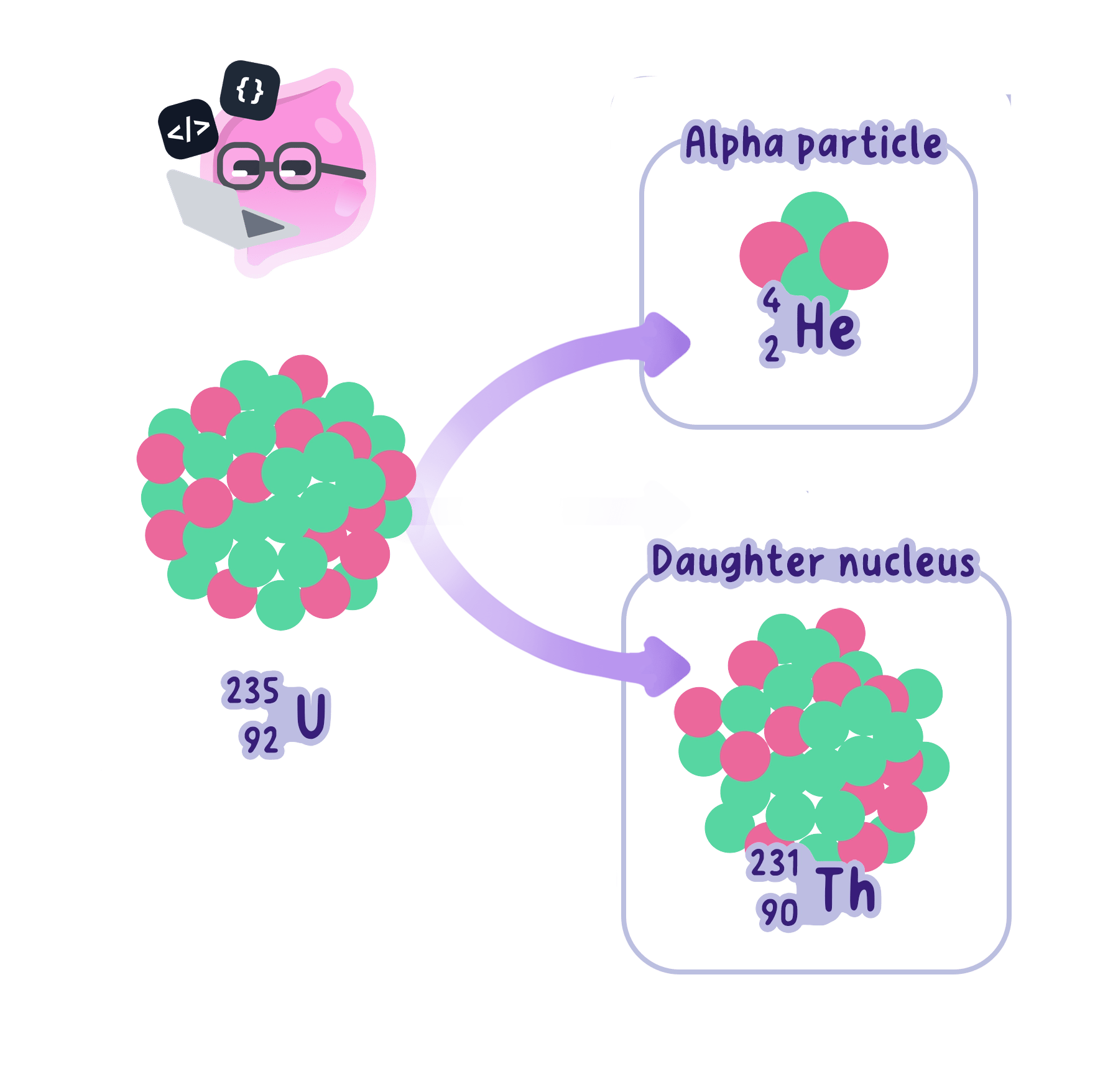
Finding the daughter of an alpha emitter
- Radium-226 is written 88226Ra_{88}^{226}\text{Ra}88226Ra, so it has 888888 protons and 226−88=138226 - 88 = 138226−88=138 neutrons.
- The mass number of the daughter is 226−4=222226 - 4 = 222226−4=222.
- The atomic number of the daughter is 88−2=8688 - 2 = 8688−2=86.
- The element with 868686 protons is radon, so the daughter nucleus is 86222Rn_{86}^{222}\text{Rn}86222Rn.
- The complete equation is 88226Ra→86222Rn+24α_{88}^{226}\text{Ra} \rightarrow _{86}^{222}\text{Rn} + _{2}^{4}\alpha88226Ra→86222Rn+24α.
- The neutron count has fallen from 138138138 to 222−86=136222 - 86 = 136222−86=136, which confirms that two protons and two neutrons left together.
Beta-minus and beta-plus decay
- In beta-minus decay a neutron becomes a proton and an electron is emitted, and the electron is written −10e_{-1}^{0}\text{e}−10e.
- Because the electron has a mass number of 000, the total nucleon count is unchanged, so the mass number stays the same.
- Because a neutron has been replaced by a proton, the atomic number rises by 111, and the daughter is the next element up.
- In general form, beta-minus decay is ZAX→Z+1AY+−10e_{Z}^{A}\text{X} \rightarrow _{Z+1}^{A}\text{Y} + _{-1}^{0}\text{e}ZAX→Z+1AY+−10e, as in 614C→714N+−10e_{6}^{14}\text{C} \rightarrow _{7}^{14}\text{N} + _{-1}^{0}\text{e}614C→714N+−10e.
- In beta-plus decay a proton becomes a neutron and a positron is emitted, and the positron is written +10e_{+1}^{0}\text{e}+10e.
- The mass number again stays the same, for the same reason, but the atomic number falls by 111, so the daughter is the previous element.
- In general form, beta-plus decay is ZAX→Z−1AY++10e_{Z}^{A}\text{X} \rightarrow _{Z-1}^{A}\text{Y} + _{+1}^{0}\text{e}ZAX→Z−1AY++10e, as in 1122Na→1022Ne++10e_{11}^{22}\text{Na} \rightarrow _{10}^{22}\text{Ne} + _{+1}^{0}\text{e}1122Na→1022Ne++10e.
- Both beta decays therefore change the element without changing the mass of the nucleus in any measurable way, because the neutron count and proton count trade places.
Gamma emission and nuclear rearrangement
Gamma radiation
Gamma radiation is electromagnetic radiation emitted from the nucleus of an unstable atom when that nucleus loses energy.
Nuclear rearrangement
Nuclear rearrangement is the movement of the protons and neutrons of a nucleus into a lower energy arrangement after a decay, with the surplus energy released as gamma radiation.
- Gamma radiation is not a particle at all; it is a very high frequency electromagnetic wave carrying energy away from the nucleus.
- A gamma ray has no mass number and no charge, so it is written 00γ_{0}^{0}\gamma00γ.
- The direct consequence is that after gamma emission the mass number stays the same, the atomic number stays the same, and the element does not change.
- What does change is the energy of the nucleus, which is left lower than it was before.
- Gamma emission normally follows another decay rather than happening on its own, because an alpha or beta decay usually leaves the daughter nucleus with its nucleons in a high energy arrangement.
- That high energy state is described as an excited nucleus, and it settles by nuclear rearrangement: the protons and neutrons shift into a lower energy arrangement and the surplus energy leaves as a gamma ray.
- Because gamma emission needs no nucleon to leave and no nucleon to change, it is the only one of these processes that leaves the identity of the nucleus completely untouched.
- In general form, gamma emission is ZAX∗→ZAX+00γ_{Z}^{A}\text{X}^{*} \rightarrow _{Z}^{A}\text{X} + _{0}^{0}\gammaZAX∗→ZAX+00γ, where the asterisk marks the excited nucleus.
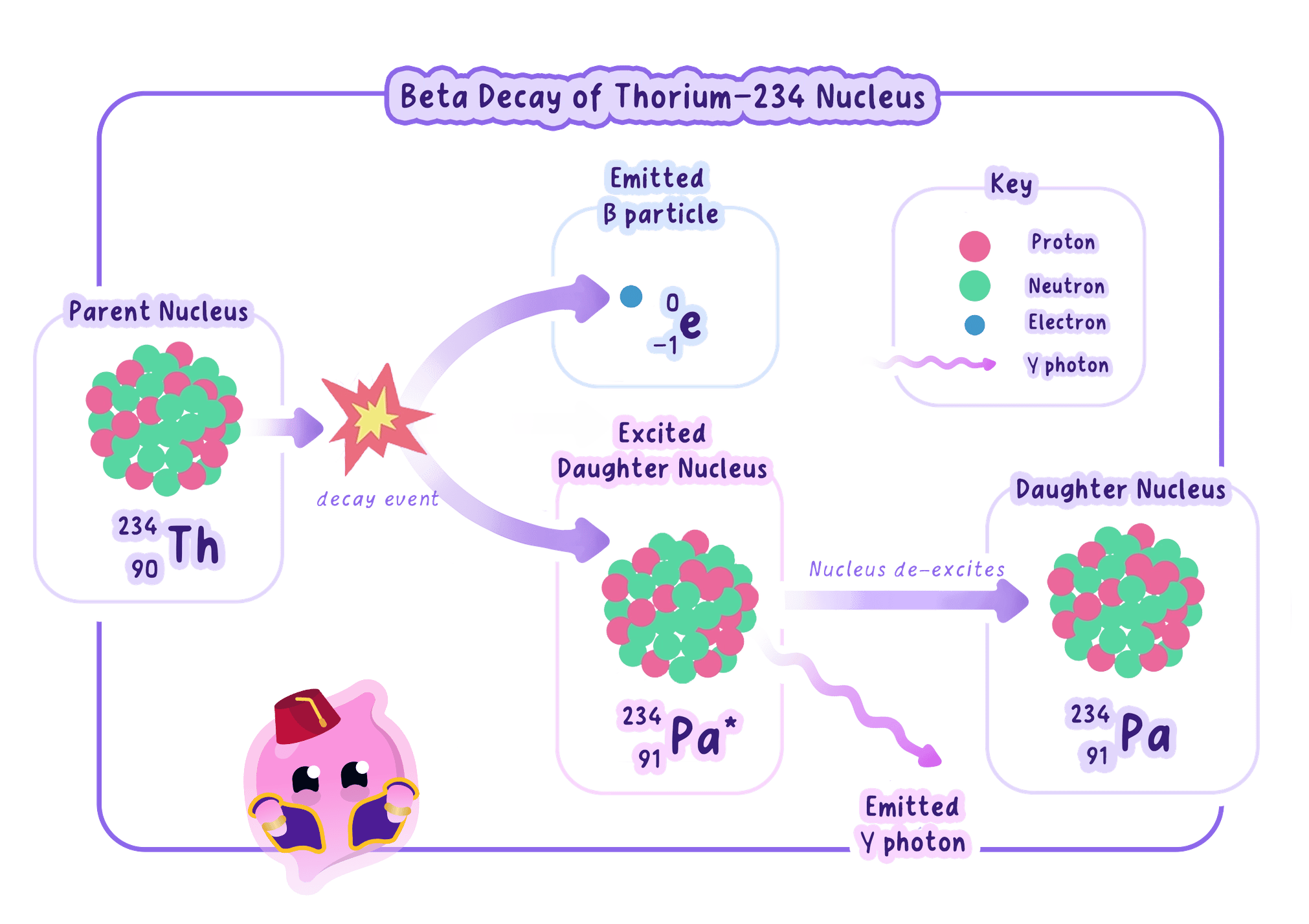
A beta decay followed by gamma emission
- Thorium-234, written 90234Th_{90}^{234}\text{Th}90234Th, is neutron-rich and decays by beta-minus emission.
- The mass number stays at 234234234 and the atomic number rises from 909090 to 919191, giving protactinium-234.
- The equation for the first stage is 90234Th→91234Pa+−10e_{90}^{234}\text{Th} \rightarrow _{91}^{234}\text{Pa} + _{-1}^{0}\text{e}90234Th→91234Pa+−10e.
- The protactinium nucleus is left excited, so its nucleons rearrange and it emits a gamma ray.
- The equation for the second stage is 91234Pa∗→91234Pa+00γ_{91}^{234}\text{Pa}^{*} \rightarrow _{91}^{234}\text{Pa} + _{0}^{0}\gamma91234Pa∗→91234Pa+00γ.
- Across both stages the mass number never changed, the atomic number changed only once, and only the beta stage produced a new element.
Neutron emission
Neutron emission
Neutron emission is the release of a neutron from an unstable nucleus.
- A neutron released from a nucleus is written 01n_{0}^{1}\text{n}01n, giving it a mass number of 111 and a charge of 000.
- The nucleus therefore loses one nucleon, so its mass number falls by 111.
- The neutron carries no charge, so the proton count is untouched and the atomic number stays the same.
- Since the atomic number is unchanged, the daughter is the same element as the parent, but a different isotope of it, with one fewer neutron.
- In general form, neutron emission is ZAX→ZA−1X+01n_{Z}^{A}\text{X} \rightarrow _{Z}^{A-1}\text{X} + _{0}^{1}\text{n}ZAX→ZA−1X+01n, so oxygen-17 emitting a neutron gives 817O→816O+01n_{8}^{17}\text{O} \rightarrow _{8}^{16}\text{O} + _{0}^{1}\text{n}817O→816O+01n.
- Neutron emission is the one decay in this set that changes the isotope without changing the element, which makes it easy to tell apart from a beta decay in an equation.
Working out the effect of a decay
- Write the emitted particle in the form chargemass numbersymbol_{\text{charge}}^{\text{mass number}}\text{symbol}chargemass numbersymbol first, then subtract those two numbers from the parent.
- Subtract the numbers separately: the top numbers form one total and the bottom numbers form another, and they are never added together.
- Use the atomic number, not the mass number, to decide whether the element has changed, because only the proton count identifies an element.
- Give both numbers in your answer when a question asks for the effect on the nucleus, since one mark is usually for each.
- Say stays the same rather than leaving a number out, because a blank is not credited as an unchanged value.
- For a gamma question, name the energy change: the nucleus loses energy, and neither the mass number nor the atomic number changes.
- Keep to the word nucleus when describing where the emission comes from, because atom and particle are not credited in place of it.
- Do not let gamma emission change the element, because a gamma ray removes energy and carries away neither protons nor neutrons.
- Do not reduce the mass number in a beta decay, because a nucleon changes type but no nucleon leaves the nucleus.
- Do not reduce the atomic number in neutron emission, since a neutron carries no charge and the proton count is unaffected.
- Do not apply two decays at once in a chain, because each step changes the numbers separately and must be worked through in order.
- Do not treat an excited nucleus as a different element from the nucleus it settles into, because rearrangement changes only its energy.
- Do not assume every decay produces a new element, because gamma emission and neutron emission both leave the atomic number unchanged.
- State the change in mass number and atomic number when a nucleus emits an alpha particle.
- Why does the mass number stay the same in a beta-minus decay?
- A nucleus emits a positron. What happens to its atomic number?
- Explain why gamma emission does not change the element.
- What happens to the mass number and the atomic number when a neutron is emitted?
- Which of these decays leaves the nucleus as a different isotope of the same element?
- Write the general equation for the alpha decay of ZAX_{Z}^{A}\text{X}ZAX.
