How scientific models change
Definition
Scientific model
A simplified description of something that cannot be seen directly, used to explain observations and to predict the results of new experiments.
- A model of the atom is accepted only for as long as it explains all of the experimental evidence available at the time.
- A useful model makes a prediction that can be tested, so an experiment can be designed to check whether the model is right.
- When an experiment produces a result that the model cannot explain, the model has to be changed or replaced.
- New results are published and repeated by other scientists before a new model is accepted, which is why each change took years rather than days.
- The model of the atom moved through three stages: the plum pudding model, then the nuclear model, then the Bohr model.
The plum pudding model
Definition
Plum pudding model
A model of the atom as a ball of positive charge with negative electrons spread through it and no nucleus.
- Before the electron was discovered, the atom was pictured as a solid sphere that could not be divided into anything smaller.
- The discovery of the electron showed that atoms contain small, negatively charged particles.
- An atom has no net charge, so the rest of the atom had to carry an equal amount of positive charge.
- The plum pudding model described the atom as a ball of positive charge with negative electrons dotted through it, like pieces of fruit set in a pudding.
- In this model there is no nucleus, and both the positive charge and the mass are spread evenly through the whole volume of the atom.
- Spread-out charge can only exert a weak force on a passing particle, so the model predicted that a fast positive particle fired at a thin sheet of atoms would go through with a very small deflection at most.
Rutherford alpha particle scattering
Definition
Alpha particle scattering
An experiment in which alpha particles are fired at a very thin metal foil and the directions in which they travel afterwards are recorded.
- Working in Rutherford's laboratory, Geiger and Marsden aimed a narrow beam of alpha particles at a very thin sheet of gold foil.
- Gold was chosen because it can be beaten into a foil only a few atoms thick, so most alpha particles pass through only a small number of atoms.
- The apparatus was held inside an evacuated chamber, so the alpha particles were not absorbed by air before they reached the foil.
- A movable zinc sulfide detector was placed around the foil and gave a tiny flash of light wherever an alpha particle struck it.
- Most alpha particles passed straight through the foil with no measurable change of direction.
- A small number were deflected through small angles as they went through.
- About one in eight thousand was deflected through more than 90∘90^{\circ}90∘, and a few came almost straight back towards the source.
- The plum pudding model could not explain the large deflections, because a positive charge spread through the whole atom could never push an alpha particle backwards.
What the results showed
- Most alpha particles passed straight through, so most of the atom must be empty space.
- Some alpha particles were pushed off course, so the atom must hold a concentrated region of positive charge that repels a positive alpha particle.
- Only a very small fraction came close enough to that region to be turned through a large angle, so the region must be extremely small compared with the whole atom.
- An alpha particle is heavy and fast, so only something with a much larger mass could reverse its direction, which showed that this small central region holds almost all of the mass of the atom.
- The small, dense, positively charged centre was named the nucleus.
The nuclear model and the Bohr model
Definition
Nuclear model
A model of the atom with a tiny, dense, positively charged nucleus at the centre and electrons outside it.
Definition
Bohr model
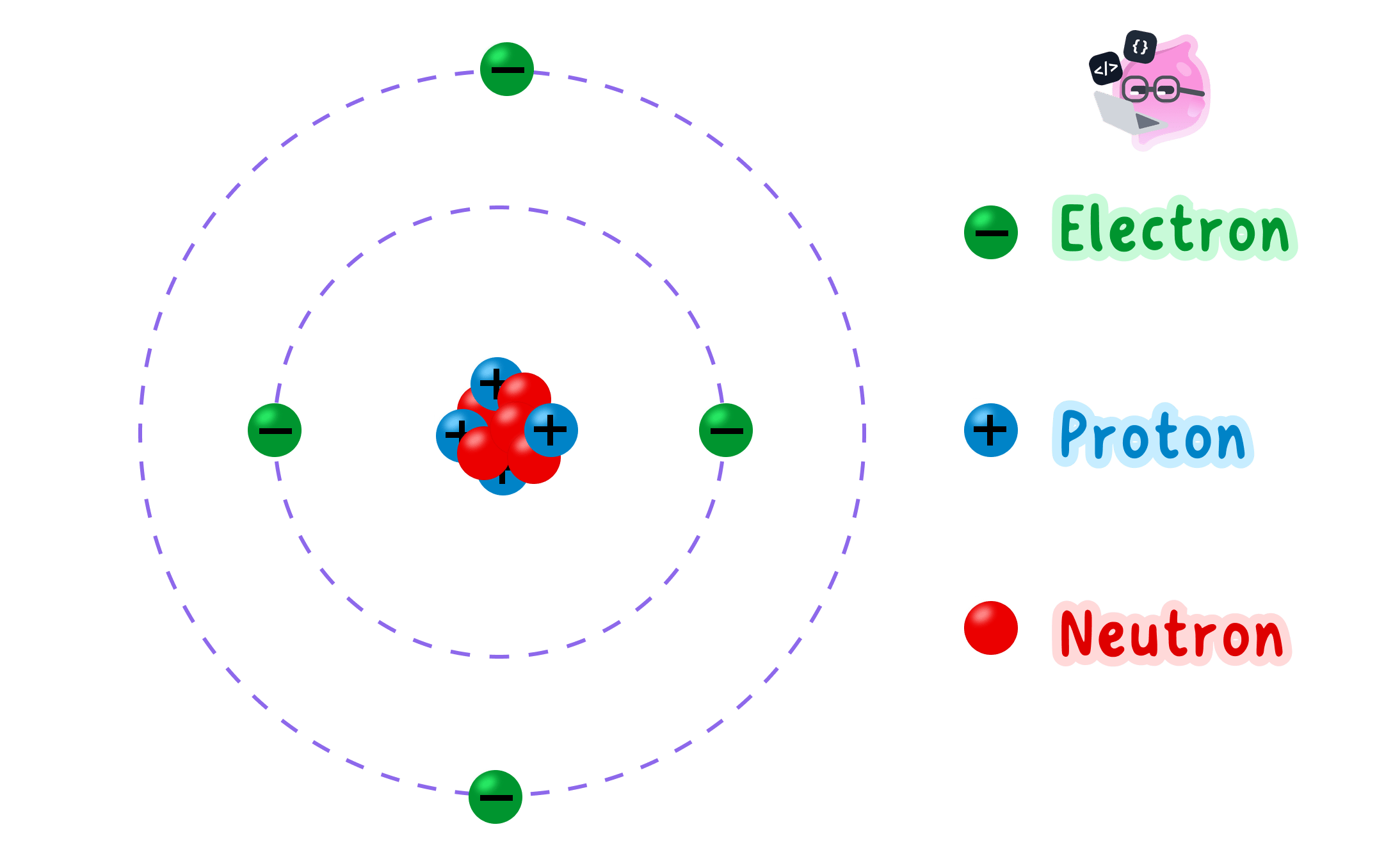
A model of the atom in which electrons orbit the nucleus only at certain fixed distances, called shells.
- The nuclear model places a tiny positive nucleus at the centre of the atom with the electrons somewhere outside it.
- Almost all of the mass sits in the nucleus, while almost all of the volume of the atom is empty space.
- A typical atom has a diameter of about 1×10⁻¹⁰ m1\times10^{-10}\ \text{m}1×10⁻¹⁰ m, and its nucleus is roughly 10 00010\,00010000 times smaller than that.
- The nuclear model left a problem unsolved, because an electron free to circle at any distance should lose energy steadily and spiral into the nucleus.
- Bohr answered this by proposing that electrons can only orbit at certain fixed distances from the nucleus, called shells or energy levels.
- An electron staying in one shell does not lose energy, so the atom is stable and does not collapse.
- The Bohr model also explained why an atom only absorbs and emits particular frequencies of light, because an electron changes energy only when it moves between two shells.
- Calculations of the energies of those shells matched measurements of the light given out by real atoms, which is why the Bohr model replaced the simple nuclear model.
Example
Reading scattering results
- In one run of the experiment 20 00020\,00020000 alpha particles reach the foil and 19 95819\,95819958 of them pass through with almost no deflection.
- The fraction that passes straight through is 19 95820 000=0.9979\dfrac{19\,958}{20\,000}=0.99792000019958=0.9979, which is 99.79%99.79\%99.79%, so the atom is almost entirely empty space.
- Of the remainder, 404040 are deflected through small angles by repulsion from a concentrated positive charge.
- Only 222 are turned through more than 90∘90^{\circ}90∘, a fraction of 220 000=1×10⁻⁴\dfrac{2}{20\,000}=1\times10^{-4}200002=1×10⁻⁴.
- A fraction that small shows the positive charge fills only a tiny part of the area the beam passes through, so the nucleus is both very small and very dense.
Exam technique
Linking observation to conclusion
- Pair every observation with the conclusion it supports instead of listing the observations on their own.
- Use most passed straight through, so the atom is mostly empty space, as the first pair.
- Use some were deflected, so the positive charge is concentrated in one place, as the second pair.
- Use a very few came back, so the nucleus is tiny and holds most of the mass, as the third pair.
- State what the plum pudding model predicted and why the results disagreed with it whenever a question asks why the model was replaced.
- Describe Bohr's change precisely: electrons orbit at fixed distances in shells rather than anywhere around the nucleus.
Common Mistake
- Do not say that alpha particles were deflected by electrons, because an electron has far too little mass to turn a heavy alpha particle.
- Do not say that the nucleus takes up most of the atom, because it holds most of the mass but almost none of the volume.
- Do not describe the foil as thick, because a very thin foil is needed so that alpha particles meet only a few layers of atoms.
- Do not describe the plum pudding model as having a nucleus with electrons around it, because that is the nuclear model.
- Do not write that the scattering experiment proved the Bohr model, because it led to the nuclear model that Bohr later developed.
Self review
- Describe the plum pudding model in terms of where the positive charge, the mass and the electrons are.
- State the three observations made in the alpha particle scattering experiment.
- Explain what each of those three observations showed about the structure of the atom.
- Explain why the plum pudding model had to be replaced.
- State how the Bohr model changed the nuclear model and give one thing it explained.
