5.6.1c Velocity
Velocity
Definition
Velocity
Velocity is the speed of an object in a given direction.
- A car at 15 m/s15\ \text{m/s}15 m/s has a speed; a car at 15 m/s15\ \text{m/s}15 m/s east has a velocity, because both its speed and its direction are stated.
- Speed and velocity share units (such as m/s\text{m/s}m/s) but are different: speed is a scalar and velocity is a vector.
- Two objects can have the same speed but different velocities if they move equally fast in different directions.
- An object’s velocity also changes if its direction changes, even at constant speed, because direction is part of velocity.
Scalar and vector quantities
Definition
Scalar quantity
A scalar quantity has magnitude but no direction.
- The magnitude is the size or numerical value; a speed of 12 m/s12\ \text{m/s}12 m/s gives the magnitude but no direction.
- A vector quantity has both magnitude and direction; a velocity of 12 m/s12\ \text{m/s}12 m/s north gives the magnitude (12 m/s12\ \text{m/s}12 m/s) and the direction (north).
- Directions can be described using words such as north, south, left or right.
Applying the distinction to motion quantities
- Speed and distance are scalars (magnitude only).
- Velocity and displacement are vectors (magnitude and direction).
- Distance is the total path travelled; displacement is the straight-line change in position, in a stated direction.
- For a student who walks 5 m5\ \text{m}5 m east then 5 m5\ \text{m}5 m west, the distance is 10 m10\ \text{m}10 m but the displacement is 0 m0\ \text{m}0 m, because they finish at the start.
Exam technique
- Do not treat speed and velocity as identical: speed has no direction, velocity does.
- Do not confuse distance (total path) with displacement (straight-line change in position, with direction).
- To explain why a quantity is a vector, say it has both magnitude and direction.
- When comparing speed and velocity, make the contrast explicit: speed is a scalar with magnitude only, whereas velocity is a vector with magnitude and direction.
Self review
- What is velocity?
- What is the difference between a scalar and a vector?
- Which of speed, velocity, distance and displacement are scalars, and which are vectors?
- Can two objects have the same speed but different velocities?
- Why can distance differ from the magnitude of displacement?
5.6.1d Circular motion (HT)
Speed and velocity
Definition
Velocity
Velocity is speed in a given direction.
- Speed tells you only how quickly an object moves; velocity includes both the speed and the direction of motion.
- Two cars moving at the same speed but in different directions have different velocities.
Velocity during circular motion
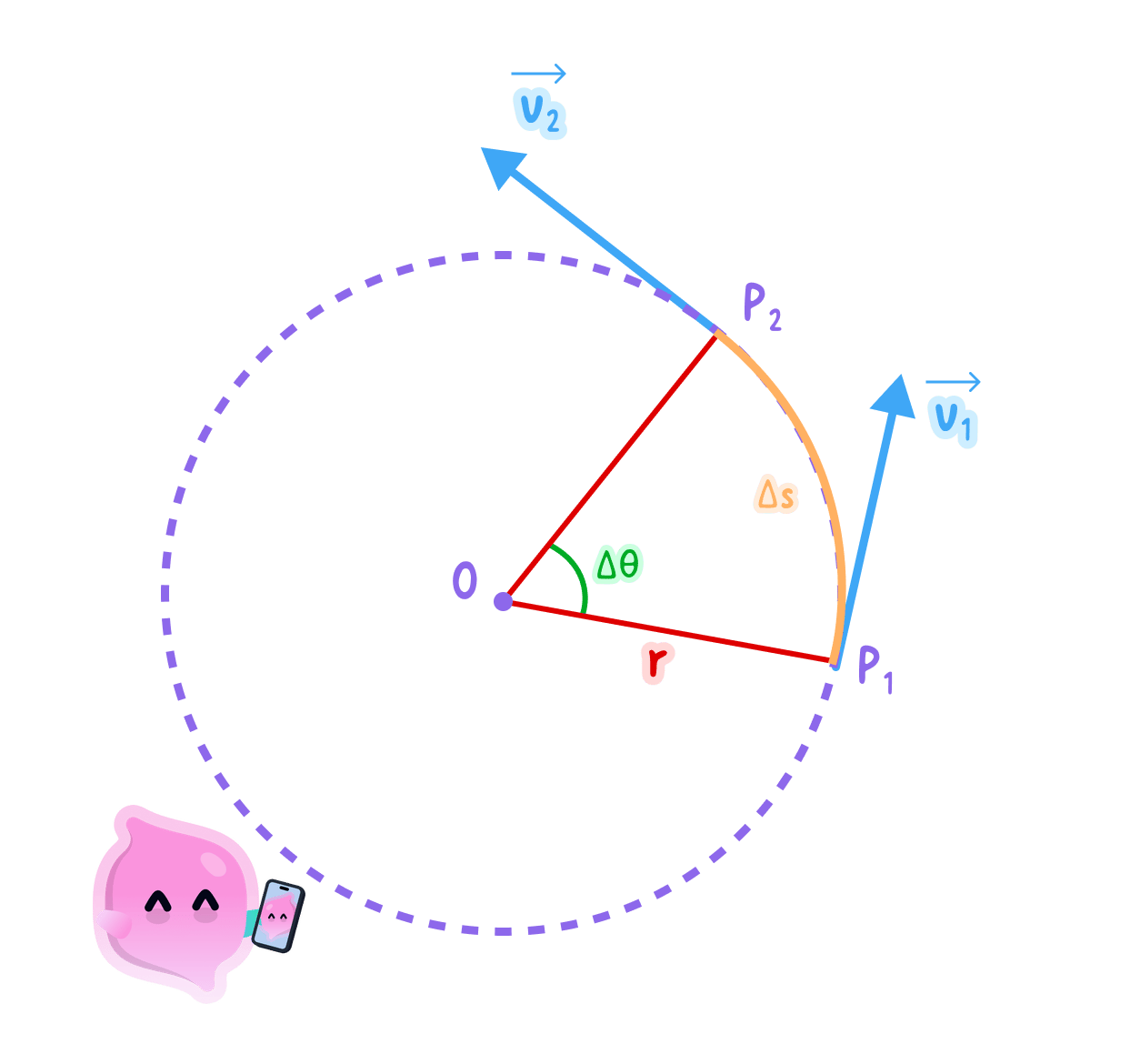
- An object moving around a circle can travel at constant speed, covering equal distances in equal times.
- But its direction of motion changes continuously as it travels around the circle.
- Because velocity depends on direction as well as speed, the object’s velocity changes continuously.
Key Idea
- An object moving around a circle at constant speed has a constant speed.
- It has a continuously changing direction.
- It therefore has a continuously changing velocity.
Examples of circular motion
- A car on a roundabout at steady speed may move north at one point and west shortly after; its speed is unchanged, but its direction, and so its velocity, has changed.
- The same applies to a runner on a circular track, a seat on a Ferris wheel, a point on the edge of a rotating wheel, and an object in a circular orbit.
- At every point the object moves in a different direction from a moment earlier, so its velocity changes continuously.
Exam technique
- Do not assume constant speed means constant velocity; velocity is constant only when both the speed and the direction are unchanged.
- Do not write only “the car turns”; state that turning changes its direction, and therefore its velocity.
- Give the full chain: constant speed, changing direction, velocity is speed in a given direction, so the velocity changes.
- The key marking point is the change in direction; saying only “it moves in a circle” is not a complete explanation.
Self review
- What is the difference between speed and velocity?
- Can an object have constant speed but changing velocity?
- Why does an object’s direction change as it moves around a circle?
- Explain why a runner at constant speed on a circular track has changing velocity.
- What key word must be included when explaining changing velocity in circular motion?
