7.3.4a Transformer construction and the turns ratio
Transformer construction
Definition
Transformer
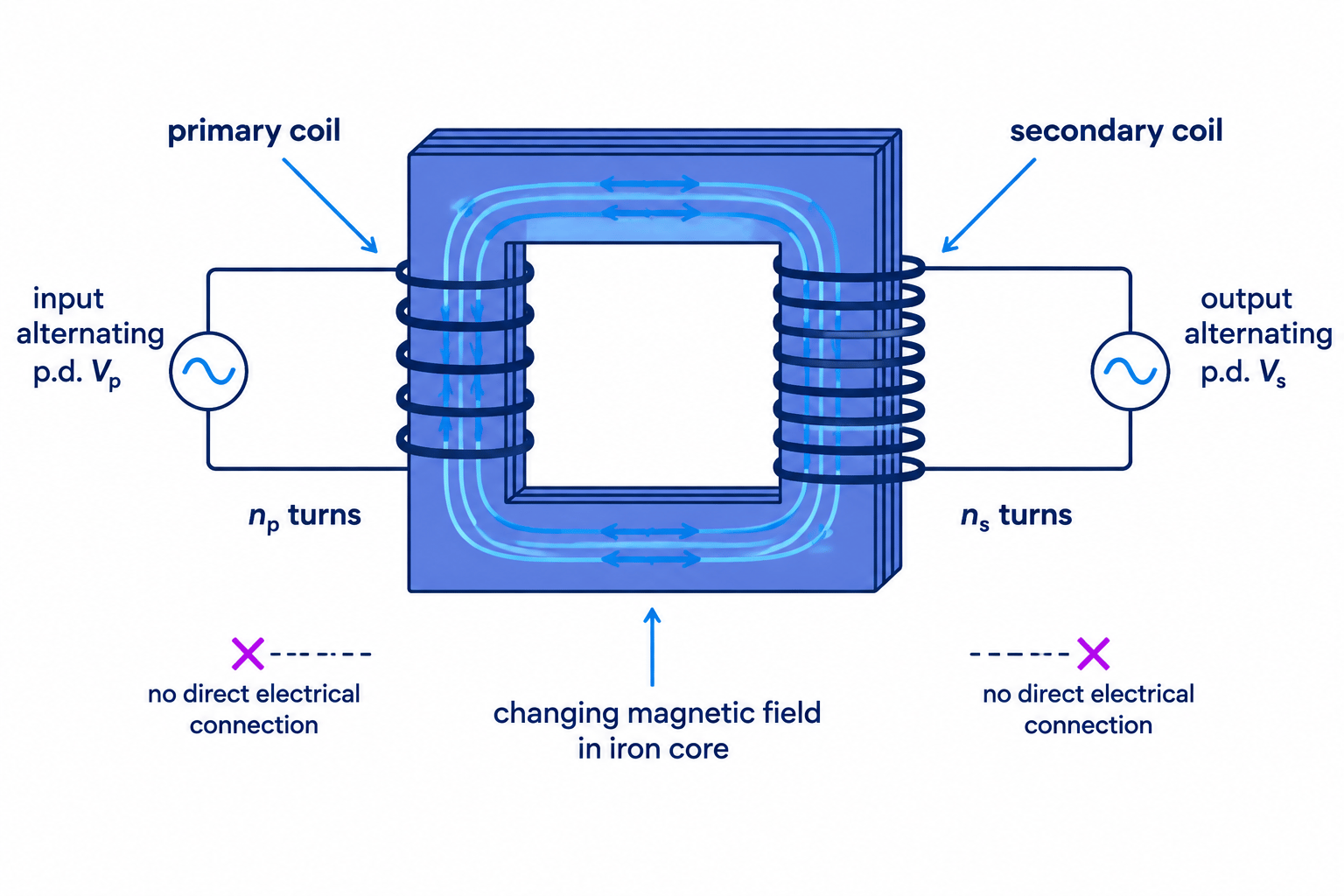
A transformer is a device that uses electromagnetic induction to change an alternating potential difference.
- The primary coil is connected to the input alternating potential difference.
- The secondary coil is connected to the output circuit.
- Both coils are wound on an iron core.
- The two coils are separate, with no direct electrical connection; energy passes between them through a changing magnetic field in the core.
- Iron is used because it is easily magnetised, so the changing field from the primary coil passes effectively through the secondary coil.
How a transformer works
- A transformer needs an alternating current in the primary coil, because it continually changes direction and size.
- The alternating current in the primary coil produces a changing magnetic field.
- The iron core becomes magnetised and carries the changing field through the secondary coil.
- The changing field induces an alternating potential difference across the secondary coil.
- If the secondary circuit is complete, this drives an alternating current in it.
- A steady direct current gives no continuous transformer action, because a constant current's field is not changing.
Key Idea
Current is not passed directly from one coil to the other; a changing magnetic field links the coils and induces a potential difference across the secondary coil.
The transformer turns ratio
- The potential difference across each coil depends on its number of turns, given by VpVs=npns\dfrac{V_p}{V_s} = \dfrac{n_p}{n_s}VsVp=nsnp.
- VpV_pVp is the potential difference across the primary coil, in volts, V\text{V}V.
- VsV_sVs is the potential difference across the secondary coil, in volts, V\text{V}V.
- npn_pnp is the number of turns on the primary coil.
- nsn_sns is the number of turns on the secondary coil.
- Write both ratios in the same order: if primary is on top for the potential differences, primary must be on top for the turns.
- A coil with more turns has the greater potential difference, so a secondary coil with five times as many turns has five times the potential difference.
Example
- Question: A transformer has 400400400 turns on the primary coil and 200020002000 turns on the secondary coil, with 12 V12\ \text{V}12 V across the primary. Calculate the secondary potential difference.
- Write the equation: VpVs=npns\dfrac{V_p}{V_s} = \dfrac{n_p}{n_s}VsVp=nsnp.
- Substitute the values: 12Vs=4002000\dfrac{12}{V_s} = \dfrac{400}{2000}Vs12=2000400.
- Rearrange: Vs=12×2000400V_s = \dfrac{12 \times 2000}{400}Vs=40012×2000.
- Calculate: Vs=60 VV_s = 60\ \text{V}Vs=60 V, which is greater than the primary, so this is a step-up transformer.
Step-up and step-down transformers
- A step-up transformer increases the potential difference, so Vs>VpV_s > V_pVs>Vp and it has more secondary turns, ns>npn_s > n_pns>np.
- A step-down transformer decreases the potential difference, so Vs<VpV_s < V_pVs<Vp and it has fewer secondary turns, ns<npn_s < n_pns<np.
Common Mistake
- The word primary does not mean the larger potential difference; the primary is just the input coil and the secondary is the output coil.
- A changing field induces a potential difference across the secondary coil; a current flows only if the secondary circuit is complete.
Exam technique
- For how a transformer works, give the chain: alternating current in the primary, changing field in the iron core, induced potential difference in the secondary, current if the secondary circuit is complete.
- In calculations keep primary quantities together and secondary quantities together, then compare VsV_sVs with VpV_pVp to decide step-up or step-down.
Self review
- What are the three main parts of a basic transformer?
- Why is iron used for the core?
- Why must the primary current be alternating?
- State the transformer turns-ratio equation.
- How do the numbers of turns compare in a step-up transformer?
- What extra condition is needed for a current to flow in the secondary circuit?
7.3.4b Transformers and power transmission
Power input and power output
Definition
Ideal transformer
An ideal transformer is 100%100\%100% efficient, so its electrical power output equals its electrical power input.
- For an ideal transformer, Pinput=PoutputP_{input} = P_{output}Pinput=Poutput.
- Electrical power is P=VIP = VIP=VI, so for a transformer VpIp=VsIsV_p I_p = V_s I_sVpIp=VsIs.
- VpV_pVp and IpI_pIp are the potential difference and current in the primary coil, in V\text{V}V and A\text{A}A.
- VsV_sVs and IsI_sIs are the potential difference and current in the secondary coil, in V\text{V}V and A\text{A}A.
- The primary coil takes the input power and the secondary coil gives the output power; if the transformer is 100%100\%100% efficient, no power is wasted and the two are equal.
- To find the current drawn from the input supply for a given output, use Ip=PoutputVpI_p = \dfrac{P_{output}}{V_p}Ip=VpPoutput, assuming the transformer is ideal.
Linking potential difference, turns and current
- The potential differences depend on the turns, VsVp=nsnp\dfrac{V_s}{V_p} = \dfrac{n_s}{n_p}VpVs=npns.
- For an ideal transformer the power stays constant, so increasing the potential difference decreases the current, from VpIp=VsIsV_p I_p = V_s I_sVpIp=VsIs.
- Combining the relationships gives IsIp=VpVs=npns\dfrac{I_s}{I_p} = \dfrac{V_p}{V_s} = \dfrac{n_p}{n_s}IpIs=VsVp=nsnp, so the current ratio is the inverse of the potential difference and turns ratios.
- In a step-up transformer, Vs>VpV_s > V_pVs>Vp, so Is<IpI_s < I_pIs<Ip.
- In a step-down transformer, Vs<VpV_s < V_pVs<Vp, so Is>IpI_s > I_pIs>Ip.
Example
- Question: A step-up transformer has 500500500 primary turns and 500050005000 secondary turns. The input is 25 kV25\ \text{kV}25 kV and the required power output is 2.0 MW2.0\ \text{MW}2.0 MW. Assuming it is 100%100\%100% efficient, find the secondary potential difference, the input current and the output current.
- Convert units: 25 kV=25 000 V25\ \text{kV} = 25\,000\ \text{V}25 kV=25000 V and 2.0 MW=2.0×10⁶ W2.0\ \text{MW} = 2.0 \times 10^6\ \text{W}2.0 MW=2.0×10⁶ W.
- Use the turns equation: VsVp=nsnp\dfrac{V_s}{V_p} = \dfrac{n_s}{n_p}VpVs=npns, so Vs25 000=5000500\dfrac{V_s}{25\,000} = \dfrac{5000}{500}25000Vs=5005000.
- Find the secondary potential difference: Vs=25 000×10=250 000 V=250 kVV_s = 25\,000 \times 10 = 250\,000\ \text{V} = 250\ \text{kV}Vs=25000×10=250000 V=250 kV.
- Find the input current: Ip=PoutputVp=2.0×10625 000=80 AI_p = \dfrac{P_{output}}{V_p} = \dfrac{2.0 \times 10^6}{25\,000} = 80\ \text{A}Ip=VpPoutput=250002.0×106=80 A.
- Find the output current: Is=PoutputVs=2.0×106250 000=8.0 AI_s = \dfrac{P_{output}}{V_s} = \dfrac{2.0 \times 10^6}{250\,000} = 8.0\ \text{A}Is=VsPoutput=2500002.0×106=8.0 A.
- The potential difference has risen by a factor of 101010 while the current has fallen by a factor of 101010.
High-potential-difference power transmission
- The National Grid uses step-up transformers to raise the potential difference before power is sent through the transmission cables.
- For a fixed power, I=PVI = \dfrac{P}{V}I=VP, so a higher potential difference gives a lower current.
- A lower current causes less heating in the cables, which have resistance, so less energy is transferred to the thermal energy stores of the cables and surroundings.
- Near consumers, step-down transformers reduce the potential difference again to safer, usable levels.
- The reasoning chain is: step-up transformer raises the potential difference, the current falls for the same power, less heating in the cables, so less energy is wasted and transmission is more efficient.
Common Mistake
- A step-up transformer does not create energy; raising the potential difference makes the current fall so the input and output powers stay equal.
- The current ratio is the inverse of the turns ratio, so do not apply the turns ratio to the current in the same direction.
Exam technique
- Label every value as primary or secondary, use the turns equation for a missing potential difference, then use VpIp=VsIsV_p I_p = V_s I_sVpIp=VsIs to link the currents and power.
- For the National Grid, give the full chain: higher potential difference, lower current, less cable heating, less energy wasted.
Self review
- What equation links the input and output powers of a 100% efficient transformer?
- How are the potential difference ratio and turns ratio related?
- Why does a step-up transformer give a smaller secondary current?
- How would you calculate the current drawn from the input supply for a known power output?
- Why does the National Grid transmit power at a high potential difference?