What our solar system contains
Solar system
A star together with all the objects that orbit it because of its gravitational attraction.
Natural satellite
An object that orbits a planet and is not made by humans; a moon is a natural satellite.
- Our solar system contains one star, the Sun, at its centre.
- Eight planets orbit the Sun, in order out from it: Mercury, Venus, Earth, Mars, Jupiter, Saturn, Uranus and Neptune.
- Dwarf planets, such as Pluto, also orbit the Sun.
- Natural satellites, such as moons, orbit the planets.
- The Sun's gravitational attraction holds the planets and dwarf planets in orbit around it.
- In the same way, a planet's gravitational attraction holds its moons in orbit around that planet.
- A natural satellite is a moon that formed naturally, whereas an artificial satellite is a human-made object placed into orbit.
Our solar system is only a small part of the Milky Way
Galaxy
A very large collection of stars held together by gravitational attraction.
- Our solar system sits inside the Milky Way galaxy.
- A galaxy is a huge collection of stars held together by gravitational attraction.
- The Milky Way contains the Sun and billions of other stars, many of which have their own planets.
- The solar system is only a tiny part of the Milky Way, so the two are not the same thing.
- The solar system is the Sun plus everything that orbits it, while the galaxy is a vast group of many stars, one of which is the Sun.
How the Sun formed from a nebula
Nebula
A cloud of dust and gas in space, which is the material a star forms from.
Nuclear fusion
A reaction in which small nuclei join to form a larger nucleus, releasing energy.
- The Sun began as a nebula, a cloud of dust and gas in space.
- Gravitational attraction pulled the dust and gas together.
- As more material was pulled in, the cloud collapsed and became denser.
- Squeezing the material together made the centre much hotter.
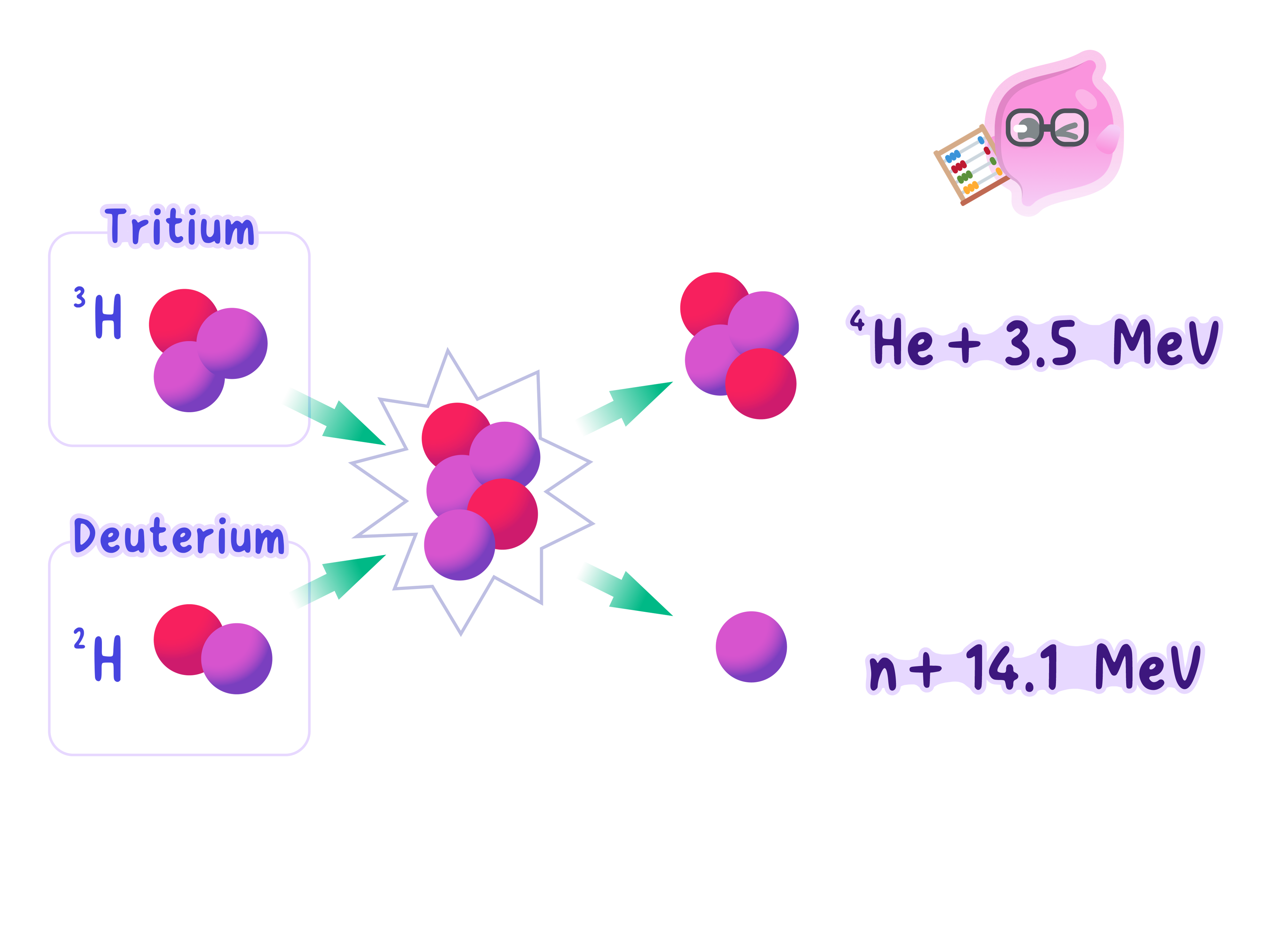
- The centre eventually became hot and dense enough for nuclear fusion to begin.
- In fusion, hydrogen nuclei join to form helium, releasing energy.
- Once fusion was releasing energy steadily, the Sun became a stable star, also called a main sequence star.
Why a star stays stable
Equilibrium (stable star)
The state of a stable star in which the inward pull of gravity is balanced by the outward push from the energy released in fusion.
- In a stable star, two effects act in opposite directions.
- Gravitational attraction pulls the star's material inwards, tending to make it collapse.
- The energy released by fusion pushes the star's material outwards, tending to make it expand.
- While these two effects are balanced, the star stays the same size and is stable; this balance is called equilibrium.
- Neither effect stops: fusion keeps releasing energy and gravity keeps pulling inwards, and the star is stable only because they cancel out.
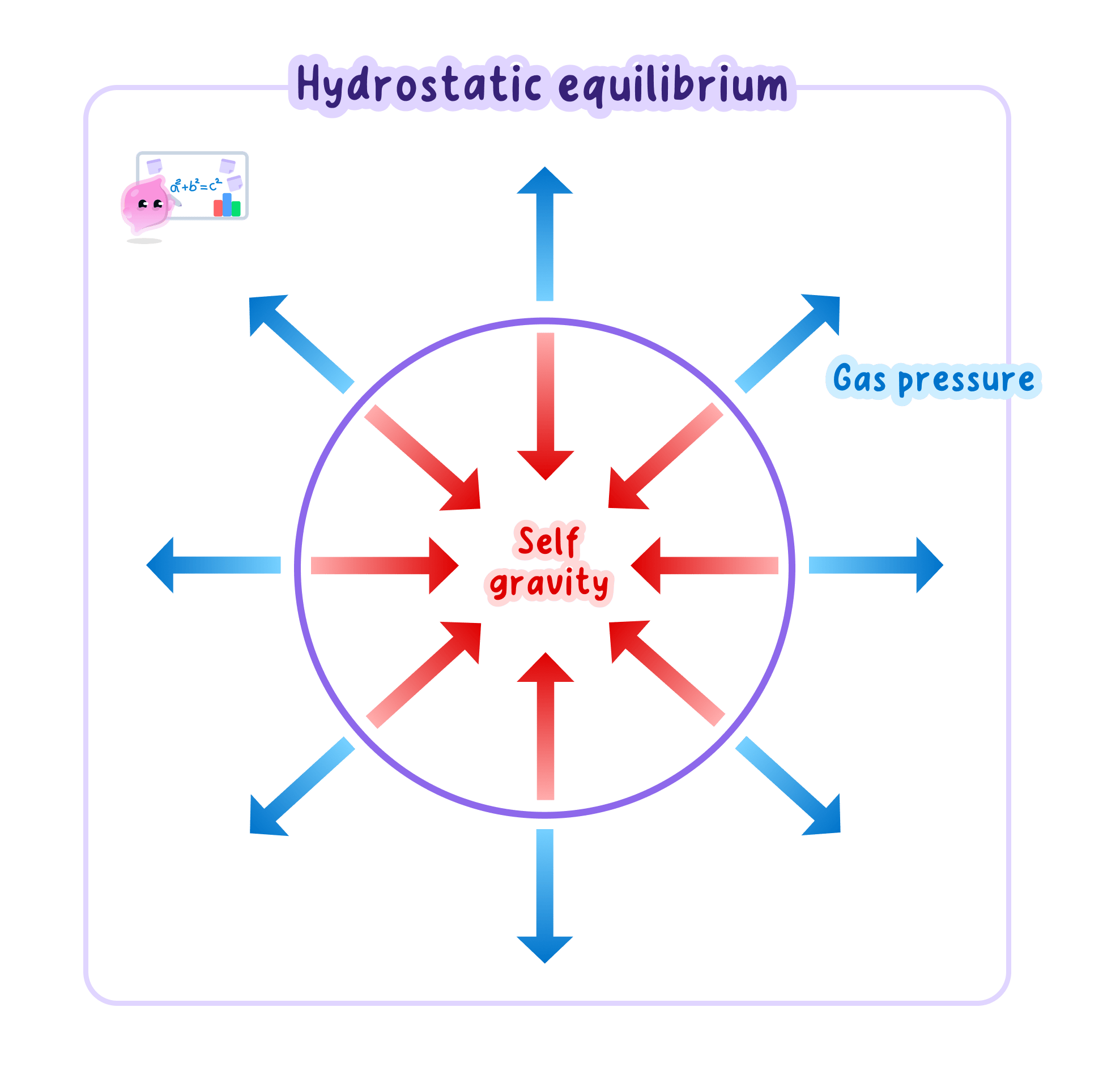
A star is stable when the inward pull of gravitational attraction is balanced by the outward push from the energy released in nuclear fusion.
- Do not confuse a solar system with a galaxy: our solar system has one star, the Sun, while the Milky Way galaxy contains billions of stars.
- Do not write that gravity or fusion switches off in a stable star, because both keep going and the star is stable only because their effects are balanced.
- What objects are found in our solar system?
- What is the difference between a natural satellite and an artificial satellite?
- What is the name of the galaxy that contains our solar system?
- What is a nebula, and what force pulls its material together?
- What two opposing effects are balanced in a stable star?
