8.1.2a The life cycle of a star
A star's life cycle depends on its mass
Life cycle of a star
The sequence of stages a star passes through, from formation to its final state.
Nebula
A cloud of dust and gas in space, from which stars form.
Protostar
An early stage of a star, formed as gravity pulls a nebula together, before fusion makes it stable.
Main sequence star
A stable star in the long-lasting stage of its life, where the inward pull of gravity is balanced by the outward push from fusion energy.
- Every star goes through a life cycle, a sequence of stages from formation to its final state.
- The path a star follows is decided by its mass, so there are two pathways to learn: a star about the size of the Sun, and a star much more massive than the Sun.
- All stars begin the same way, forming from a nebula, a cloud of dust and gas in space.
- Gravitational attraction pulls the dust and gas together, so the material becomes denser and hotter, forming a protostar.
- When the protostar's core is hot enough, nuclear fusion begins and releases energy.
- The star then becomes a stable main sequence star, where it spends most of its life.
- A main sequence star is stable because the inward pull of gravity is balanced by the outward push from the energy released by fusion.
The life cycle of a star about the size of the Sun
Red giant
A large, cooler star that a star about the size of the Sun becomes near the end of its life.
White dwarf
The small, hot, dense core left behind after a Sun-sized star sheds its outer layers.
Black dwarf
The cold, dark remains of a white dwarf after it has cooled down.
- A star about the size of the Sun follows the path: a nebula, then a protostar, then a main sequence star, then a red giant, then a white dwarf, and finally a black dwarf.
- It stays on the main sequence while gravity and fusion pressure stay balanced.
- When the core runs low on fuel, the balance changes and the star swells into a red giant, which is larger and cooler.
- The star then sheds its outer layers, leaving a hot, dense core called a white dwarf.
- Over an extremely long time the white dwarf cools and fades into a black dwarf.
- A star this size does not explode as a supernova.
The life cycle of a star much more massive than the Sun
Red supergiant
A very large star that a star much more massive than the Sun becomes near the end of its life.
Supernova
A huge explosion at the end of the life of a much more massive star.
Neutron star
A very dense object that can form from the collapsed core left after a supernova.
Black hole
An extremely dense object formed from the collapsed core of a very massive star, whose gravity is so strong that not even light can escape.
- A much more massive star starts the same way: a nebula, then a protostar, then a main sequence star.
- Because it has far more mass, its later stages are different.
- After the main sequence, it swells into a red supergiant, even larger than a red giant.
- The red supergiant then explodes as a supernova, a huge and sudden explosion.
- The core left behind becomes either a neutron star or, if enough mass remains, a black hole.
- Which one forms depends on the mass of the remaining core.
- Do not mix up the two life cycles: a Sun-sized star ends as a red giant, then white dwarf, then black dwarf.
- A much more massive star ends as a red supergiant, then supernova, then neutron star or black hole.
- The Sun is not massive enough to become a supernova, a neutron star or a black hole.
- What decides the life cycle a star will follow?
- What are the first two stages that every star passes through?
- Why is a main sequence star stable?
- List, in order, the stages a star about the size of the Sun goes through after the main sequence.
- What two objects can be left behind after a supernova?
8.1.2b Formation of the elements in stars
Fusion in stars forms new elements
Nuclear fusion
A reaction in which two light nuclei join to form a heavier nucleus, releasing energy.
- An element is identified by the number of protons in its nucleus.
- When nuclei fuse, they make a new nucleus with a different number of protons, so fusion can produce a new element.
- For example, hydrogen nuclei fuse to form helium, and further fusion builds up increasingly heavy elements.
- Fusion happens in stars because their cores are at extremely high temperature and pressure, which push the positively charged nuclei close enough to join.
- In this way, fusion processes in stars produce all of the naturally occurring elements up to iron.
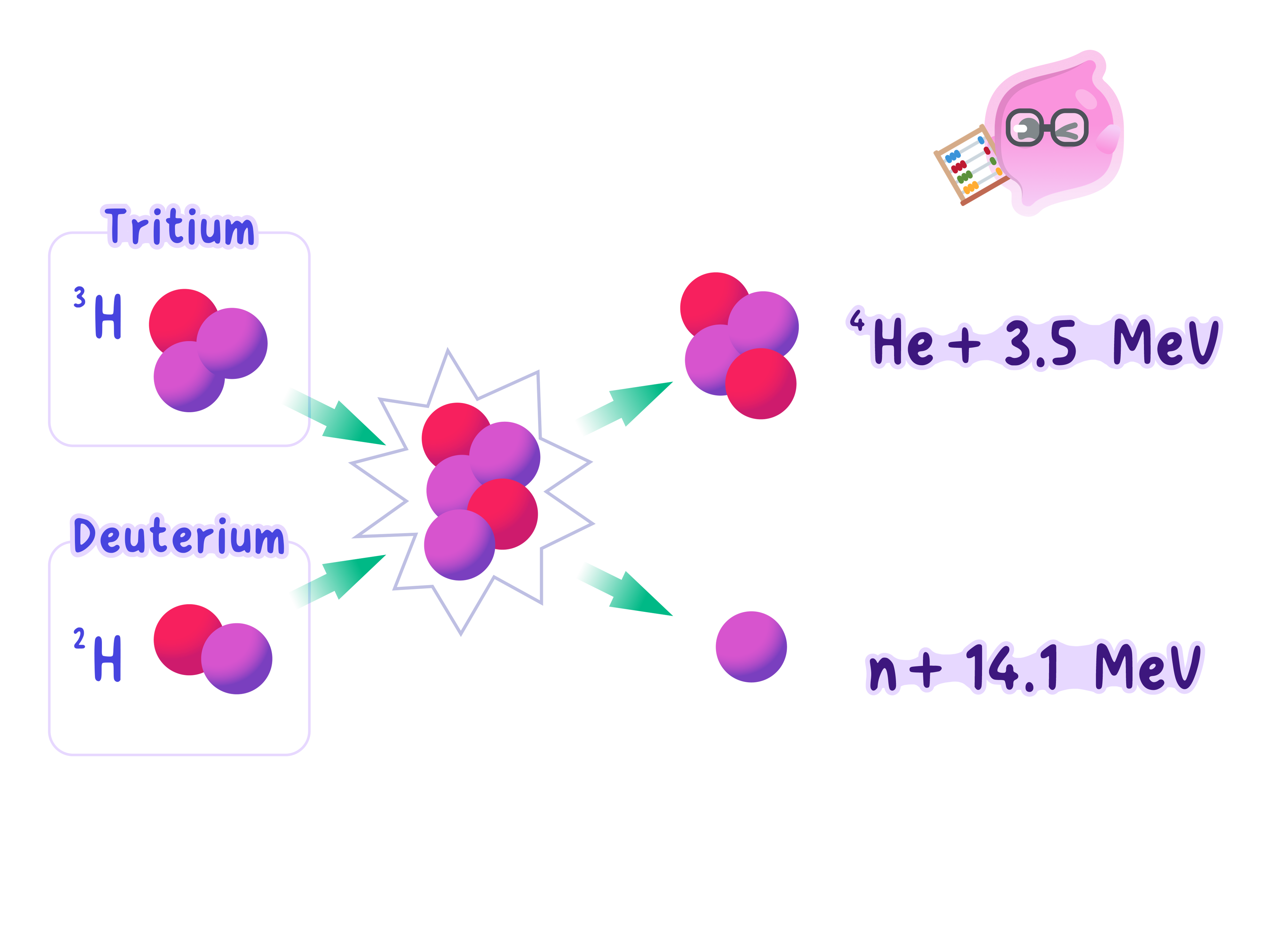
Fusion does two jobs in a star: it releases energy, and it joins nuclei to make heavier ones, which forms new elements.
Elements heavier than iron form in a supernova
Supernova
The explosion of a massive star at the end of its life.
- Fusion during a star's life builds up elements only as far as iron.
- Elements heavier than iron are produced in a supernova, the explosion of a massive star.
- The conditions during the explosion are extreme enough to build these heavier nuclei; you do not need to describe the detailed nuclear processes.
- Do not confuse fusion (small nuclei join to make a larger one) with fission (a large nucleus splits into smaller ones).
- Do not say ordinary fusion during a star's life makes elements heavier than iron; those form only in a supernova.
Supernovae spread the elements through the universe
- A supernova does more than make heavier elements; the explosion also throws the star's material outwards.
- This distributes the elements throughout the universe, so they are not left trapped inside the star.
- The scattered material can later become part of new stars, planets and everything on them.
For an explain question, give a linked chain rather than separate facts: nuclei fuse →\rightarrow→ heavier nuclei form →\rightarrow→ new elements form →\rightarrow→ elements heavier than iron form in a supernova →\rightarrow→ the explosion distributes them.
- What happens to atomic nuclei during nuclear fusion?
- Why can fusion produce a new element?
- Up to which element can fusion in a star's life build?
- Where are elements heavier than iron produced?
- How are the elements made in stars spread through the universe?
