8.1.3a Orbital motion: planets, moons and satellites
Planets, moons and satellites: what orbits what
Orbit
The curved path an object follows as it moves around another object in space.
Planet
A large natural object that orbits a star.
Moon
A natural satellite that orbits a planet.
Satellite
Any object that orbits another object; it can be natural, like a moon, or artificial.
Artificial satellite
A human-made object placed into orbit, usually around a planet such as Earth.
- An orbit is the curved path an object follows around another object in space.
- A planet is a large natural object that orbits a star; for example, Earth orbits the Sun.
- A moon is a natural satellite that orbits a planet; our Moon orbits Earth.
- A satellite is any object that orbits another object, and it may be natural or artificial.
- An artificial satellite is a human-made object placed into orbit, most often around Earth.
Gravity holds an object in a circular orbit
Circular orbit
An orbit in which an object moves in a circle, staying at a constant distance from the centre of the object it goes around.
- Gravity is an attractive force between objects that have mass.
- In a circular orbit, gravity provides a force directed towards the centre of the object being orbited.
- An orbiting object is already moving forwards, and gravity constantly pulls it inwards.
- This inward pull continually changes the direction of the object's motion, so its path curves into an orbit.
- The Sun's gravity keeps Earth in orbit around the Sun.
- Earth's gravity keeps the Moon, and also artificial satellites, in orbit around Earth.
- Without this inward force the object would carry on in a straight line and leave its orbit.
Gravity does not push an orbiting object forwards; it provides the inward force that keeps changing the direction of its motion, holding it in orbit.
Comparing planets, moons and artificial satellites
- All three are similar in that they move in orbits.
- In every case gravity provides the force that maintains the circular orbit.
- Each one orbits a larger central object with a stronger gravitational pull.
- They differ in what they orbit and in how they formed.
- A planet is natural and orbits a star.
- A moon is natural and orbits a planet, so it is a natural satellite.
- An artificial satellite is human-made and is placed into orbit, usually around Earth.
- Do not say there is no gravity in space; gravity acts over huge distances and is exactly what holds objects in orbit.
- Do not assume every satellite is artificial; a moon is a natural satellite.
- Do not say a satellite needs its engines running to stay in orbit; gravity supplies the inward force for the curved path.
- What force keeps a planet or satellite in its orbit?
- In a circular orbit, in which direction does gravity act?
- What does a planet orbit, and what does a moon orbit?
- What is the difference between a natural and an artificial satellite?
- What would happen to an orbiting object if the inward force of gravity were removed?
8.1.3b Circular orbits: force, velocity and speed (HT)
Speed and velocity in a circular orbit
Speed and velocity
Speed is how fast an object moves; it has size but no direction. Velocity is speed in a stated direction, so a change in either size or direction is a change in velocity.
- Speed tells you how fast an object moves and has size but no direction, so it is the magnitude of the velocity, speed=∣v⃗∣\text{speed}=|\vec{v}|speed=∣v∣.
- Velocity is speed in a stated direction, so it is a vector.
- A change in either the size or the direction of the motion counts as a change in velocity.
Gravity provides the centripetal force
Centripetal force
The resultant force that points towards the centre of a circular path; for an orbit, gravity provides it.
- A satellite in a circular orbit is pulled towards the centre of the body it orbits by the force of gravity.
- This inward force is the centripetal force, the resultant force directed towards the centre of the circular path.
- Gravity is not an extra force; in an orbit gravity provides the centripetal force.
- Without it, the satellite would move off in a straight line along the tangent to the circle.
Gravity acts as the centripetal force on an orbiting satellite; it is not a separate force but the inward force that keeps the satellite on its circular path.
Changing velocity while the speed stays the same
- At each point the satellite's velocity points along the tangent to the circular path.
- Gravity acts at right angles (90∘90^\circ90∘) to this motion, pointing towards the centre.
- A force acting at 90∘90^\circ90∘ to the motion changes the direction of the velocity but not its magnitude.
- So the direction keeps changing while the speed stays constant.
- Because the velocity is changing, the satellite is accelerating, even though its speed does not change, since acceleration is any change in velocity.
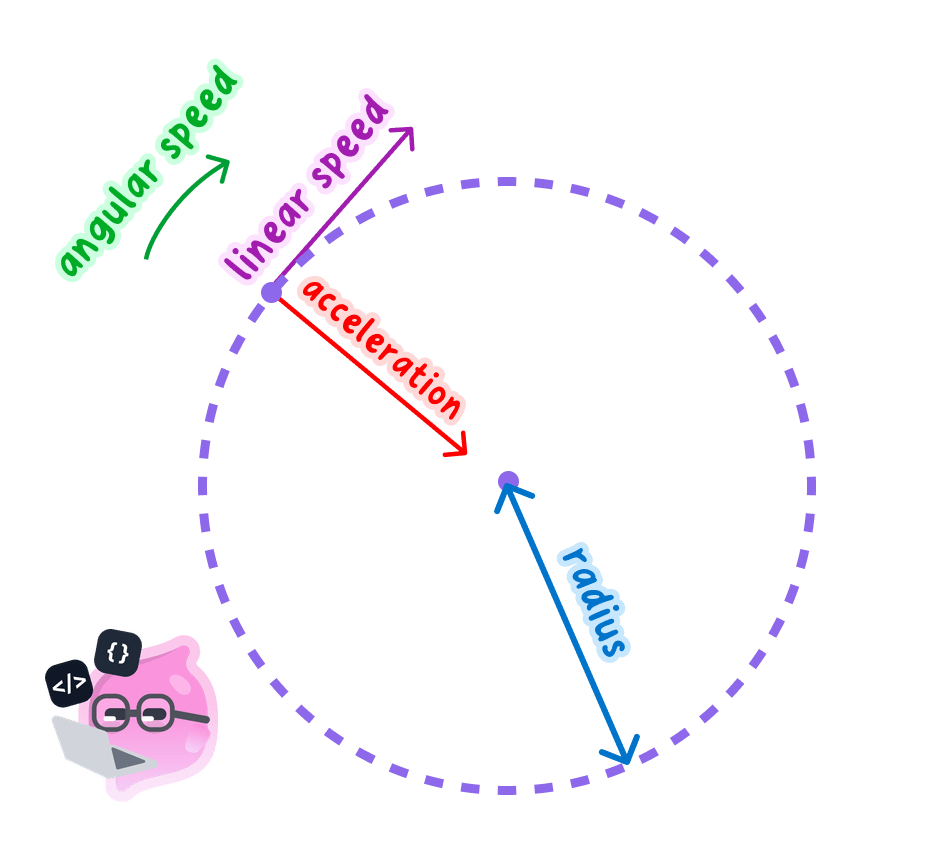
Picture swinging a ball on a string in a circle: the tension pulls it towards the centre and keeps changing its direction, and in an orbit gravity does the job the string tension does.
Stable orbits link speed and radius
Stable circular orbit
An orbit in which an object keeps moving in a circle at a constant distance (radius) from the body it goes around.
- A stable circular orbit keeps a constant radius around the central body.
- For each radius, the satellite needs a particular speed so that gravity bends its path by exactly the right amount.
- If the speed changes but the radius stays the same, gravity bends the path by the wrong amount and the orbit is no longer stable.
- So to stay in a stable orbit at a new speed, the orbital radius must also change: a faster satellite orbits at a smaller radius, and a slower one at a larger radius.
- Speed and radius therefore cannot be changed independently in a stable orbit.
- Do not say the velocity is constant just because the speed is constant; the direction is always changing, so the velocity is always changing.
- Do not treat the centripetal force as a separate force added to gravity; gravity is the centripetal force here.
- What is the difference between speed and velocity?
- Which force provides the centripetal force on an orbiting satellite?
- Why does a satellite in a circular orbit have a changing velocity but a constant speed?
- Why is an orbiting satellite accelerating even at constant speed?
- If a satellite's speed increases, what must happen to its orbital radius to keep a stable orbit?
