What the temperature rise depends on
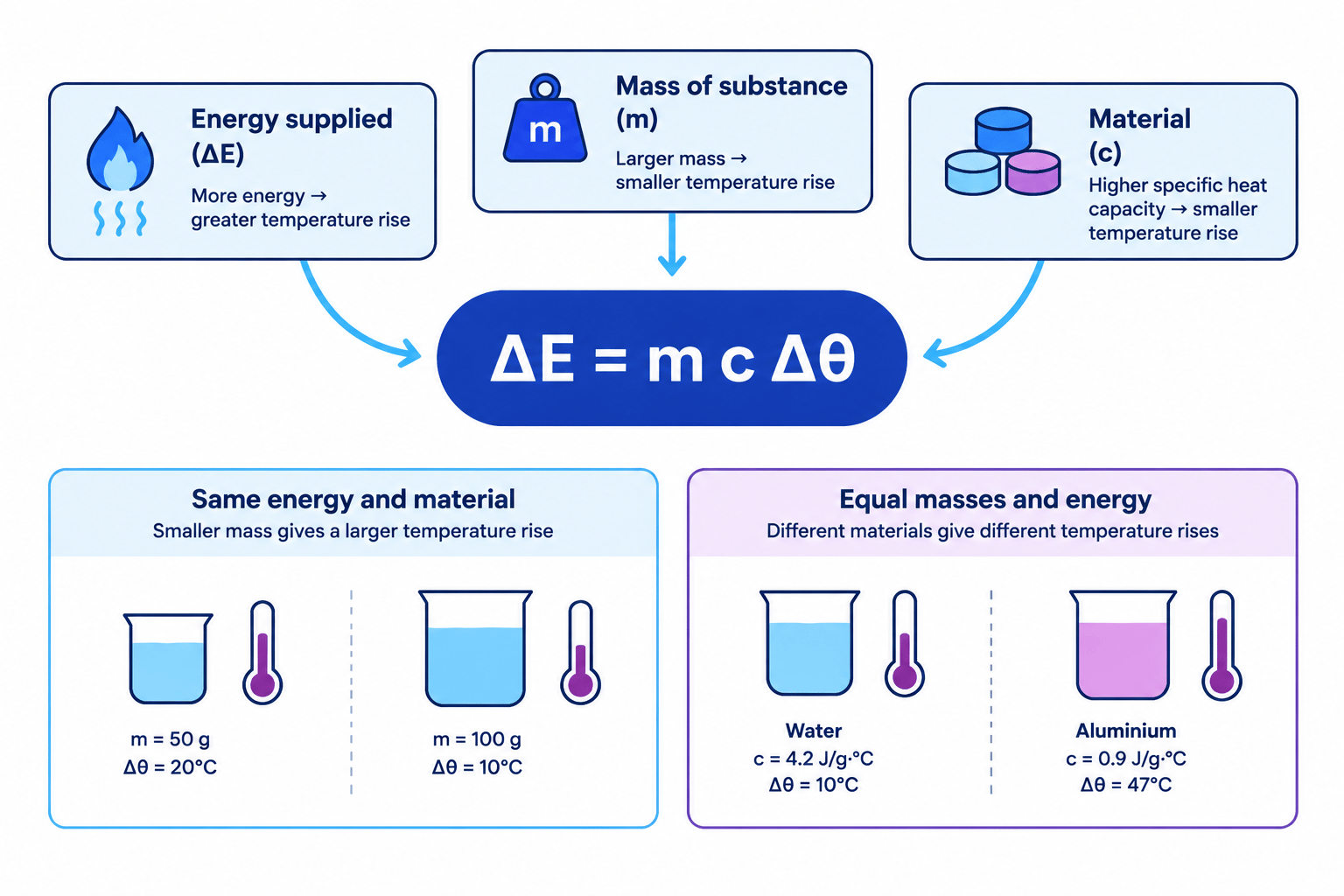
- When energy is transferred to a system by heating and its temperature rises, the size of the rise depends on three things: the mass of the substance, the material it is made of, and the amount of energy supplied.
- For the same material given the same energy, a smaller mass gives a larger temperature rise, because the energy is shared between fewer particles.
- For equal masses of different materials given the same energy, the temperature rises are different, because different materials need different amounts of energy for the same rise.
Key Idea
The energy transferred by heating raises the internal energy of the system. How much the temperature rises depends on the energy supplied, the mass being heated, and the material it is made of.
Specific heat capacity and its equation
Definition
Specific heat capacity
The specific heat capacity of a substance is the amount of energy needed to raise the temperature of one kilogram of the substance by one degree Celsius, measured in J/kg ∘C\text{J/kg}\,^\circ\text{C}J/kg∘C.
- The change in thermal energy when a substance is heated or cooled is given by ΔE=m c Δθ\Delta E = m\,c\,\Delta\thetaΔE=mcΔθ.
- ΔE\Delta EΔE is the change in thermal energy, in joules, J\text{J}J.
- mmm is the mass, in kilograms, kg\text{kg}kg.
- ccc is the specific heat capacity, in joules per kilogram per degree Celsius, J/kg ∘C\text{J/kg}\,^\circ\text{C}J/kg∘C.
- Δθ\Delta\thetaΔθ is the temperature change, in degrees Celsius, ∘C^\circ\text{C}∘C; the symbol Δ\DeltaΔ means “change in”, so Δθ\Delta\thetaΔθ is the final temperature minus the starting temperature, for example 65−20=45 ∘C65 - 20 = 45\ ^\circ\text{C}65−20=45 ∘C.
- A material with a high specific heat capacity needs a lot of energy to warm each kilogram by 1 ∘C1\ ^\circ\text{C}1 ∘C; one with a low value needs less.
Example
- A 2.0 kg2.0\ \text{kg}2.0 kg block of aluminium has a specific heat capacity of 900 J/kg ∘C900\ \text{J/kg}\,^\circ\text{C}900 J/kg∘C. Its temperature rises by 15 ∘C15\ ^\circ\text{C}15 ∘C. Calculate the change in thermal energy.
- Write the equation:
- Substitute and calculate:
- The change in thermal energy is 27 000 J27\,000\ \text{J}27000 J.
Rearranging the equation
- To find the specific heat capacity, use c=ΔEm Δθc = \dfrac{\Delta E}{m\,\Delta\theta}c=mΔθΔE.
- To find the mass, use m=ΔEc Δθm = \dfrac{\Delta E}{c\,\Delta\theta}m=cΔθΔE.
- To find the temperature change, use Δθ=ΔEm c\Delta\theta = \dfrac{\Delta E}{m\,c}Δθ=mcΔE.
- Use the units to check your working: energy in J\text{J}J, mass in kg\text{kg}kg and temperature change in ∘C^\circ\text{C}∘C.
Example
- A heater transfers 12 600 J12\,600\ \text{J}12600 J of energy to a 0.50 kg0.50\ \text{kg}0.50 kg metal block, and its temperature rises by 20 ∘C20\ ^\circ\text{C}20 ∘C. Calculate the specific heat capacity.
- Rearrange for c:
- Substitute and calculate:
- The specific heat capacity of the metal is 1260 J/kg ∘C1260\ \text{J/kg}\,^\circ\text{C}1260 J/kg∘C.
Common Mistake
- Do not confuse temperature with energy: temperature is measured in ∘C^\circ\text{C}∘C and tells you how hot something is, while energy is measured in J\text{J}J.
- Δθ\Delta\thetaΔθ is the temperature change, not the starting or final temperature, so always subtract: Δθ=final−initial\Delta\theta = \text{final} - \text{initial}Δθ=final−initial.
Self review
- What three things decide how much a substance’s temperature rises when it is heated?
- State the specific heat capacity equation and give the unit of each quantity.
- What is meant by specific heat capacity?
- Water is heated from 20 ∘C20\ ^\circ\text{C}20 ∘C to 65 ∘C65\ ^\circ\text{C}65 ∘C; what is the temperature change?
- Why is a measured specific heat capacity often a little higher than the true value?