5.1.4a Resultant forces
Resultant force
Definition
Resultant force
The resultant force is the single force that has the same effect as all the forces acting on an object together.
- An object can have more than one force acting at once; for example, a box being pushed along the floor has a push forwards and friction backwards.
- Instead of tracking every force separately, replace them with one overall resultant force that gives the same effect.
- If forces act in the same direction they add; if they act in opposite directions along the same straight line, subtract the smaller from the larger.
- Forces are measured in newtons (N\text{N}N).
Two forces in a straight line
- Here you only need the resultant of two forces acting in a straight line, either in the same direction or in opposite directions.
- Same direction: add the forces, Fresultant=F1+F2F_{\text{resultant}} = F_1 + F_2Fresultant=F1+F2.
- Opposite directions: subtract, Fresultant=Flarger−FsmallerF_{\text{resultant}} = F_{\text{larger}} - F_{\text{smaller}}Fresultant=Flarger−Fsmaller.
- The direction of the resultant force is the direction of the larger force.
Key Idea
- A resultant force needs both a size and a direction.
- For example, 30 N30\ \text{N}30 N to the right is different from 30 N30\ \text{N}30 N to the left.
Forces in the same direction
- If two people push a car in the same direction, their forces work together.
- Find the resultant force by adding the two forces.
Example
- Two students push a trolley to the right. One pushes with a force of 40 N40\ \text{N}40 N; the other pushes with 25 N25\ \text{N}25 N. Calculate the resultant force.
- Write the equation: Fresultant=F1+F2F_{\text{resultant}} = F_1 + F_2Fresultant=F1+F2.
- Substitute the values: Fresultant=40 N+25 NF_{\text{resultant}} = 40\ \text{N} + 25\ \text{N}Fresultant=40 N+25 N.
- Calculate: Fresultant=65 NF_{\text{resultant}} = 65\ \text{N}Fresultant=65 N.
- Add the direction: the resultant force is 65 N65\ \text{N}65 N to the right.
Forces in opposite directions
- If two forces act in opposite directions, they partly cancel, so the resultant force is the difference between them.
- If the two opposite forces are equal, the resultant force is 0 N0\ \text{N}0 N; for example, 50 N50\ \text{N}50 N to the left and 50 N50\ \text{N}50 N to the right cancel out.
Example
- A box is pulled to the right with a force of 70 N70\ \text{N}70 N. Friction acts to the left with a force of 30 N30\ \text{N}30 N. Calculate the resultant force.
- Write the equation: Fresultant=Flarger−FsmallerF_{\text{resultant}} = F_{\text{larger}} - F_{\text{smaller}}Fresultant=Flarger−Fsmaller.
- Substitute the values: Fresultant=70 N−30 NF_{\text{resultant}} = 70\ \text{N} - 30\ \text{N}Fresultant=70 N−30 N.
- Calculate: Fresultant=40 NF_{\text{resultant}} = 40\ \text{N}Fresultant=40 N.
- Give the direction: the larger force acts to the right, so the resultant force is 40 N40\ \text{N}40 N to the right.
Using signs for direction
- In calculations it can help to choose one direction as positive; for example, forces to the right are positive and forces to the left are negative.
- Then 80 N80\ \text{N}80 N to the right is +80 N+80\ \text{N}+80 N, and 20 N20\ \text{N}20 N to the left is −20 N-20\ \text{N}−20 N.
- Adding them gives +80 N+(−20 N)=+60 N+80\ \text{N} + (-20\ \text{N}) = +60\ \text{N}+80 N+(−20 N)=+60 N.
- The positive answer means the resultant force is 60 N60\ \text{N}60 N to the right; this method helps avoid mistakes with opposite directions.
Common Mistake
- Do not add opposite forces as if they act the same way: 70 N70\ \text{N}70 N right and 30 N30\ \text{N}30 N left make 40 N40\ \text{N}40 N to the right, not 100 N100\ \text{N}100 N.
- Do not forget the direction; a resultant force answer of just 40 N40\ \text{N}40 N may be incomplete.
Exam technique
- Check whether the forces are in the same direction or opposite directions.
- Add forces in the same direction; subtract forces in opposite directions.
- Give the unit, newtons (N\text{N}N), and include the direction of the resultant when directions are shown.
- If a diagram shows arrows, use the force values given; the longest arrow does not automatically give the answer.
Self review
- What is a resultant force?
- How do you find the resultant of two forces acting in the same direction?
- How do you find the resultant of two forces acting in opposite directions?
- What is the resultant of 50 N50\ \text{N}50 N to the left and 50 N50\ \text{N}50 N to the right?
- Besides its size, what must you always include with a resultant force?
5.1.4b Free body diagrams and resolving forces
Forces on an isolated object or system
Definition
Isolated object or system
An isolated object or system is the object, or group of objects, chosen for analysis separately from its surroundings, so that you can consider only the external forces acting on it.
- Identify all the external forces acting on the chosen object or system.
- A book resting on a table has its weight acting downwards and a normal contact force from the table acting upwards.
- A falling parachutist has weight acting downwards and air resistance acting upwards.
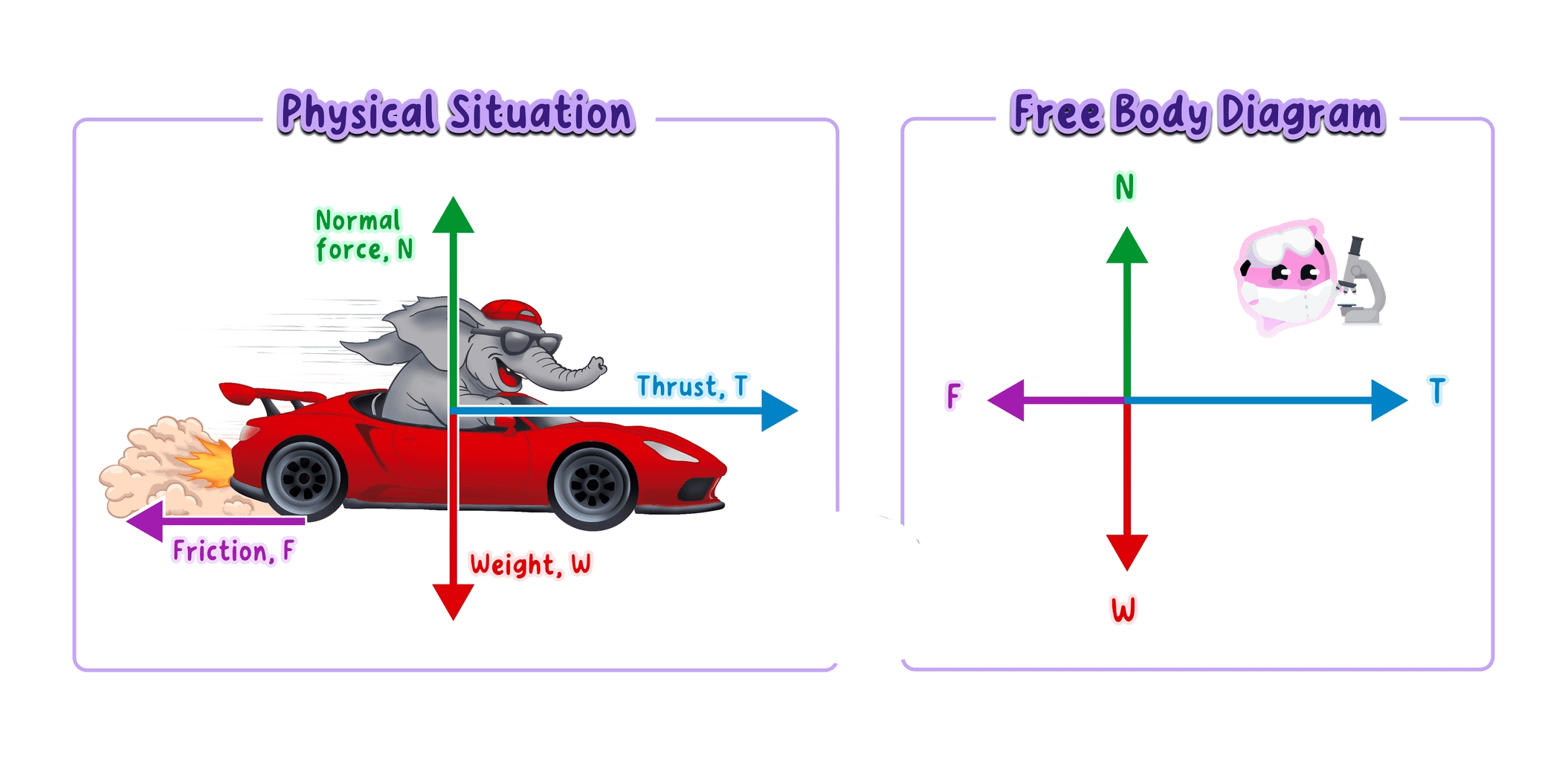
- A moving car may have a driving force forwards, resistive forces backwards, weight downwards and a normal contact force upwards.
- If two connected trolleys are treated as one system, include external forces such as the pull and friction; forces the trolleys exert on each other are internal to the system.
- Name forces precisely: write weight rather than just “gravity”, and identify the object providing a contact force.
Free-body diagrams and resultant force
Definition
Free-body diagram
A free-body diagram shows all the forces acting on an isolated object or system.
- The object is drawn as a dot or a simple box, with each force shown as an arrow.
- The direction of the arrow shows the direction of the force.
- The length of the arrow can represent the force’s magnitude.
- Each arrow is labelled with the force’s name.
- Show only forces acting on the chosen object; do not include forces it exerts on other objects.
- A resultant force is the single force that has the same effect as all the forces on the object combined.
- Forces are vectors, so magnitude and direction both matter; if opposite forces are equal they are balanced and the resultant force is zero.
- When the resultant force is zero the object is in equilibrium: it stays stationary or moves at constant velocity.
- If the forces are unequal, there is a non-zero resultant force in the direction of the larger force; for example, if weight is greater than air resistance, the resultant on a parachutist acts downwards.
Resolving forces
Definition
Resolving a force
Resolving a force means replacing it with two component forces at right angles that together have the same effect as the original force.
- A common choice is to resolve a diagonal force into a horizontal component and a vertical component.
- The original force and its components form a right-angled vector diagram; the components start at the same point and form the sides of a rectangle whose diagonal is the original force.
- For this content, components are found using scale drawings only, not trigonometric calculations.
Example
- A cable pulls with a force of 50 N50\ \text{N}50 N at 37∘37^\circ37∘ above the horizontal. Resolve the force into horizontal and vertical components using a scale drawing.
- Note the vector relationship F⃗=F⃗horizontal+F⃗vertical\vec{F} = \vec{F}_{\text{horizontal}} + \vec{F}_{\text{vertical}}F=Fhorizontal+Fvertical.
- Choose a scale: 1 cm=10 N1\ \text{cm} = 10\ \text{N}1 cm=10 N.
- Draw the 50 N50\ \text{N}50 N force as a 5.0 cm5.0\ \text{cm}5.0 cm arrow at 37∘37^\circ37∘ above the horizontal.
- Complete a rectangle by drawing horizontal and vertical lines from the arrow’s ends.
- Measure the horizontal side (≈4.0 cm\approx 4.0\ \text{cm}≈4.0 cm) and convert: 4.0 cm×10 N/cm=40 N4.0\ \text{cm} \times 10\ \text{N/cm} = 40\ \text{N}4.0 cm×10 N/cm=40 N.
- Measure the vertical side (≈3.0 cm\approx 3.0\ \text{cm}≈3.0 cm) and convert: 3.0 cm×10 N/cm=30 N3.0\ \text{cm} \times 10\ \text{N/cm} = 30\ \text{N}3.0 cm×10 N/cm=30 N.
- The components are about 40 N40\ \text{N}40 N horizontally and 30 N30\ \text{N}30 N vertically.
Vector diagrams for resultants and equilibrium
- To find the resultant of two forces, draw the vectors head to tail.
- The resultant goes from the start of the first force to the end of the second force.
- For an equilibrium situation, the force vectors form a closed shape when drawn head to tail, showing the resultant force is zero.
Example
- A boat experiences a force of 30 N30\ \text{N}30 N east and a force of 40 N40\ \text{N}40 N north. Determine the resultant force using a scale drawing.
- Note the vector relationship F⃗R=F⃗1+F⃗2\vec{F}_{\text{R}} = \vec{F}_1 + \vec{F}_2FR=F1+F2.
- Choose a scale: 1 cm=10 N1\ \text{cm} = 10\ \text{N}1 cm=10 N.
- Draw a 3.0 cm3.0\ \text{cm}3.0 cm arrow east.
- From its arrowhead, draw a 4.0 cm4.0\ \text{cm}4.0 cm arrow north.
- Draw the resultant from the start of the first arrow to the end of the second.
- Measure the resultant (5.0 cm5.0\ \text{cm}5.0 cm): 5.0 cm×10 N/cm=50 N5.0\ \text{cm} \times 10\ \text{N/cm} = 50\ \text{N}5.0 cm×10 N/cm=50 N.
- Measure the angle with a protractor: about 53∘53^\circ53∘ north of east.
- The resultant force is about 50 N50\ \text{N}50 N at 53∘53^\circ53∘ north of east.
Working with force vectors
- Force arrows show forces, not the direction an object is moving.
- Balanced forces do not always mean an object is stationary; it may move at constant velocity.
Common Mistake
- Component forces are not extra forces; they replace the original force and have the same combined effect.
- Do not add vector magnitudes directly unless the forces act along the same straight line in the same direction.
Exam technique
- State the scale and use a sharp pencil, ruler and protractor.
- Include arrowheads, draw the vectors in the correct order, and measure carefully.
- Give both the magnitude and direction of the resultant, such as “50 N50\ \text{N}50 N at 53∘53^\circ53∘ north of east”, not just an angle or a force.
Self review
- What does a free-body diagram show?
- What is a resultant force?
- What does equilibrium mean?
- How is a force resolved?
- How do you find a resultant using a vector diagram, and what two things must you state?
