8.2.1a Red-shift and the expanding universe
Red-shift: light stretched to longer wavelengths
Red-shift
The observed increase in the wavelength of light from a distant galaxy.
- Light from a galaxy carries a pattern of wavelengths produced by the elements in its stars.
- For most distant galaxies this pattern is shifted towards longer wavelengths than the same pattern measured in a laboratory.
- Longer wavelengths lie towards the red end of the spectrum, so this increase in wavelength is called red-shift.
- Red-shift is seen when a galaxy is receding, meaning it is moving away from the observer.
- A bigger red-shift means a bigger increase in wavelength and so a greater recession speed.
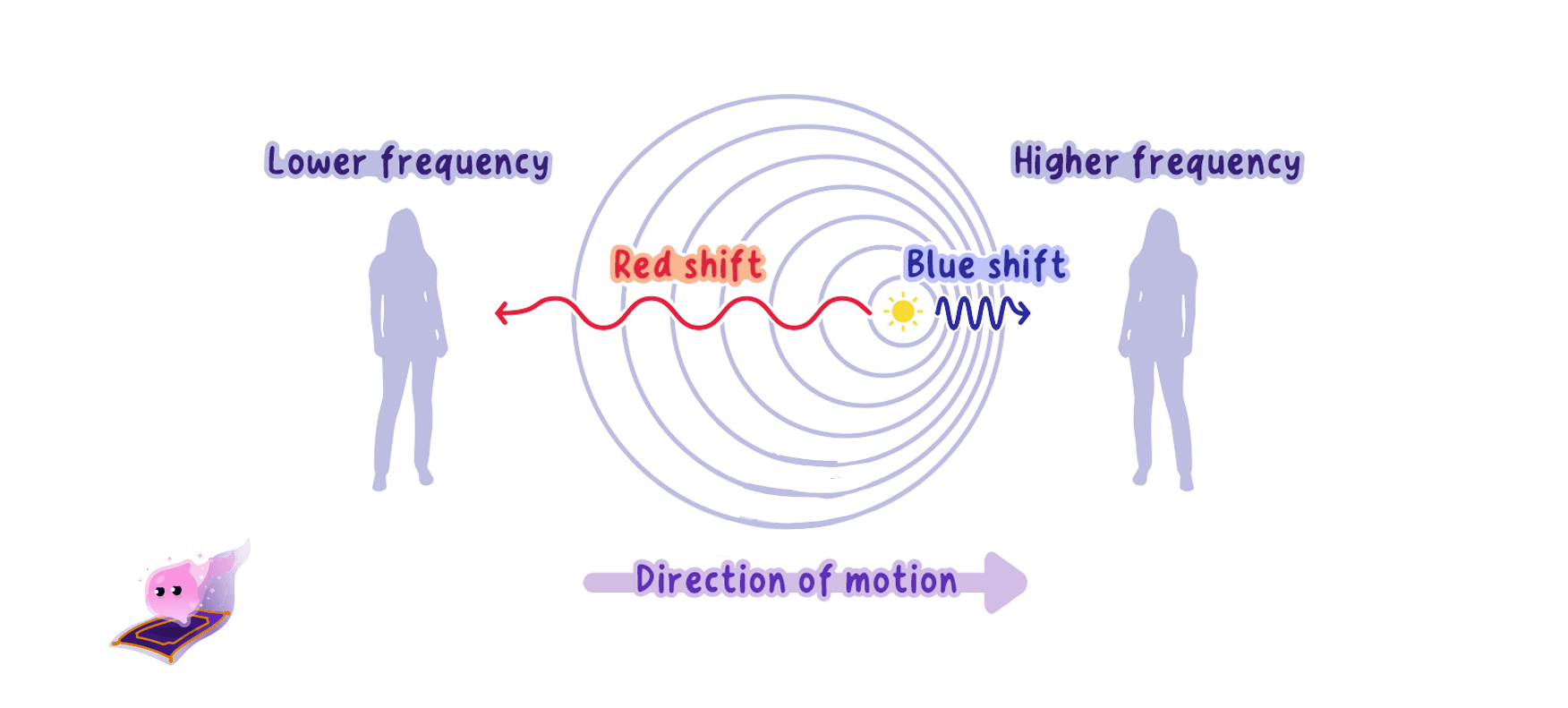
Red-shift is an increase in the observed wavelength of light from a receding galaxy; the bigger the red-shift, the faster the galaxy is moving away.
The universe is expanding
- Most distant galaxies show red-shift, so they are moving away from us.
- The further away a galaxy is, the faster it is receding.
- The faster a galaxy recedes, the bigger its observed red-shift.
- This pattern is evidence that space itself is expanding, so the distances between distant galaxies keep increasing.
- If galaxies were just moving at random, the most distant ones would not consistently be receding fastest, so the ordered pattern points to an expanding universe.
- Picture dots on a balloon: as it inflates every dot moves away from every other, and dots that start further apart separate fastest, which is how galaxies behave as space expands.
- The balloon is only a model; the universe is not expanding into a surrounding space the way a balloon expands into a room.
- Red-shift does not mean a galaxy turns red or that only red light reaches us; the whole pattern of wavelengths is shifted to longer values.
- Do not say Earth is at the centre of the expansion; observers in other galaxies would also see most galaxies receding from them.
Red-shift supports the Big Bang theory
Big Bang theory
The idea that the universe began from a very small region that was extremely hot and dense, and has been expanding ever since.
- Light from most distant galaxies is red-shifted.
- Red-shift shows these galaxies are receding.
- More distant galaxies recede faster and show a bigger red-shift.
- This relationship is evidence that the universe is expanding.
- If it is expanding now, it must have been smaller in the past.
- Following the expansion backwards supports the idea that the universe began from a very small, extremely hot and dense region, which is the Big Bang theory.
- Red-shift provides evidence for the Big Bang theory rather than proving it beyond all doubt.
Build the full chain rather than stopping at receding galaxies: increased wavelength →\rightarrow→ red-shift →\rightarrow→ galaxy receding →\rightarrow→ distant galaxies recede faster →\rightarrow→ expanding universe →\rightarrow→ universe was smaller in the past →\rightarrow→ support for the Big Bang theory.
- What is red-shift?
- What does the red-shift of a galaxy tell you about its motion?
- How does a galaxy's distance relate to its recession speed and red-shift?
- What does the distance-speed pattern tell us about the universe?
- How does red-shift support the Big Bang theory?
8.2.1b Supernovae and the unknown universe
Supernovae reveal that the expansion is accelerating
Supernova
The explosion of a star, which causes a sudden and very large increase in brightness.
- A supernova is the explosion of a star, giving a sudden, very large increase in brightness.
- Since 1998, observations of supernovae in distant galaxies have been used to study how the universe is expanding.
- The red-shift of a galaxy's light shows it is receding, and a bigger red-shift means a greater recession speed.
- The observed brightness of certain supernovae lets scientists estimate how far away their galaxies are.
- Comparing these distances with the galaxies' red-shifts gave a surprise: the distant galaxies are receding faster than expected.
- This is evidence that the expansion of the universe is accelerating, or speeding up.
Observations of distant supernovae suggest the universe is expanding at an increasing rate; this result was unexpected and is still not fully explained.
How scientists use observations to build theories
Scientific theory
An explanation that is supported by evidence and can be tested using observations or experiments.
- Scientists cannot directly observe the beginning of the universe, so they use present-day observations to build and test explanations.
- They collect evidence, such as red-shift measurements and supernova observations.
- They look for patterns in that evidence and propose a theory to explain them.
- The theory is used to make predictions, which are checked against further observations.
- The theory is then accepted, modified or rejected depending on how well it matches the evidence.
- For example, red-shift observations support the Big Bang theory, and the later supernova evidence for accelerating expansion made scientists develop their explanations further.
- A scientific theory is not just a guess; it is the best explanation that fits the evidence, and it can change when better evidence appears.
Dark mass and dark energy: what we do not yet know
Dark mass
Matter that cannot be observed directly but is inferred from its gravitational effects; it is also called dark matter.
Dark energy
The name given to an unknown effect that may be causing the accelerating expansion of the universe.
- There is still much about the universe that scientists do not understand, and two examples are dark mass and dark energy.
- Dark mass is proposed because some gravitational effects cannot be explained by the matter we can see.
- Dark energy is proposed because the supernova observations suggest the universe is expanding at an increasing rate.
- Scientists do not yet know what dark mass and dark energy really are, so they keep gathering evidence and testing possible explanations.
- Do not say a scientific theory is an unsupported guess; it must be based on evidence and be testable.
- Accelerating expansion does not mean one galaxy has been watched speeding up; it comes from comparing light emitted at different times in the universe's history.
- Dark energy is not one of the ordinary energy stores, and dark mass is not just normal matter that happens to be black.
- What do observations of distant supernovae suggest about the expansion of the universe?
- What are the main steps by which scientists use observations to build and test a theory?
- Why can a scientific theory change over time?
- What is dark mass, and how is its presence inferred?
- What is dark energy proposed to explain?
