6.2.2a Refraction and wavelength-dependent behaviour of EM waves (HT)
The same material treats different waves differently
Absorption
Absorption is when the energy carried by an electromagnetic wave is transferred to a material.
Transmission
Transmission is when an electromagnetic wave passes straight through a substance.
Reflection
Reflection is when an electromagnetic wave bounces off a boundary and stays in its original medium.
Refraction
Refraction is the change in direction of a wave at a boundary, caused by a change in its speed as it enters a different medium.
- A substance can absorb, transmit, reflect or refract an electromagnetic wave, and which of these happens can depend on the wave’s wavelength.
- So the same material may transmit one range of wavelengths while it absorbs or reflects another range.
- This is why a material should never be called simply “transparent” or “opaque” without saying which wavelength you mean: glass transmits visible light but absorbs much of the ultraviolet in sunlight.
One substance can interact differently with different parts of the spectrum because its absorption, transmission, reflection and refraction all vary with wavelength.
Refraction happens because the wave changes speed
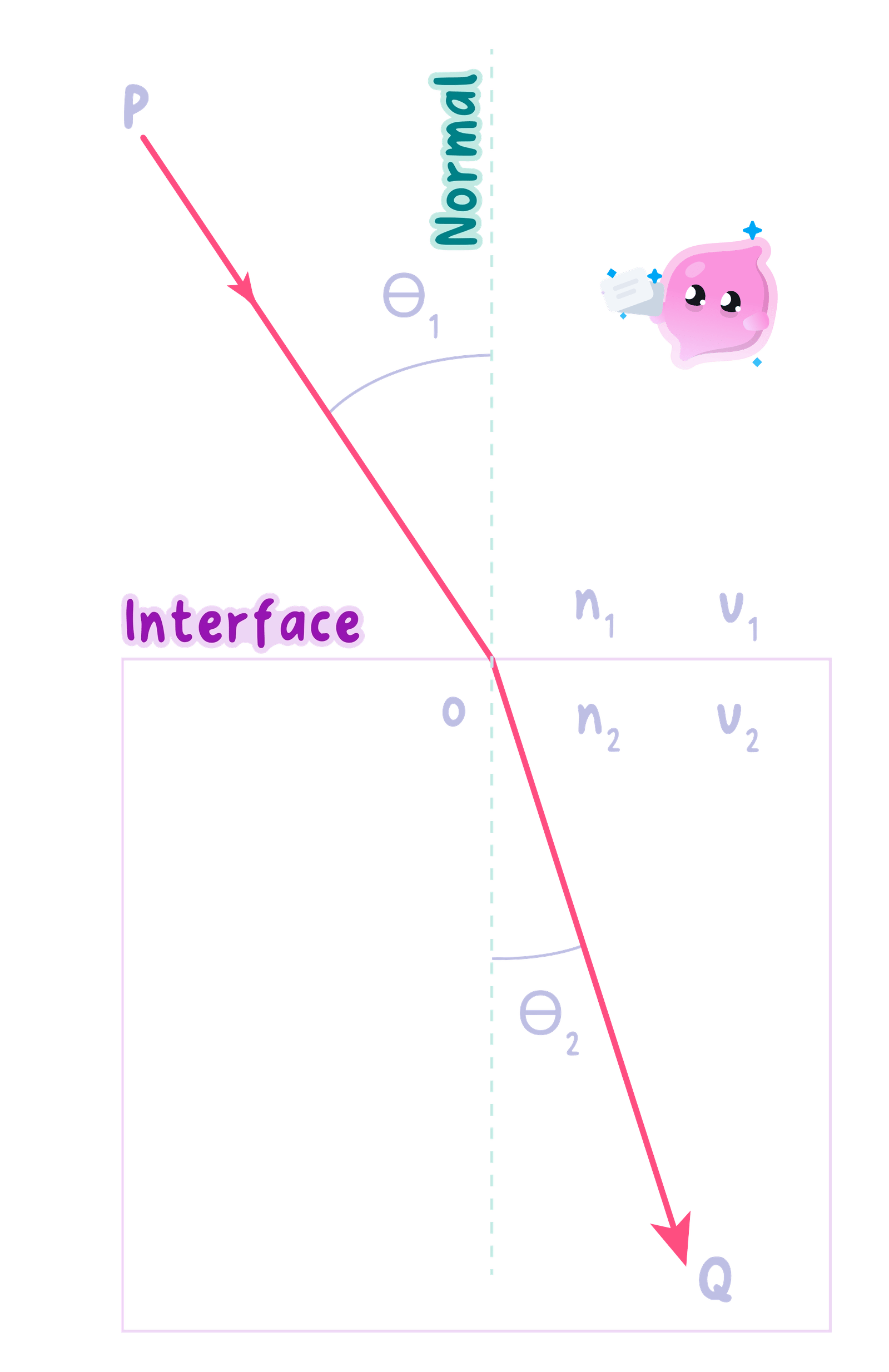
- An electromagnetic wave can travel at different speeds in different substances, so its speed may change as it crosses a boundary.
- The normal is an imaginary line drawn at 90∘90^\circ90∘ to the boundary at the point where the wave meets it.
- If the wave slows down, it bends towards the normal.
- If the wave speeds up, it bends away from the normal.
- If the wave meets the boundary along the normal, its speed still changes but its direction does not.
- The frequency of the wave does not change at a boundary.
- Because v=fλv = f\lambdav=fλ and the frequency fff is fixed, a change in speed vvv must be matched by a change in wavelength λ\lambdaλ.
- So when the wave slows down its wavelength decreases, and when it speeds up its wavelength increases.
Explaining refraction with wave fronts
Wave front
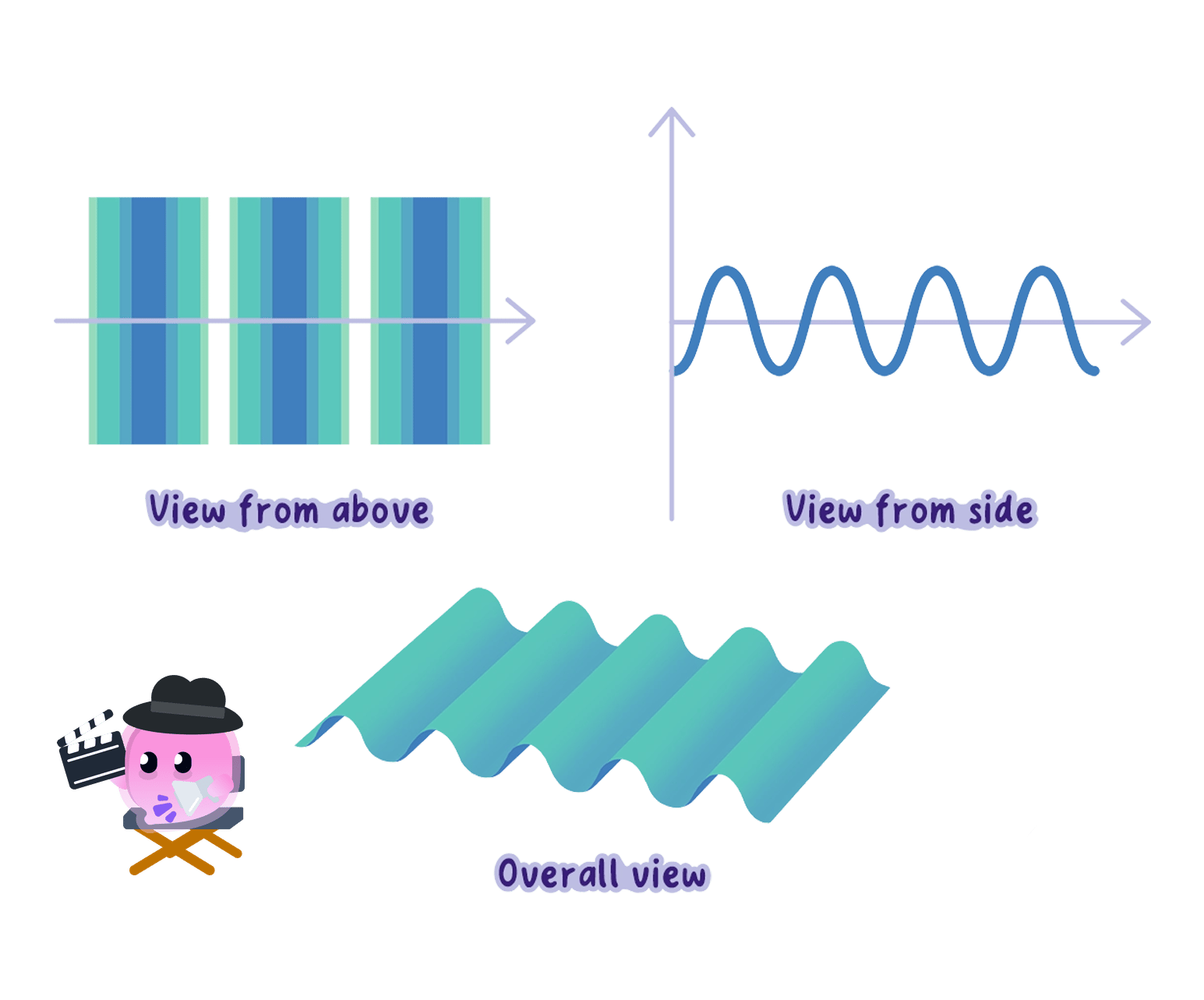
A wave front is a line joining points on a wave that are all at the same point in their oscillation, such as a line of crests.
- Wave fronts are drawn as a set of parallel lines; the spacing between them is the wavelength, and the wave travels at 90∘90^\circ90∘ to them.
- When a wave front reaches a slower medium at an angle, the end that crosses the boundary first slows down first.
- The rest of that wave front is still in the faster medium, so it keeps moving faster for a moment.
- This makes the wave front pivot, which turns the direction of travel towards the normal.
- Because the frequency is unchanged, the slower speed also pulls the wave fronts closer together, showing the shorter wavelength.
- Do not say a wave always bends towards the normal: it bends towards the normal only when it slows down, and away from the normal when it speeds up.
- A change in speed does not always mean a change in direction: a wave entering along the normal changes speed and wavelength but keeps going straight.
- The frequency never changes at the boundary; it is the wavelength that changes with the speed.
For a wave-front explanation, link the steps in a clear chain:
- One end of the wave front enters the new medium first.
- That end changes speed first.
- The wave front pivots.
- The direction bends towards or away from the normal.
If asked about spacing, add that frequency is constant and use v=fλv = f\lambdav=fλ.
- Name the four ways a substance can interact with an electromagnetic wave.
- Why can one material transmit one wavelength but absorb another?
- What physical change at a boundary causes refraction?
- Which way does a wave bend when it enters a slower medium at an angle?
- Using v=fλv = f\lambdav=fλ, explain why the wavelength shortens when a wave slows down.
6.2.2b Refraction ray diagrams and infrared radiation (required practical)
Drawing refraction: bend at the boundary, measure from the normal
Refraction
Refraction is the change in direction of a wave as it crosses a boundary between two media, because the wave changes speed.
- When light passes from air into glass at an angle, it changes speed and so changes direction.
- If the wave slows down, it bends towards the normal.
- If the wave speeds up, it bends away from the normal.
- If the wave travels along the normal, its speed changes but its direction does not.
- The normal is a line drawn at 90∘90^\circ90∘ to the boundary at the point where the ray meets it.
Constructing a refraction ray diagram
- Draw the boundary between the two media, and mark the point where the ray meets it.
- Draw a dashed normal at 90∘90^\circ90∘ to the boundary at that point.
- Draw the incident ray approaching the boundary, with an arrow showing its direction.
- Draw the refracted ray leaving the boundary, also with a direction arrow.
- If the wave slows down, draw the refracted ray closer to the normal; if it speeds up, draw it further from the normal.
- Measure the angle of incidence and angle of refraction from the normal, never from the boundary.
- Angles of incidence and refraction are measured from the normal, not from the surface.
- “Towards the normal” does not mean along the normal: the ray just makes a smaller angle with it.
Infrared and surfaces: dark and matt wins both ways
- All objects absorb and emit infrared radiation, and the amount depends on the nature of the surface.
- Dark, matt surfaces are the best absorbers and the best emitters of infrared radiation.
- Light, shiny surfaces are poor absorbers and poor emitters, and are good reflectors of infrared radiation.

- A good absorber is always a good emitter, so a matt black surface both soaks up and radiates infrared most readily.
Investigation: comparing the infrared radiated by different surfaces
You fill a Leslie cube with hot water so its four differently finished faces are all at the same temperature, then use an infrared detector the same distance from each face to compare how much infrared radiation each surface emits.
- Stand the Leslie cube on a heatproof mat; it is a sealed metal cube whose four vertical faces are finished matt black, shiny black, matt white and shiny silver.
- Boil a kettle and fill the cube with very hot water, then fit the lid so that all four faces are heated equally to the same starting temperature.
- Set up an infrared detector facing one face, a fixed short distance away (for example a few centimetres), and note the reading; the detector may be an infrared thermopile with a meter, an infrared thermometer, or a thermometer with a matt-black-painted bulb.
- Record the detector reading for the matt black face.
- Turn the cube (or move the detector) to face the next surface, keeping the same distance and same angle, and record its reading.
- Repeat for all four faces: matt black, shiny black, matt white and shiny silver.
- Work quickly so the water temperature barely falls, then take a second full set of readings and find a mean for each surface to spot and reject any anomalies.
- The independent variable is the type of surface; the dependent variable is the detector reading; the control variables are the water temperature, the distance and angle of the detector, and the area of surface measured.
- The matt black face gives the highest reading because it is the best emitter, and the shiny silver face gives the lowest reading because it is the poorest emitter.
- Hot water and hot metal can scald, so handle the filled cube with care and let it cool before emptying it.
- For a ray diagram, always include the boundary, a dashed normal, arrowheads and the correct bending direction.
- For the practical, state the independent, dependent and control variables, include repeats and a mean, and link the result to which surface is the best emitter or absorber.
- What causes refraction at a boundary?
- From which line are angles of incidence and refraction measured?
- Which surfaces are the best absorbers and emitters of infrared radiation?
- In the Leslie cube investigation, what are the independent, dependent and control variables?
- Which face of the Leslie cube gives the highest detector reading, and why?
