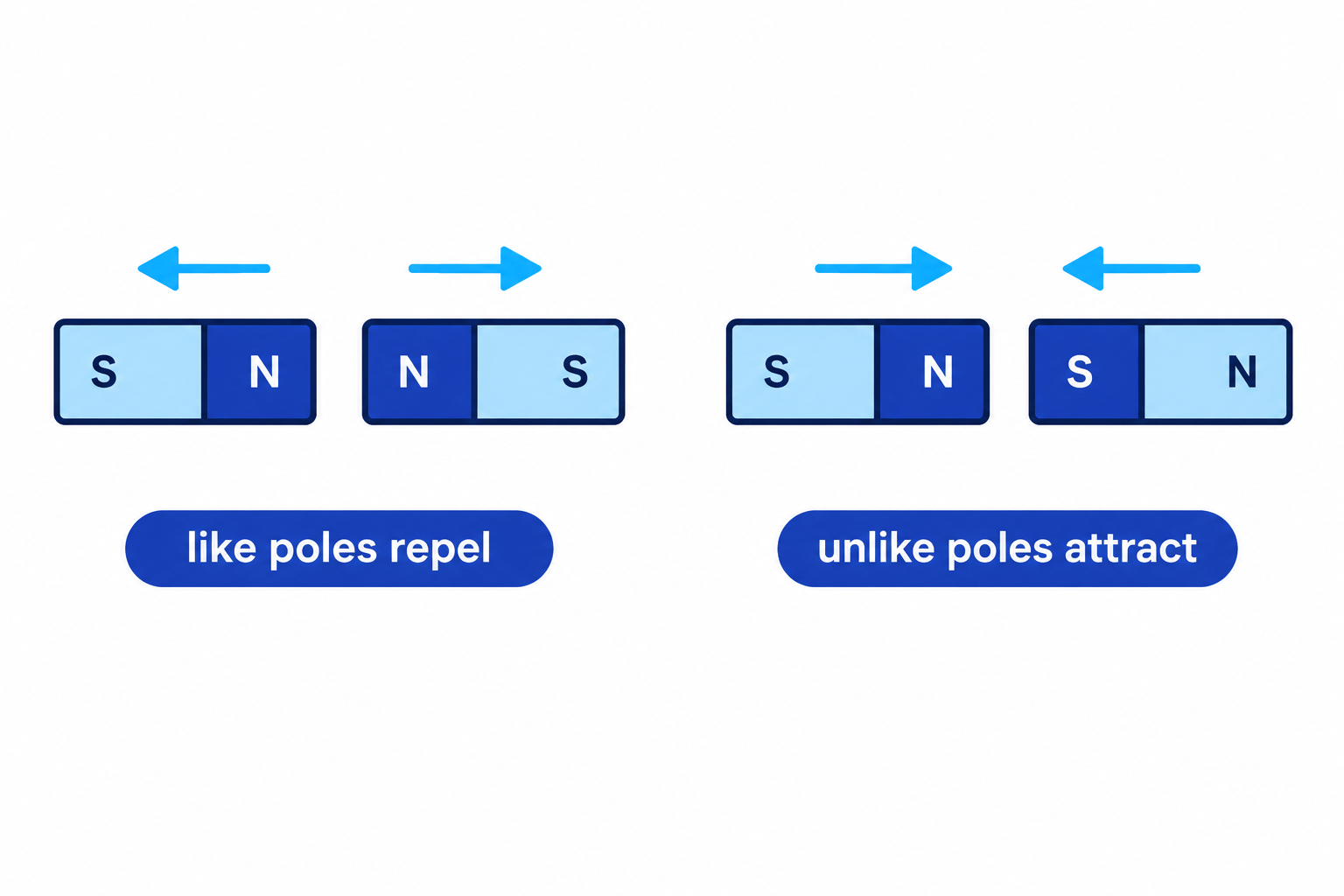
The poles of a magnet
Definition
Magnetic pole
A magnetic pole is a place on a magnet where the magnetic forces are strongest.
- Every magnet has two poles: a north pole and a south pole.
- Two like poles repel, so a north pole pushes away another north pole, and a south pole pushes away another south pole.
- Two unlike poles attract, so a north pole and a south pole pull towards each other.
Key Idea
The rule to remember is: like poles repel; unlike poles attract.
Magnetic forces are non-contact forces
Definition
Non-contact force
A non-contact force is a force that acts between objects that are not touching.
- Attraction and repulsion between magnetic poles are examples of non-contact forces, because each magnet exerts a force on the other across a gap.
- The direction of the force depends on which poles face each other, so two north poles placed close together move apart because like poles repel.
Permanent magnets
Definition
Permanent magnet
A permanent magnet is a magnet that produces its own magnetic field.
- A permanent magnet can attract or repel another permanent magnet, depending on the poles that face each other.
- Like poles produce a repulsive force.
- Unlike poles produce an attractive force.
- A permanent magnet stays magnetic without being placed in another magnetic field.
Induced magnets
Definition
Induced magnet
An induced magnet is a material that becomes a magnet when it is placed in a magnetic field.
- When a magnetic material is placed near a permanent magnet, the permanent magnet's field makes it magnetic, and this is called induced magnetism.
- Induced magnetism always causes a force of attraction, so an induced magnet is attracted to the magnet that caused it and never repelled by it.
- When an induced magnet is removed from the field, it loses most or all of its magnetism quickly.
Comparing permanent and induced magnets
- A permanent magnet produces its own magnetic field and stays magnetic.
- An induced magnet becomes magnetic only while it is in a magnetic field.
- An induced magnet loses most or all of its magnetism quickly once removed from the field.
- Two permanent magnets can attract or repel, depending on the poles that face each other.
- Induced magnetism always causes attraction.
Common Mistake
- Do not say every pair of magnets attracts, because two permanent magnets repel when like poles face each other.
- A permanent magnet and the induced magnet it produces always attract.
- Do not call magnetic attraction and repulsion contact forces, because they act across a gap and are non-contact forces.
Exam technique
- When comparing permanent and induced magnets, say what happens both inside and after leaving a magnetic field.
- For a pole question, state the pole relationship and the resulting force, for example: the north poles are like poles, so they repel.
Self review
- Where are the magnetic forces on a magnet strongest?
- What happens when two like poles are brought together?
- What happens when two unlike poles are brought together?
- Why are magnetic attraction and repulsion non-contact forces?
- What is the difference between a permanent magnet and an induced magnet?
- What happens to an induced magnet when it is removed from the magnetic field?