6.3.2a Black body radiation and temperature
All bodies emit radiation, and temperature sets what they emit
Definition
Thermal radiation
Thermal radiation is energy emitted by an object as electromagnetic waves because of its temperature.
- All bodies emit radiation, including objects that do not feel hot or glow, such as a person, a table or the walls of a room.
- At everyday temperatures most of this radiation is infrared, so the eye cannot see it, yet it still transfers energy away from the object.
- An object does not have to be luminous, burning or radioactive to emit thermal radiation.
Higher temperature means greater intensity
Definition
Intensity
Intensity describes how much energy the radiation transfers in a given time over a given area.
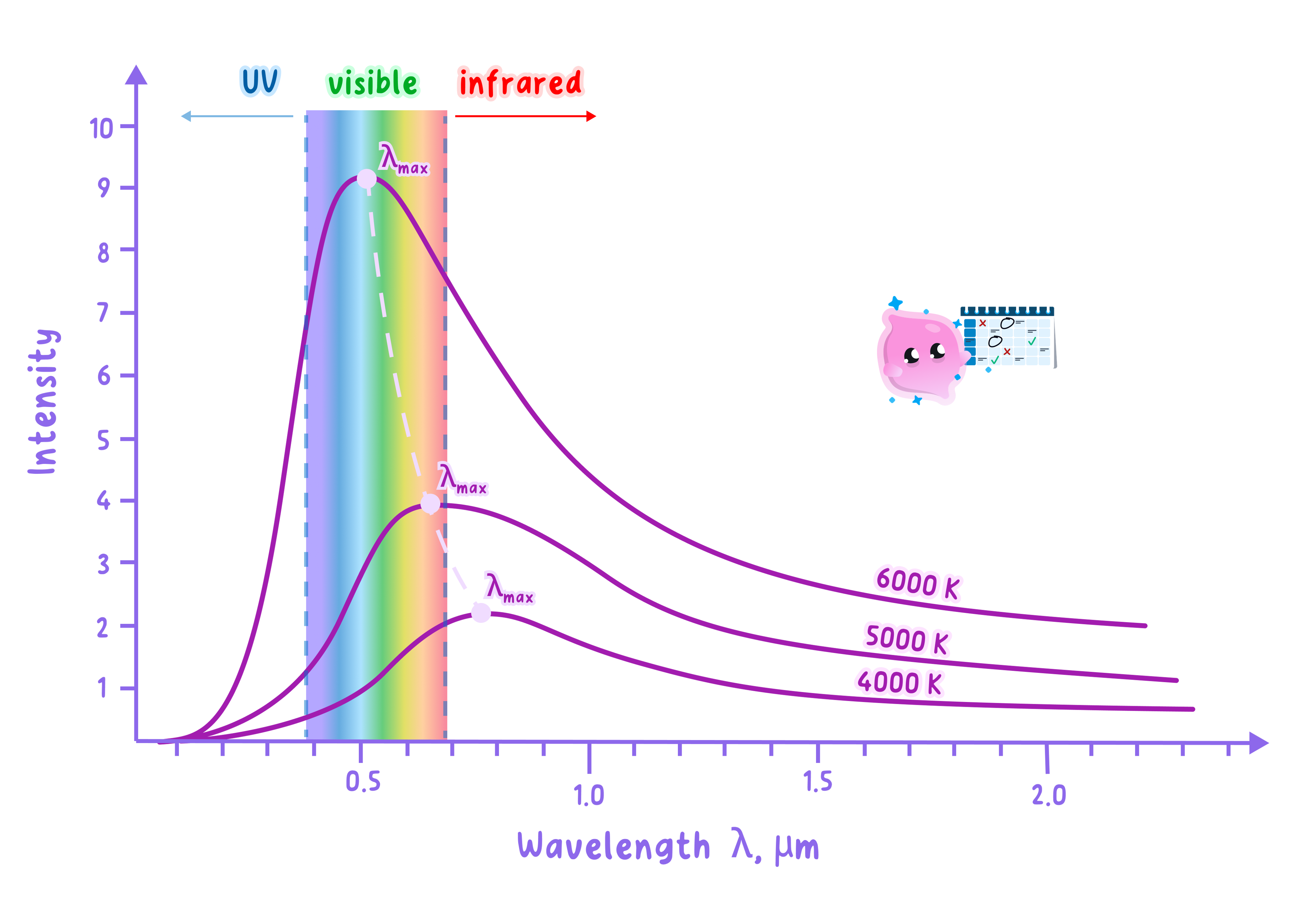
- As a body’s temperature rises, the intensity of the radiation it emits increases, so a hotter body emits more energy as radiation than the same body when cooler.
- On a graph of intensity against wavelength, a higher temperature makes the curve higher, and the larger area beneath it represents more radiation emitted in total.
Higher temperature shifts the peak to shorter wavelengths
Definition
Wavelength distribution
The wavelength distribution shows how the intensity of the emitted radiation varies across different wavelengths.
- A body emits a range of wavelengths, not one; the wavelength emitted most intensely is the peak wavelength.
- As the temperature increases, the intensity rises, the peak of the distribution gets higher, and the peak moves towards shorter wavelengths.
- So a cooler body has a lower, longer-wavelength peak and a hotter body a higher, shorter-wavelength peak.
- This is why a very hot object begins to glow: as it heats, more of its radiation is emitted at shorter, visible wavelengths.
Common Mistake
- Do not confuse thermal radiation with radioactive radiation: an object need not contain radioactive material to emit it.
- Do not say cool objects emit no radiation: they still emit it, at lower intensity with a longer peak wavelength.
Exam technique
For a change in temperature, give both required changes:
- the intensity increases
- the peak of the wavelength distribution moves to a shorter wavelength
On a graph, describe the hotter curve as higher with its peak further to the short-wavelength side; do not just write "more heat".
Self review
- Which objects emit thermal radiation?
- What happens to the intensity of emitted radiation as temperature rises?
- What does the wavelength distribution show?
- Which way does the peak wavelength move as a body gets hotter?
- Why does a very hot object begin to glow?
6.3.2b Temperature balance and the temperature of the Earth (HT)
Constant temperature means radiation in balances radiation out
Definition
Constant temperature by radiation balance
A body is at constant temperature when it absorbs radiation at the same rate as it emits radiation.
- The key word is rate: if the energy arriving each second equals the energy leaving each second, the body’s thermal energy does not change, so its temperature stays the same.
- This does not mean no radiation is transferred; it means the absorption and emission are balanced.
- A person sitting in a room both absorbs infrared from the surroundings and emits infrared; if their temperature is steady, the two rates are balanced.
An unbalanced rate changes the temperature
- A body’s temperature rises when it absorbs radiation faster than it emits it, so it gains energy overall.
- A body’s temperature falls when it emits radiation faster than it absorbs it, so it loses energy overall.
- Standing near a fire, you absorb infrared faster than you emit it, so you warm up; a hot mug emits faster than it absorbs from a cooler room, so it cools until the rates balance.
The temperature of the Earth is a radiation balance
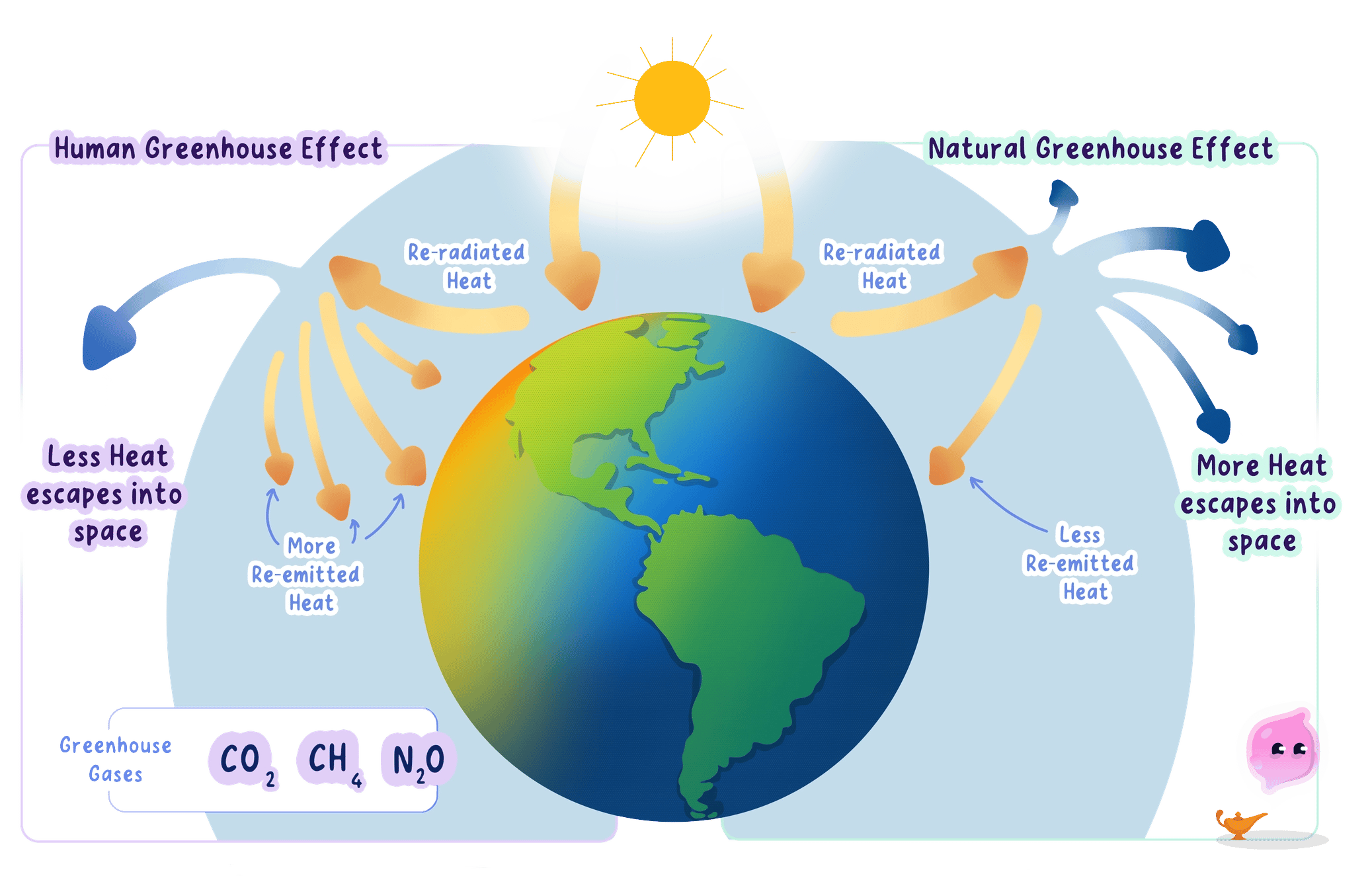
- The Earth’s temperature depends on the rate radiation from the Sun is absorbed, the rate the Earth emits radiation, and the amount reflected back into space.
- Radiation from the Sun reaches Earth; some is absorbed by the surface and atmosphere, transferring energy, and some is reflected back into space and so transfers no energy to Earth.
- The Earth also emits radiation into space, and its temperature depends on the balance between incoming radiation absorbed and outgoing radiation emitted.
- If the Earth absorbs faster than it emits, its temperature rises; if it emits faster than it absorbs, its temperature falls; if the rates are equal, its average temperature stays constant.
Common Mistake
- Do not say an object only emits radiation when hot: all bodies emit, and it is the balance of absorption and emission that changes temperature.
- Do not count reflected radiation as absorbed: reflected radiation returns to space and transfers no energy to the Earth.
Exam technique
Answer as a comparison of rates:
- identify the radiation absorbed
- identify the radiation emitted or reflected
- compare the rate absorbed with the rate emitted
- state the effect on temperature
Self review
- What is true of absorption and emission when a body is at constant temperature?
- What happens to temperature if a body absorbs radiation faster than it emits it?
- On what three things does the Earth’s temperature depend?
- Why does reflected solar radiation not raise the Earth’s temperature?
- From a radiation-balance diagram, how do you decide whether the temperature rises?
