7.1.2a Magnetic fields and field lines
Magnetic fields
Definition
Magnetic field
A magnetic field is the region around a magnet where a force acts on another magnet or on a magnetic material.
- A magnetic field cannot be seen, but its effects can, for example a magnet attracting a piece of iron without touching it because the iron is inside the field.
- The magnetic materials you need to know are iron, steel, cobalt and nickel.
- A magnetic field can exert a force on another magnet or on any of these magnetic materials.
Forces on magnetic materials
- The force between a magnet and a magnetic material is always attraction, so both the north pole and the south pole attract an unmagnetised iron nail.
- This is different from two magnets, which can attract or repel depending on the poles, while a magnet and a magnetic material always attract.
Common Mistake
- Do not say a magnet repels iron, steel, cobalt or nickel, because the force between a magnet and a magnetic material is always attractive.
- Repulsion happens between two magnets, not between a magnet and an unmagnetised magnetic material.
Magnetic field strength
- The strength of a magnetic field depends on the distance from the magnet.
- The field is stronger closer to the magnet and weaker further away.
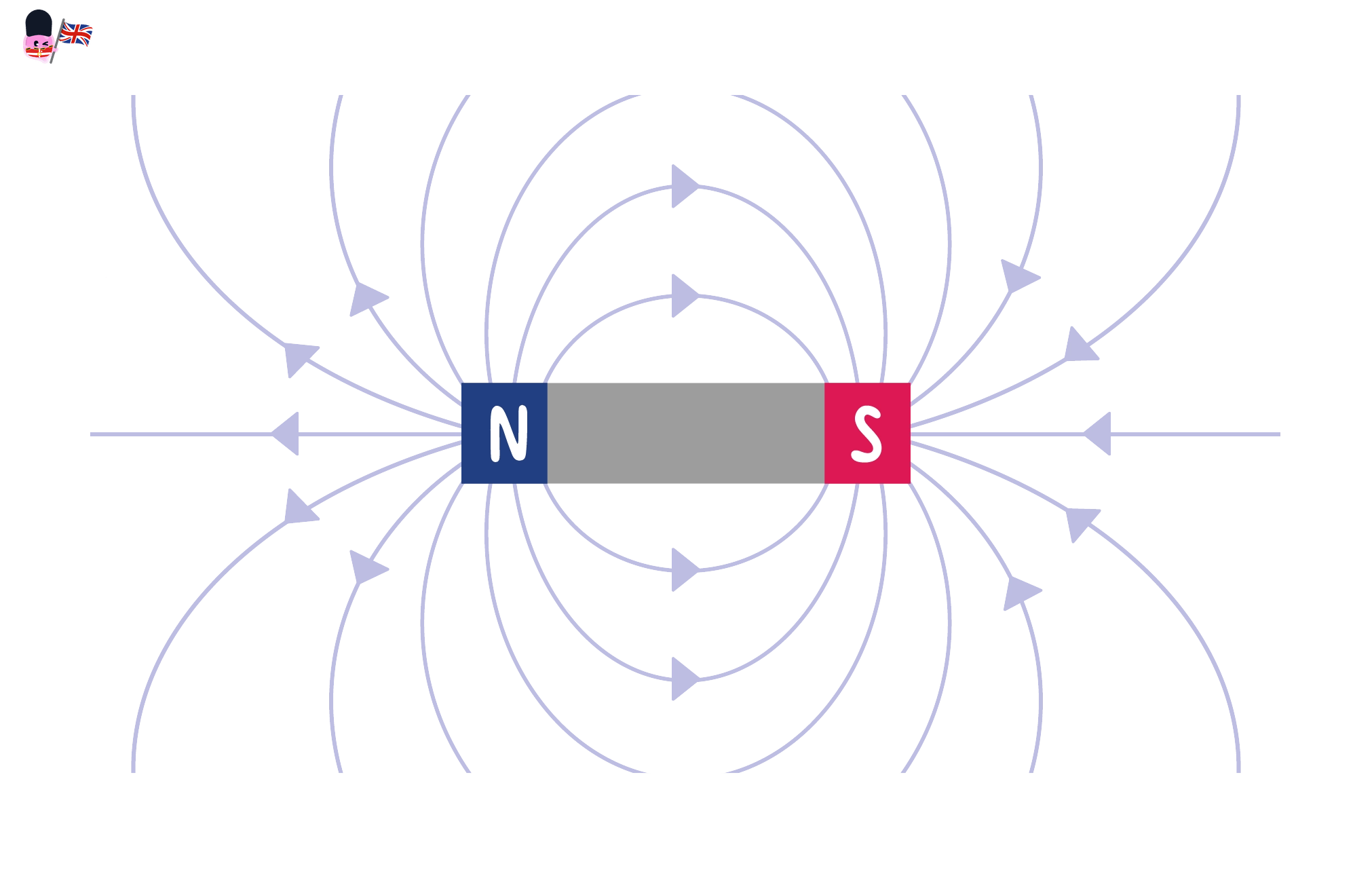
- The field is strongest at the poles, which are the two ends of the magnet.
- The force on another magnet or magnetic material is therefore greatest near the poles and weaker further away.
- On a field-line diagram, the lines are closest together where the field is strongest, usually near the poles.
Magnetic field direction and field lines
Definition
Direction of a magnetic field
The direction of a magnetic field at a point is the direction of the force that would act on a north pole placed at that point.
- Magnetic field lines show the shape and direction of a magnetic field, with arrows to show the direction.
- Outside a magnet, field lines point away from the north pole and towards the south pole.
- The field direction is therefore from the north pole to the south pole.
- The direction is always defined using a north pole, because a south pole at the same point would feel a force in the opposite direction.
Exam technique
- Give the field direction as the direction of the force on a north pole.
- State that field lines run from north to south outside the magnet.
- For strength, say the field is strongest at the poles and weakens with distance, rather than just writing it is strong near the magnet.
Self review
- What is a magnetic field?
- Which four magnetic materials must you know?
- Is the force between a magnet and a magnetic material attractive or repulsive?
- Where is a magnet's magnetic field strongest?
- How does magnetic field strength change with distance from a magnet?
- Which way do magnetic field lines point outside a magnet?
7.1.2b Compasses and the Earth's magnetic field
A compass contains a small bar magnet
Definition
Magnetic field
A magnetic field is the region around a magnet where a magnetic material or another magnet experiences a force.
- A magnetic compass contains a small bar magnet, called the compass needle, that is free to turn.
- Like any bar magnet, the needle has a north-seeking pole and a south-seeking pole.
- The needle turns because it feels a force from a magnetic field, and its north-seeking end points in the direction of the field at that point.
Key Idea
The direction of a magnetic field is the direction a north pole would move, so a compass shows the field direction.
The Earth has a magnetic field
- The Earth has a magnetic field around it, so a compass needle lines up with it even when there are no magnets nearby.
- A compass needle usually points approximately north-south, with its north-seeking end pointing towards the Earth's magnetic north.
- This is evidence that the Earth produces a magnetic field, and because the field comes from inside the Earth, it is evidence that the core must be magnetic.
Common Mistake
- Do not say the needle points north because it is pulled by the North Pole.
- The key idea is that the compass needle is a small magnet that lines up with the Earth's magnetic field.
Plotting a magnetic field pattern using a compass
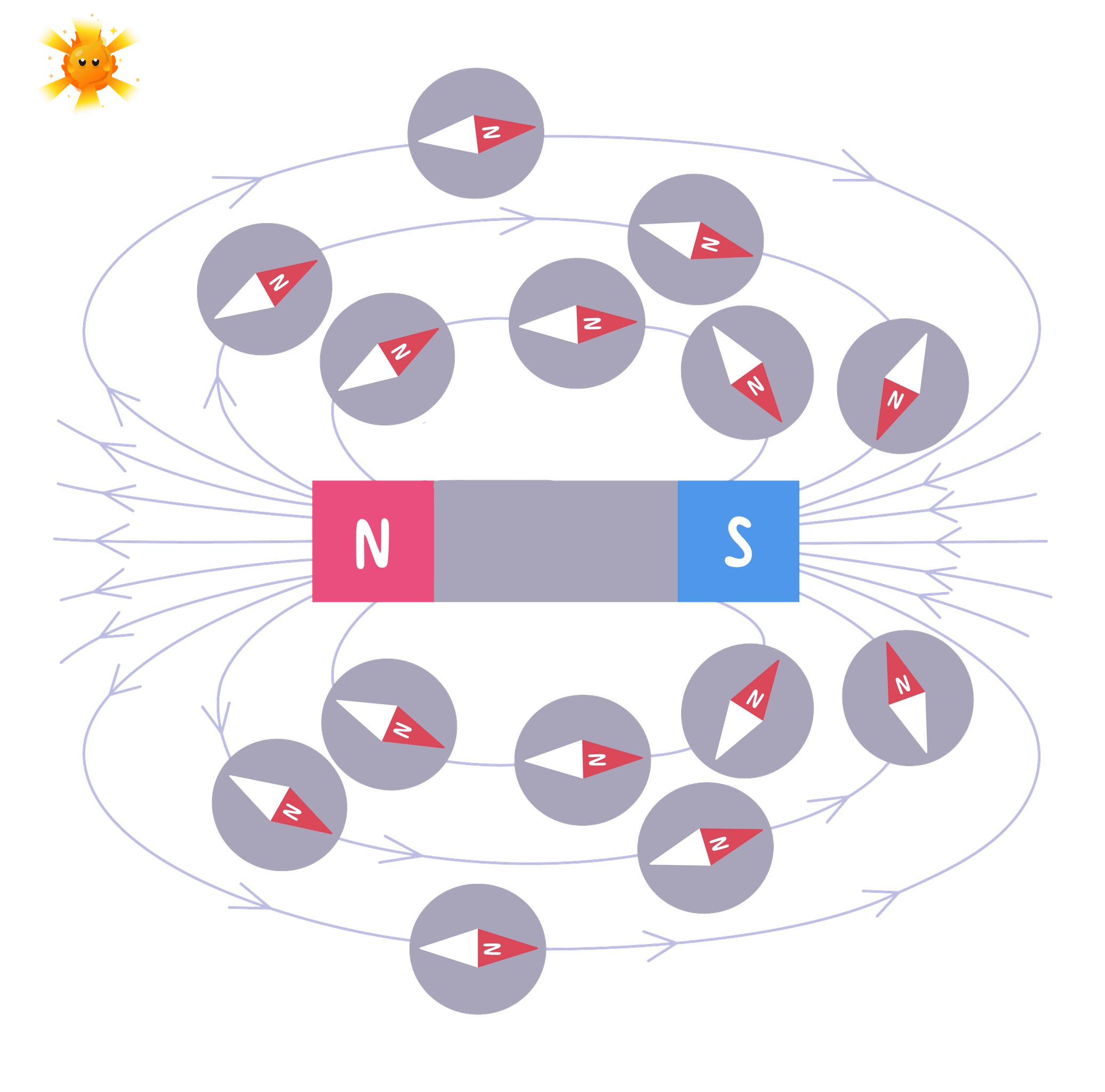
- Place the bar magnet on a sheet of paper and draw around it to mark its position.
- Place a plotting compass near one pole of the magnet.
- Mark the direction shown by the needle with a small dot or arrow.
- Move the compass so the tail of the needle starts at the point just marked, then mark the new direction.
- Repeat several times to trace out one field line.
- Start at different points around the magnet and repeat to build up the full field pattern.
- Add arrows to the field lines to show the direction of the field.
- The needle changes direction from place to place because the direction of the field changes around the magnet.
Drawing the field pattern of a bar magnet
- Outside the magnet, the field lines go from the north pole to the south pole, with arrows showing the direction.
- The field is strongest near the poles, shown by field lines being closer together there.
- The field is weaker further away, where the field lines are more spread out.
- Field lines never cross, because the field can only have one direction at each point.
Compasses as evidence for the Earth's magnetic core
- A compass needle is a small magnet, so it only settles in a fixed direction if a magnetic field acts on it.
- It lines up in a consistent north-south direction almost anywhere on Earth, even when no magnet is nearby.
- This shows the Earth produces a magnetic field, which is evidence that the Earth's core must be magnetic.
Self review
- What does a compass contain, and how is it able to turn?
- In which direction does a compass needle point?
- Why does a compass usually point approximately north-south?
- Describe how to plot the magnetic field pattern of a bar magnet using a compass.
- Which way do field lines point around a bar magnet, and where are they closest together?
- How is the behaviour of a compass evidence that the Earth's core is magnetic?
