Skip to content
MathsGenie logo
Open app

Course home

  1. GCSE
  2. Physics AQA
  3. Revision guides

4.4.2 Nuclear fusion

Fusion joins two light nuclei into a heavier one

Definition

Nuclear fusion

The joining of two light nuclei to form a heavier nucleus, in which some mass is converted into the energy of radiation.

  1. Nuclear fusion is when two light nuclei join together to form a single heavier nucleus.
  2. It is the opposite of fission, which splits one heavy nucleus into smaller pieces.
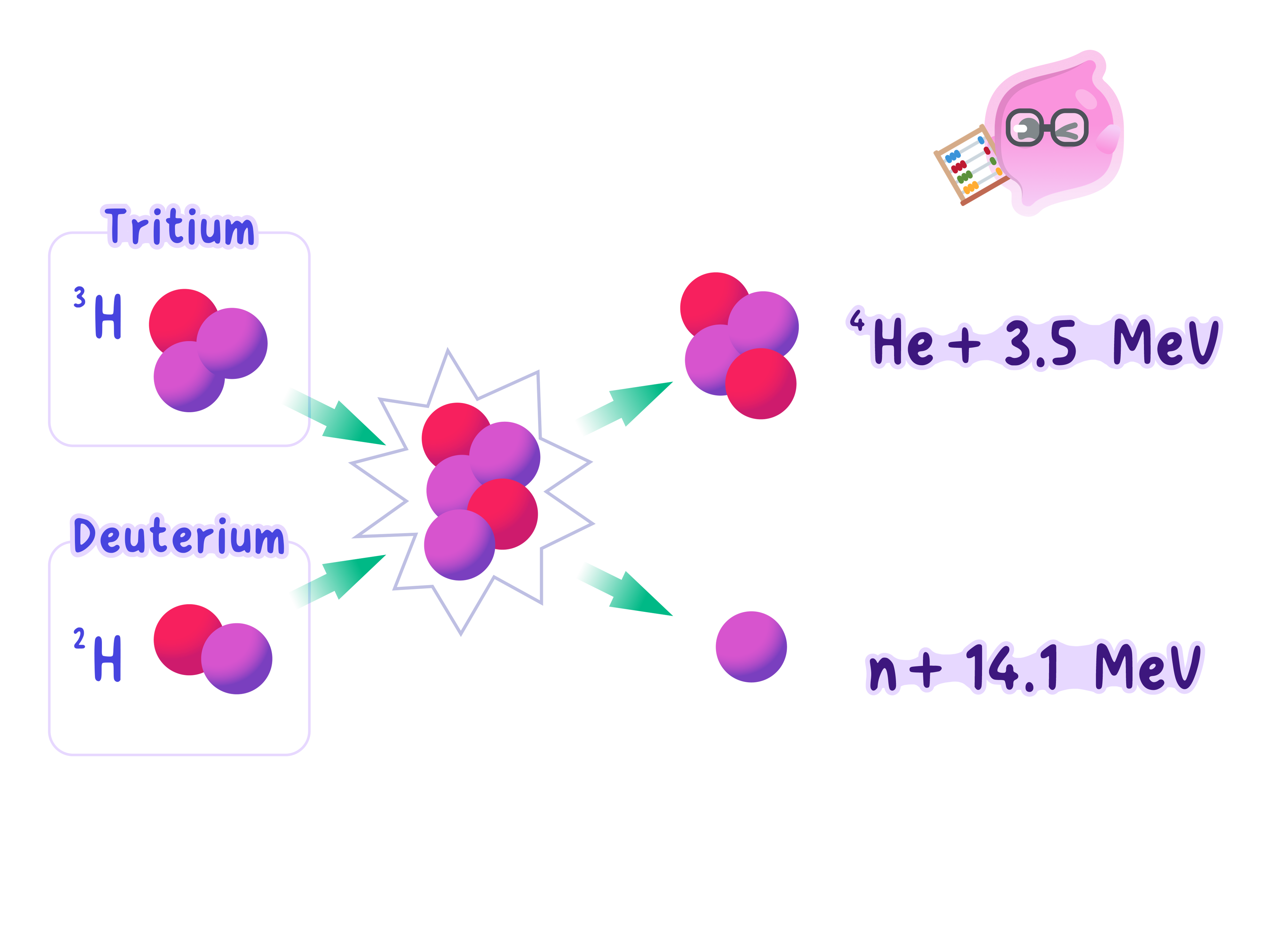
A diagram showing nuclear fusion: a deuterium nucleus (one proton, one neutron) and a tritium nucleus (one proton, two neutrons) join to form a helium-4 nucleus (two protons, two neutrons) and a single neutron, releasing energy (3.5 MeV and 14.1 MeV).

Some of the mass is converted into the energy of radiation

  1. In fusion some of the mass of the original nuclei is converted into energy.
  2. This energy is released as radiation.
  3. Fusion needs extremely high temperatures and pressures, because the two positively charged nuclei repel each other and must be forced very close together.
Note
  • Fusion is the process that releases energy in the Sun and other stars.
Common Mistake
  • Do not mix up fusion and fission: fusion joins two light nuclei, while fission splits one heavy nucleus.
Self review
  • What is nuclear fusion?
  • What happens to some of the mass of the nuclei during fusion?
  • In what form is the energy released during fusion?
  • Why does fusion need very high temperatures and pressures?
  • How is fusion different from fission?
PreviousNext

How was this guide?

Teach Genie

Review 4.4.2 Nuclear fusion by teaching Genie

Teach it back in your own words, spot gaps, and remember it better.

Start teaching
Genie and Baby Genie

Lesson

Recap your knowledge with an interactive lesson

8 minute activity

Start lesson

Nuclear fusion is the joining of two light nuclei to form one heavier nucleus. The mass of the products is slightly less than the original mass of the reactants. This mass defect is converted into released energy, mainly the kinetic energy of the reaction products, which can later be converted into thermal energy.

Fusion is the opposite of nuclear fission. Fusion joins light nuclei, whereas fission splits one heavy nucleus into smaller nuclei.

Fusion occurs naturally in the Sun and other stars, where extremely high temperatures and pressures allow nuclei to get very close together.

Flashcards

Remember key concepts with flashcards

20 flashcards

Practice flashcards

What determines which element an atom is?

4.4.2 Nuclear fusion Revision Guide

  1. GCSE
  2. /Physics
  3. /4.4.2 Nuclear fusion

Revision notes for AQA GCSE Physics 4.4.2 Nuclear fusion. Open the guide for explanations and worked examples. Written against the AQA GCSE Physics (8463) specification, so the content matches what's examinable rather than general Physics background.

Revision guides
