Fission splits a large unstable nucleus into two smaller ones
Definition
Nuclear fission
The splitting of a large, unstable nucleus, such as uranium or plutonium, into two smaller nuclei, releasing energy.
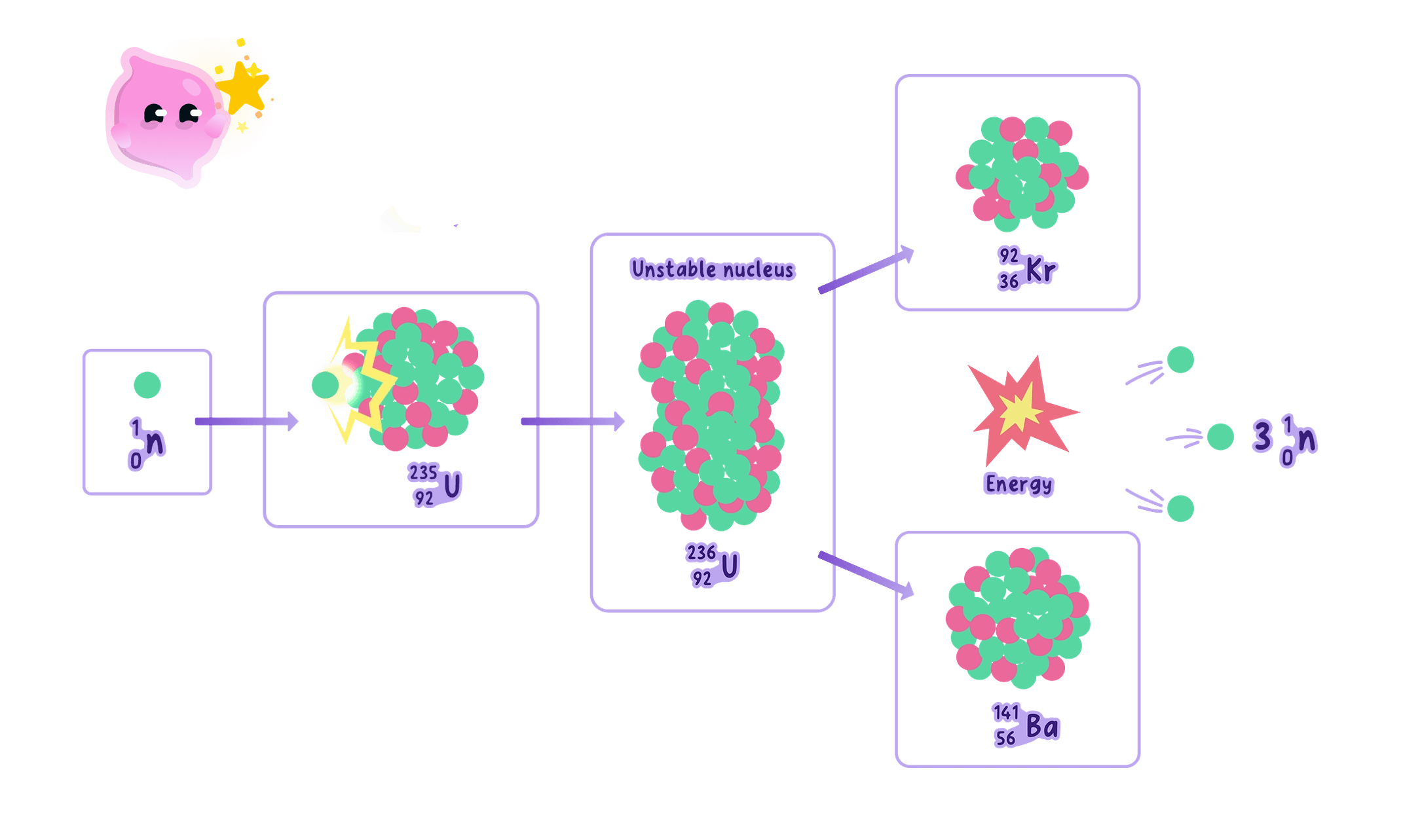
- Nuclear fission is the splitting of a large, unstable nucleus such as uranium-235 or plutonium-239.
- Spontaneous fission is rare, so usually the nucleus must first absorb a neutron before it will split.
Fission releases neutrons, gamma rays and energy
- The nucleus splits into two smaller nuclei that are roughly equal in size.
- It also emits two or three neutrons together with gamma rays.
- Energy is released, and all of the fission products are given kinetic energy.
A chain reaction: one fission sets off the next
Definition
Chain reaction
A reaction in which the neutrons released by one fission go on to cause fission in further nuclei.
- The neutrons that are released can be absorbed by other large nuclei, making them split as well.
- This is a chain reaction, and it can build up very quickly because each fission releases more neutrons.
Controlled in a reactor, uncontrolled in a weapon
- In a nuclear reactor the chain reaction is controlled so the energy is released steadily and safely.
- In a nuclear weapon the chain reaction is uncontrolled, releasing an enormous amount of energy all at once in an explosion.
Key Idea
- A large nucleus absorbs a neutron and splits into two smaller nuclei.
- Two or three neutrons and gamma rays are emitted, and energy is released.
- Those neutrons can cause further fissions, giving a chain reaction.
Self review
- What is nuclear fission?
- What usually has to happen before a nucleus will undergo fission?
- What is released when a nucleus undergoes fission?
- What is a chain reaction?
- How is the chain reaction different in a nuclear reactor and a nuclear weapon?
