5.6.2c Newton's Second Law
Newton’s second law
Newton’s second law
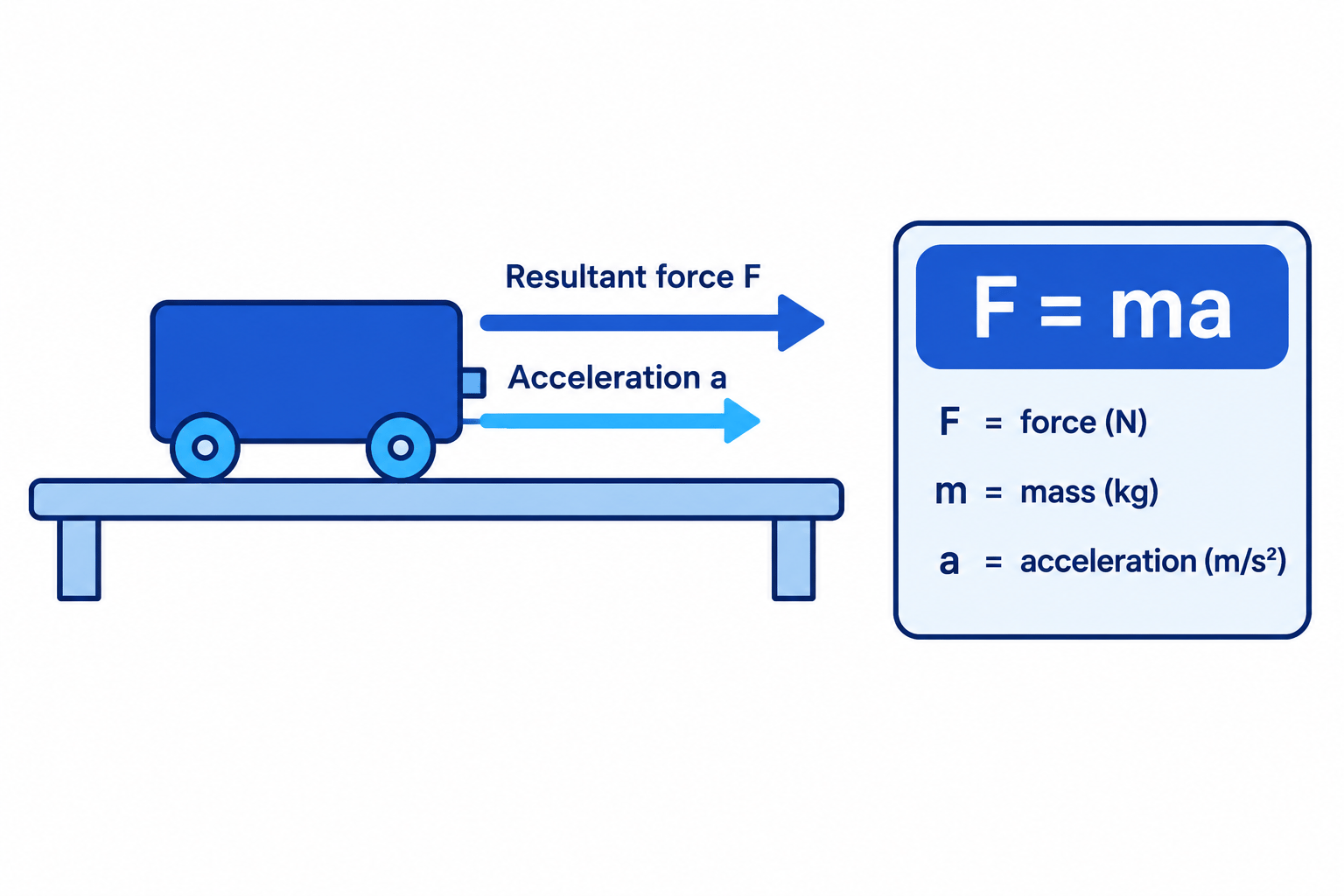
The acceleration of an object is proportional to the resultant force acting on it and inversely proportional to its mass.
- The equation is F=maF = maF=ma.
- FFF is the resultant force in newtons (N\text{N}N).
- mmm is the mass in kilograms (kg\text{kg}kg).
- aaa is the acceleration in m/s2\text{m/s}^2m/s2.
- The resultant force is the overall force after all the forces on the object are combined, and the object accelerates in its direction.
- At constant mass, increasing the resultant force increases the acceleration by the same factor: doubling the force doubles the acceleration.
- At constant force, increasing the mass decreases the acceleration, because a larger mass is harder to accelerate: doubling the mass halves the acceleration.
- Rearranged, the equation gives a=Fma = \dfrac{F}{m}a=mF and m=Fam = \dfrac{F}{a}m=aF.
A car has a mass of 1200 kg1200\ \text{kg}1200 kg and accelerates at 2.5 m/s22.5\ \text{m/s}^22.5 m/s2. Calculate the resultant force on the car.
- Write the equation: F=maF = maF=ma.
- Substitute the values: F=1200 kg×2.5 m/s2F = 1200\ \text{kg} \times 2.5\ \text{m/s}^2F=1200 kg×2.5 m/s2.
- Calculate the force: F=3000 NF = 3000\ \text{N}F=3000 N.
Estimating forces in road transport
- You should be able to estimate the speeds, accelerations and forces when road vehicles accelerate rapidly; estimates need sensible values rather than exact ones.
- The symbol ≈\approx≈ means approximately equal to; for example, 60 mph≈27 m/s60\ \text{mph} \approx 27\ \text{m/s}60 mph≈27 m/s.
- Estimate the acceleration with a=change in velocitytimea = \dfrac{\text{change in velocity}}{\text{time}}a=timechange in velocity, then find the force with F=maF = maF=ma.
A car of mass 1500 kg1500\ \text{kg}1500 kg accelerates from rest to about 27 m/s27\ \text{m/s}27 m/s in 9.0 s9.0\ \text{s}9.0 s. Estimate its acceleration and the resultant force on it.
- Estimate the acceleration: a=27−09.0≈3.0 m/s2a = \dfrac{27 - 0}{9.0} \approx 3.0\ \text{m/s}^2a=9.027−0≈3.0 m/s2.
- Find the force: F=ma=1500 kg×3.0 m/s2F = ma = 1500\ \text{kg} \times 3.0\ \text{m/s}^2F=ma=1500 kg×3.0 m/s2.
- Calculate the force: F≈4500 NF \approx 4500\ \text{N}F≈4500 N; the ≈\approx≈ symbol is used because the speed and time are estimates.
Using the equation carefully
- Always use the resultant force in F=maF = maF=ma, not just one of the forces acting.
- Acceleration does not mean “moving quickly”; it means a change in velocity. An object at high constant velocity has zero acceleration and zero resultant force.
- Do not confuse mass (kilograms, kg\text{kg}kg) with weight (newtons, N\text{N}N).
- Write F=maF = maF=ma before substituting, use mass in kg\text{kg}kg and give force in N\text{N}N; at Higher tier you may need to select and rearrange the equation yourself.
Investigation: how force and mass affect the acceleration of a trolley
- Aim: investigate how the acceleration of a trolley depends on the force applied to it (at constant mass) and on its mass (at constant force).
- Apparatus: a toy car or trolley, a metre ruler, pencil, chalk or masking tape to mark intervals, a bench pulley, string, a small weight stack (for example up to 1.0 N1.0\ \text{N}1.0 N in 0.2 N0.2\ \text{N}0.2 N steps), a stopwatch, and Blu-Tack to fix masses to the car.
- Set up: use the ruler to mark equal intervals along the bench (for example every 20 cm20\ \text{cm}20 cm up to 100 cm100\ \text{cm}100 cm); clamp the bench pulley at the end of the bench; tie the string to the car, pass it over the pulley and hang the weight stack on the other end, keeping the string horizontal and in line with the car.
- Vary the force (constant mass): attach the full weight stack (1.0 N1.0\ \text{N}1.0 N) to the string and hold the car at the start line.
- Release and time: release the car and start the stopwatch together, then use lap timing to record the time at each marked interval and the final time at 100 cm100\ \text{cm}100 cm.
- Change the force: repeat for smaller pulling forces (0.8 N0.8\ \text{N}0.8 N, 0.6 N0.6\ \text{N}0.6 N, 0.4 N0.4\ \text{N}0.4 N, 0.2 N0.2\ \text{N}0.2 N); each time you remove a weight from the stack, place it on top of the car so the total mass of the system stays constant.
- Find the acceleration for each force from the distance–time data, for example from a velocity–time graph.
- Vary the mass (constant force): keep the hanging weight the same so the pulling force is constant, then add a known mass (for example 200 g200\ \text{g}200 g) to the car.
- Release, time and repeat: lap-time the car to 100 cm100\ \text{cm}100 cm, find its acceleration, then repeat with more masses added to the car, taking repeat readings and calculating a mean acceleration each time.
- Control variables: the same runway, pulley and release point; the total mass is constant when varying the force, and the pulling force is constant when varying the mass.
- Result: at constant mass the acceleration is proportional to the force; at constant force the acceleration is inversely proportional to the mass, both consistent with F=maF = maF=ma.
Interpreting the results
- When the force is varied at constant mass, a graph of acceleration against force is a straight line through the origin: acceleration is proportional to force.
- When the mass is varied at constant force, the acceleration decreases as the mass increases, because acceleration is inversely proportional to mass.
- For the practical, clearly state what is changed, what is measured and what is kept constant; when varying the force, the key point is that the total mass stays constant.
- Take repeat readings and use mean accelerations to reduce random error.
- State Newton’s second law.
- Give the equation and the units of each quantity.
- What happens to the acceleration if the force doubles at constant mass?
- What happens if the mass doubles at constant force?
- In the investigation, why must the total mass stay constant when the force is changed?
5.6.2d Inertial mass (HT)
What inertial mass means
Inertial mass
Inertial mass is a measure of how difficult it is to change the velocity of an object.
- Changing an object's velocity means accelerating it, which can involve changing its speed, its direction, or both.
- An object with a large inertial mass is harder to accelerate than one with a small inertial mass, because a greater resultant force is needed to produce the same acceleration.
- For example, with the same resultant force an empty shopping trolley has the smaller inertial mass, so it gains the greater acceleration.
- A fully loaded trolley has the larger inertial mass, so with the same force it gains the smaller acceleration.
For a fixed resultant force, a larger inertial mass gives a smaller acceleration; for a fixed acceleration, a larger inertial mass needs a greater resultant force.
Defining inertial mass with force and acceleration
- Inertial mass is defined as the ratio of the resultant force acting on an object to the acceleration produced: m=Fam = \frac{F}{a}m=aF.
- In this equation mmm is the inertial mass in kilograms, kg\text{kg}kg; FFF is the resultant force in newtons, N\text{N}N; and aaa is the acceleration in m/s2\text{m/s}^2m/s2.
- The word resultant matters: if several forces act, FFF is the overall force once their sizes and directions have been combined.
- The ratio Fa\frac{F}{a}aF shows how strongly an object resists a change in velocity; a larger ratio means a larger inertial mass.
- The relationship can also be written as F=maF = maF=ma, so for a particular object doubling the resultant force doubles its acceleration.
- If two objects feel the same resultant force, the one with the greater inertial mass has the smaller acceleration.
A resultant force of 18 N18\ \text{N}18 N makes an object accelerate at 3.0 m/s23.0\ \text{m/s}^23.0 m/s2. Calculate its inertial mass.
- Write the equation: m=Fam = \frac{F}{a}m=aF.
- Substitute the values: m=18 N3.0 m/s2m = \frac{18\ \text{N}}{3.0\ \text{m/s}^2}m=3.0 m/s218 N.
- The inertial mass is m=6.0 kgm = 6.0\ \text{kg}m=6.0 kg.
Inertial mass is not weight
- Inertial mass measures how difficult it is to change an object's velocity and is measured in kg\text{kg}kg.
- Weight is a force and is measured in N\text{N}N, so it is not the same as inertial mass.
- An object with a large inertial mass can still accelerate; it simply needs a greater resultant force to reach a particular acceleration.
Do not confuse inertial mass (in kg\text{kg}kg) with weight (a force, in N\text{N}N). Also, do not say that an object with a large inertial mass cannot accelerate; it can, but only with a greater resultant force.
- To explain inertial mass, state that it measures how difficult it is to change an object's velocity.
- Then state that it is defined by m=Fam = \frac{F}{a}m=aF.
- In a comparison, link all three quantities, for example: the object has a larger inertial mass, so the same resultant force produces a smaller acceleration.
- What does inertial mass measure?
- Write the equation that defines inertial mass and give the unit of each quantity.
- Which force is used in the equation for inertial mass?
- For the same resultant force, how does a larger inertial mass affect the acceleration?
- For the same acceleration, how does a larger inertial mass affect the resultant force needed?