5.6.2a Newton's First Law
Newton's first law
Newton's first law
Newton's first law states that if the resultant force acting on an object is zero, a stationary object stays stationary and a moving object keeps moving at the same velocity.
- The resultant force is the single overall force left once every force acting on an object has been combined.
- When forces acting in opposite directions are equal in size they are balanced, so the resultant force is zero (F=0F=0F=0).
- Newton's first law describes what happens when this resultant force is zero: the object's velocity does not change.
- An object does not need a resultant force to keep moving at a steady velocity; a resultant force is only needed to change its velocity.
Stationary objects
- If a stationary object has a resultant force of zero, it stays stationary.
- A book resting on a horizontal table has its weight acting downwards and an equal contact force from the table acting upwards.
- These forces are balanced, so the resultant force is zero and the book stays still.
- The presence of forces does not mean an object must move; what matters is whether the forces are balanced or unbalanced.
Objects moving at a uniform velocity
Uniform velocity
Uniform velocity is motion at a constant speed in a constant direction.
- If a moving object has a resultant force of zero, it keeps moving at the same speed and in the same direction, so its velocity stays constant.
- Velocity includes both speed and direction, so for velocity to stay constant neither may change.
- For example, an object moving east at a steady speed has a uniform velocity as long as it does not speed up, slow down or turn.
A zero resultant force does not always mean an object is stationary; it can also mean the object is moving at a constant velocity.
Vehicles travelling at a steady speed
- A moving vehicle usually has a driving force acting forwards and resistive forces, such as air resistance and friction, acting backwards.
- When the vehicle travels in a straight line at a steady speed, the driving force is equal in size to the total resistive force, so the forces are balanced and the resultant force is zero (F=0F=0F=0).
- The vehicle is then in equilibrium and continues at a constant velocity.
Changing velocity
- The velocity of an object changes if its speed increases, its speed decreases, its direction changes, or both its speed and direction change.
- A change in velocity can only happen if a resultant force acts on the object, which means the forces are unbalanced.
- If the driving force on a car is greater than the resistive forces the car speeds up; if the resistive forces are greater than the driving force the car slows down.
- A change of direction is a change in velocity even when the speed stays constant, so a resultant force must be acting.
Do not say that a moving object needs a forward resultant force to keep it moving. If it moves at a constant velocity, the resultant force is zero.
Do not confuse a zero resultant force with no forces: several forces may act, yet balance so their overall effect is zero.
- State whether the object's velocity is constant or changing.
- State whether the resultant force is zero or non-zero, and describe the forces as balanced or unbalanced.
- For a vehicle at a steady speed in a straight line, write that the driving force equals the resistive forces, so the resultant force is zero and the velocity stays constant.
- Remember that a change of direction counts as a change in velocity, even when the speed is unchanged.
- State Newton's first law for a stationary object and for a moving object.
- What does a resultant force of zero tell you about the forces acting on an object?
- Why can an object keep moving when the resultant force on it is zero?
- How are the driving and resistive forces related when a vehicle travels at a steady speed?
- Why does a change of direction count as a change in velocity?
5.6.2b Inertia (HT)
What is inertia?
Inertia
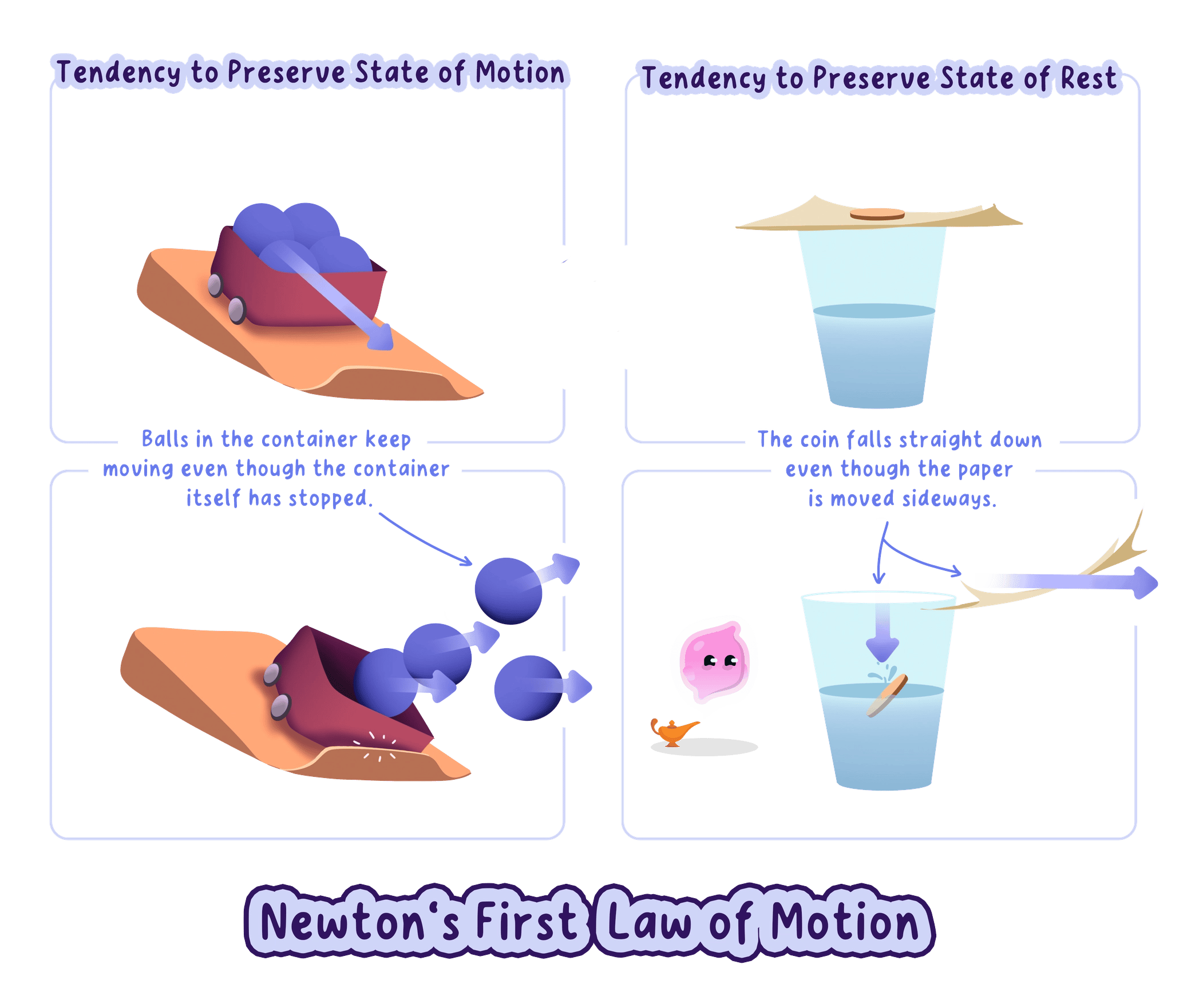
Inertia is the tendency of an object to continue in its state of rest or uniform motion.
- An object at rest tends to stay at rest, and an object in uniform motion tends to keep moving at the same velocity.
- Uniform motion means travelling at a constant speed in a constant direction.
- Inertia is a tendency, not a force; it describes why objects resist changes to their motion.
- An object does not need a continuous force to keep moving uniformly; a force is only needed to change its velocity by making it speed up, slow down or change direction.
Do not describe inertia as a force that pushes an object forwards or backwards. Inertia is the tendency to resist a change in motion, not an extra force.
Do not say that a moving object needs a forward force to keep it moving; it can continue in uniform motion with no resultant force changing its velocity.
Inertia in everyday situations
- When a stationary bus suddenly moves forwards, a passenger's body tends to stay at rest because of its inertia, so relative to the bus the passenger appears to move backwards.
- When a moving bus stops suddenly, the passenger's body tends to keep moving forwards at its original velocity.
- A seat belt provides the force that changes the passenger's velocity when the vehicle slows down.
- In each case, start by identifying the object's original state of motion, then explain that it tends to keep that state because of its inertia.
- For a definition, use the word tendency and refer to both rest and uniform motion.
- To explain a situation, first state the object's original state of motion.
- Then say it tends to remain in that state because of its inertia.
- Finally, describe the resulting motion relative to the surroundings.
- What is inertia?
- What does an object at rest tend to do because of inertia?
- What does an object in uniform motion tend to do?
- Why does a passenger move forwards relative to a car when the car stops suddenly?
- Is inertia a force? Explain your answer.
