5.6.1g Acceleration
Calculating average acceleration
Acceleration
Acceleration is the rate of change of velocity, measured in metres per second squared (m/s2\text{m/s}^2m/s2).
- Average acceleration is a=Δvta = \dfrac{\Delta v}{t}a=tΔv.
- aaa is the acceleration in m/s2\text{m/s}^2m/s2.
- Δv\Delta vΔv is the change in velocity in m/s\text{m/s}m/s.
- ttt is the time taken in s\text{s}s.
- The change in velocity is Δv=final velocity−initial velocity\Delta v = \text{final velocity} - \text{initial velocity}Δv=final velocity−initial velocity.
- An acceleration of 3 m/s23\ \text{m/s}^23 m/s2 means the velocity changes by 3 m/s3\ \text{m/s}3 m/s every second.
- A cyclist’s velocity increases from 2 m/s2\ \text{m/s}2 m/s to 8 m/s8\ \text{m/s}8 m/s in 3 s3\ \text{s}3 s. Calculate the average acceleration.
- Write the equation: a=Δvta = \dfrac{\Delta v}{t}a=tΔv.
- Find the change in velocity: Δv=8−2=6 m/s\Delta v = 8 - 2 = 6\ \text{m/s}Δv=8−2=6 m/s.
- Substitute the values: a=6 m/s3 sa = \dfrac{6\ \text{m/s}}{3\ \text{s}}a=3 s6 m/s.
- Calculate the acceleration: a=2 m/s2a = 2\ \text{m/s}^2a=2 m/s2.
Deceleration
Deceleration
Deceleration is the slowing down of an object.
- When an object moving in the positive direction slows down, its change in velocity is negative, so its acceleration is negative.
- A car slowing from 15 m/s15\ \text{m/s}15 m/s to 5 m/s5\ \text{m/s}5 m/s in 2 s2\ \text{s}2 s has Δv=5−15=−10 m/s\Delta v = 5 - 15 = -10\ \text{m/s}Δv=5−15=−10 m/s, so a=−102=−5 m/s2a = \dfrac{-10}{2} = -5\ \text{m/s}^2a=2−10=−5 m/s2.
- The magnitude of the deceleration is 5 m/s25\ \text{m/s}^25 m/s2, because magnitude means size and is given as a positive value.
- Calculate the change in velocity as final velocity minus initial velocity, not the other way round.
- Acceleration is measured in m/s2\text{m/s}^2m/s2, not m/s\text{m/s}m/s.
- A negative answer is not wrong; it shows the velocity decreasing in the chosen positive direction.
- Deceleration is not a different quantity from acceleration; it is acceleration that slows an object down.
Estimating everyday accelerations
- An estimate need not be exact but should be physically reasonable; everyday accelerations are often a few m/s2\text{m/s}^2m/s2.
- A cyclist going from 000 to 6 m/s6\ \text{m/s}6 m/s in 3 s3\ \text{s}3 s accelerates at about 2 m/s22\ \text{m/s}^22 m/s2.
- A family car going from 000 to 20 m/s20\ \text{m/s}20 m/s in 5 s5\ \text{s}5 s accelerates at about 4 m/s24\ \text{m/s}^24 m/s2.
- Hard braking gives a deceleration of magnitude several m/s2\text{m/s}^2m/s2.
- To check an estimate, ask whether the stated change in velocity could realistically happen in the stated time.
Acceleration from a velocity–time graph
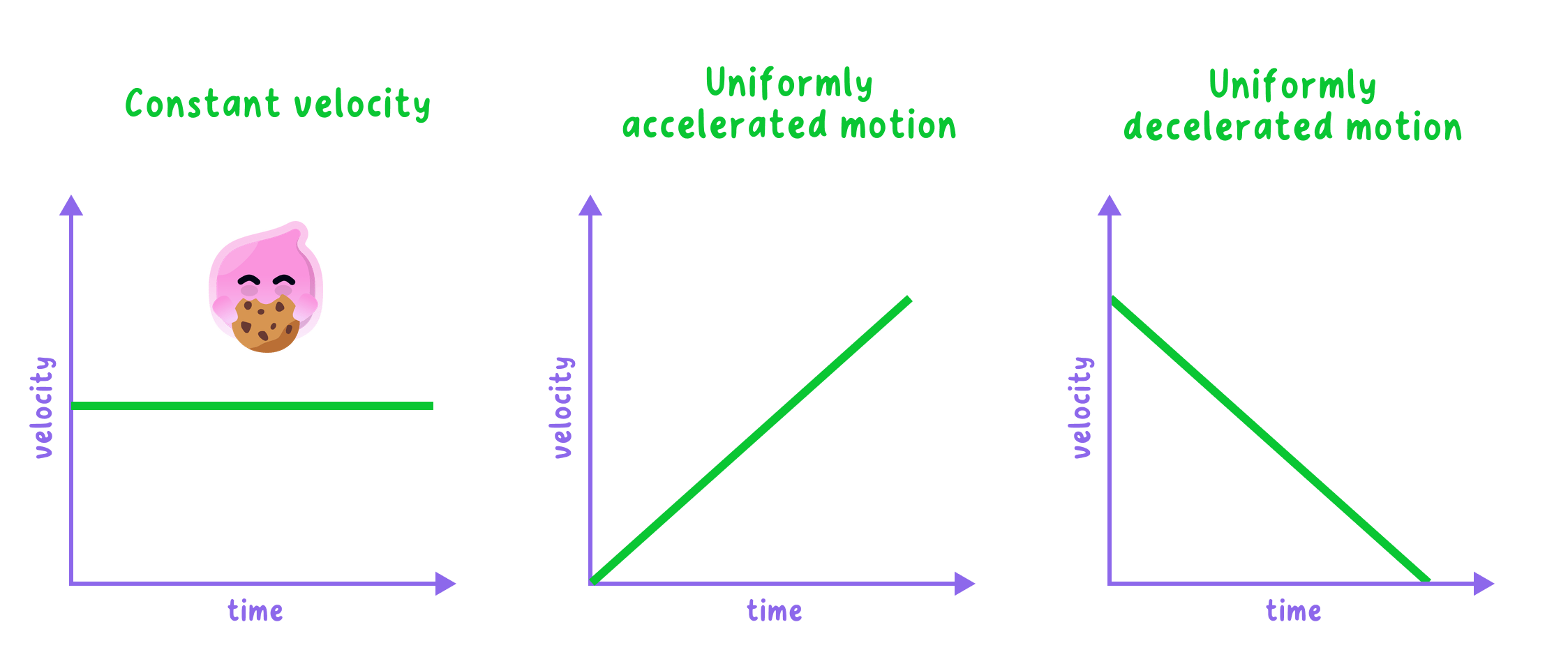
- Acceleration equals the gradient of a velocity–time graph: a=change in velocitychange in timea = \dfrac{\text{change in velocity}}{\text{change in time}}a=change in timechange in velocity, because velocity is on the vertical axis and time on the horizontal.
- A straight line with a positive gradient shows constant positive acceleration.
- A horizontal line shows constant velocity, so zero acceleration.
- A downward-sloping line shows negative acceleration (deceleration if the velocity is positive).
- A steeper line has a greater acceleration magnitude; a curved line shows changing acceleration.
- Two points on a straight section of a velocity–time graph are (2 s, 4 m/s)(2\ \text{s},\ 4\ \text{m/s})(2 s, 4 m/s) and (7 s, 14 m/s)(7\ \text{s},\ 14\ \text{m/s})(7 s, 14 m/s). Calculate the acceleration.
- Write the gradient equation: a=change in velocitychange in timea = \dfrac{\text{change in velocity}}{\text{change in time}}a=change in timechange in velocity.
- Find the change in velocity: 14−4=10 m/s14 - 4 = 10\ \text{m/s}14−4=10 m/s.
- Find the change in time: 7−2=5 s7 - 2 = 5\ \text{s}7−2=5 s.
- Calculate the acceleration: a=105=2 m/s2a = \dfrac{10}{5} = 2\ \text{m/s}^2a=510=2 m/s2.
- Put time on the horizontal axis (s\text{s}s) and velocity on the vertical axis (m/s\text{m/s}m/s), with sensible, even scales.
- Plot each measured time and velocity, draw the appropriate straight line or smooth curve, and use the gradient to find the acceleration.
- For an acceleration calculation, state the equation, find Δv\Delta vΔv as final minus initial, substitute, and give m/s2\text{m/s}^2m/s2.
- For a graph, use two well-separated points and show the changes in velocity and time; if asked for the magnitude, give the positive size of the acceleration.
- What is acceleration?
- State the equation for average acceleration and its unit.
- How do you calculate the change in velocity?
- What does a horizontal line on a velocity–time graph mean?
- How is acceleration found from a velocity–time graph?
5.6.1h Distance from a velocity–time graph and uniform acceleration (HT)
Area under a velocity–time graph
Area under a velocity–time graph
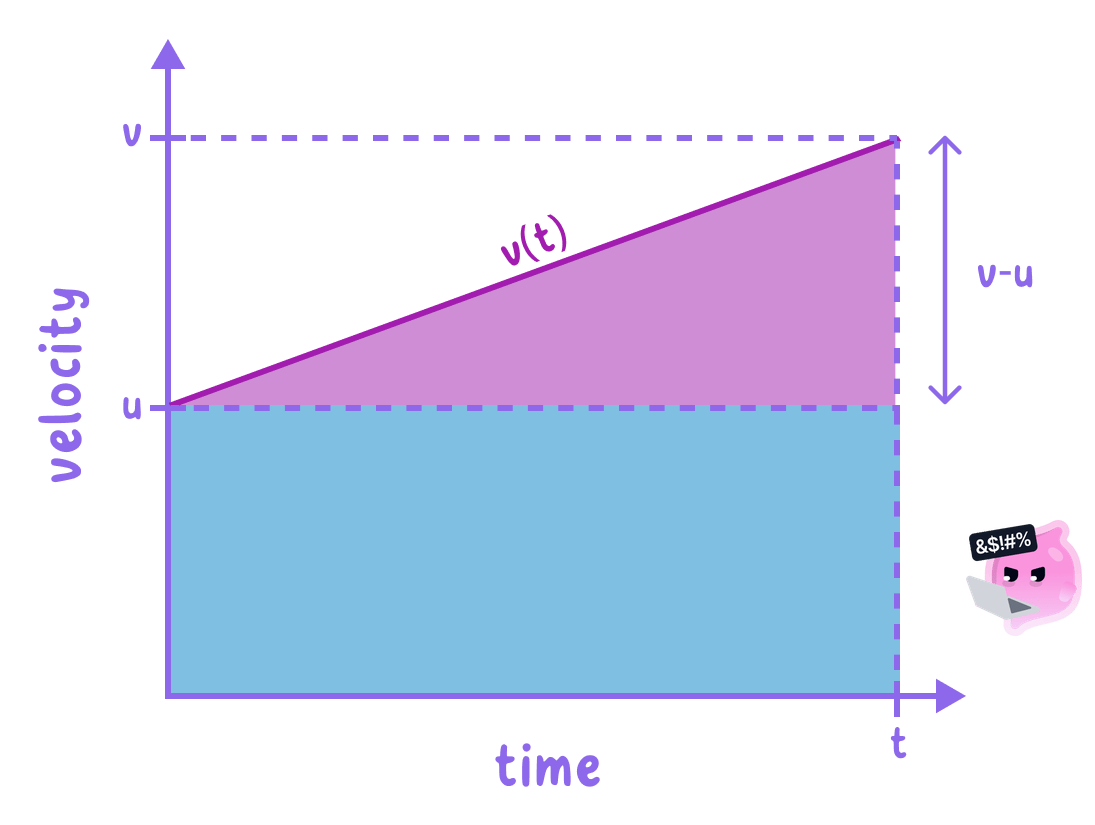
The area between a line on a velocity–time graph and the time axis represents the object's displacement.
- The area between the line and the time axis represents the object's displacement, because displacement=velocity×time\text{displacement}=\text{velocity}\times\text{time}displacement=velocity×time.
- The units confirm this, ms×s=m\dfrac{\text{m}}{\text{s}}\times\text{s}=\text{m}sm×s=m.
- If the velocity is constant, the area is a rectangle; if the velocity changes at a constant rate, the line is straight and the area is a triangle or trapezium.
- For a journey with several stages, split the area into simple shapes and add their areas.
- When the graph stays above the time axis, the magnitude of the displacement equals the distance travelled; an area below the axis represents displacement in the opposite direction.
- To find displacement, add areas above the axis and subtract areas below it.
- To find the distance travelled, add the magnitudes of all the areas, including those below the axis.
- A cyclist accelerates uniformly from 0 m/s0\ \text{m/s}0 m/s to 12 m/s12\ \text{m/s}12 m/s in the first 4 s4\ \text{s}4 s, then travels at 12 m/s12\ \text{m/s}12 m/s for a further 6 s6\ \text{s}6 s. Find the total distance travelled.
- Area of the triangle during acceleration: 12×4 s×12 m/s=24 m\dfrac{1}{2}\times 4\ \text{s}\times 12\ \text{m/s}=24\ \text{m}21×4 s×12 m/s=24 m.
- Area of the rectangle at constant velocity: 6 s×12 m/s=72 m6\ \text{s}\times 12\ \text{m/s}=72\ \text{m}6 s×12 m/s=72 m.
- Add the areas: 24 m+72 m=96 m24\ \text{m}+72\ \text{m}=96\ \text{m}24 m+72 m=96 m.
- Answer: 96 m96\ \text{m}96 m.
Estimating area by counting squares
- For an irregular velocity–time graph, the area can be estimated by counting squares.
- First find the area of one square, area of one square=time per square×velocity per square\text{area of one square}=\text{time per square}\times\text{velocity per square}area of one square=time per square×velocity per square.
- Count the complete squares, combine the part-squares into whole ones, and multiply the total by the area of one square.
- Always use the scales on both axes rather than assuming each square represents 1 m1\ \text{m}1 m.
Uniform acceleration
Uniform acceleration
Uniform acceleration is acceleration that stays constant, so the velocity changes by equal amounts in equal time intervals.
- On a velocity–time graph, uniform acceleration produces a straight line with a constant gradient.
- For uniform acceleration, distance is linked to initial velocity, final velocity and acceleration by v2−u2=2asv^2-u^2=2asv2−u2=2as, where:
- vvv is the final velocity in m/s\text{m/s}m/s;
- uuu is the initial velocity in m/s\text{m/s}m/s;
- aaa is the acceleration in m/s2\text{m/s}^2m/s2;
- sss is the distance in m\text{m}m.
- This equation applies only when the acceleration is uniform.
Free fall near the Earth
- An object in free fall accelerates under gravity; near the Earth's surface its acceleration is about g=9.8 m/s2g=9.8\ \text{m/s}^2g=9.8 m/s2.
- The value of ggg is the acceleration, not the velocity; for a freely falling object, replace aaa with 9.8 m/s29.8\ \text{m/s}^29.8 m/s2.
- A stone is dropped from rest and falls freely through a distance of 20 m20\ \text{m}20 m. Find its final velocity.
- Use v2−u2=2asv^2-u^2=2asv2−u2=2as with u=0 m/su=0\ \text{m/s}u=0 m/s, a=9.8 m/s2a=9.8\ \text{m/s}^2a=9.8 m/s2 and s=20 ms=20\ \text{m}s=20 m.
- Substitute: v2−02=2×9.8×20=392v^2-0^2=2\times 9.8\times 20=392v2−02=2×9.8×20=392.
- Take the square root: v=392v=\sqrt{392}v=392.
- Answer: v=19.8 m/sv=19.8\ \text{m/s}v=19.8 m/s downwards.
- Do not confuse the gradient and the area of a velocity–time graph: the gradient represents acceleration, while the area represents displacement.
- When counting squares, always allow for the scale of both axes.
- Areas below the time axis are negative for displacement but still count positively towards the total distance travelled.
- For an area question, divide the region into rectangles, triangles or trapeziums, write the formula for each area, and include the unit m\text{m}m.
- For an irregular graph, state the area represented by one square before you start counting.
- When using v2−u2=2asv^2-u^2=2asv2−u2=2as, write the equation first, substitute values with units, then remember to take the square root if you have found v2v^2v2.
Choosing the right method
- Use the area under the graph when a question asks for distance or displacement.
- Use v2−u2=2asv^2-u^2=2asv2−u2=2as when the acceleration is uniform and you know three of the four quantities.
- What does the area under a velocity–time graph represent?
- How do you find the distance travelled when part of the graph is below the time axis?
- What graph shape shows uniform acceleration?
- Which equation links uuu, vvv, aaa and sss?
- What is the acceleration of a freely falling object near the Earth's surface?
5.6.1i Terminal velocity
Terminal velocity
Terminal velocity
Terminal velocity is the constant velocity reached by a falling object when the resistive force acting upwards is equal to the object’s weight acting downwards.
- An object reaches its terminal velocity when the upward resistive force has grown until it equals the object’s weight.
- A fluid is a liquid or a gas; when an object falls through a fluid, two main forces act on it.
The forces on a falling object
Resultant force
The resultant force is the single force that has the same effect as all the forces acting on an object combined.
- Weight acts vertically downwards because of gravity.
- Drag, such as air resistance, acts upwards, opposing the motion.
- Whether the object speeds up, slows down or stays at a steady speed depends on the resultant force of these two forces.
How a falling object reaches terminal velocity
- When first released from rest, the object’s weight acts downwards while the drag force is zero or very small, so the forces are unbalanced.
- Weight is greater than drag, giving a resultant force downwards, so the object accelerates and its velocity increases.
- As the object speeds up, the drag force increases while its weight stays constant, so the resultant force and the acceleration both decrease.
- The velocity keeps increasing, but at a decreasing rate.
- Eventually the drag force equals the weight; the resultant force is zero, so the object stops accelerating and falls at a constant terminal velocity.
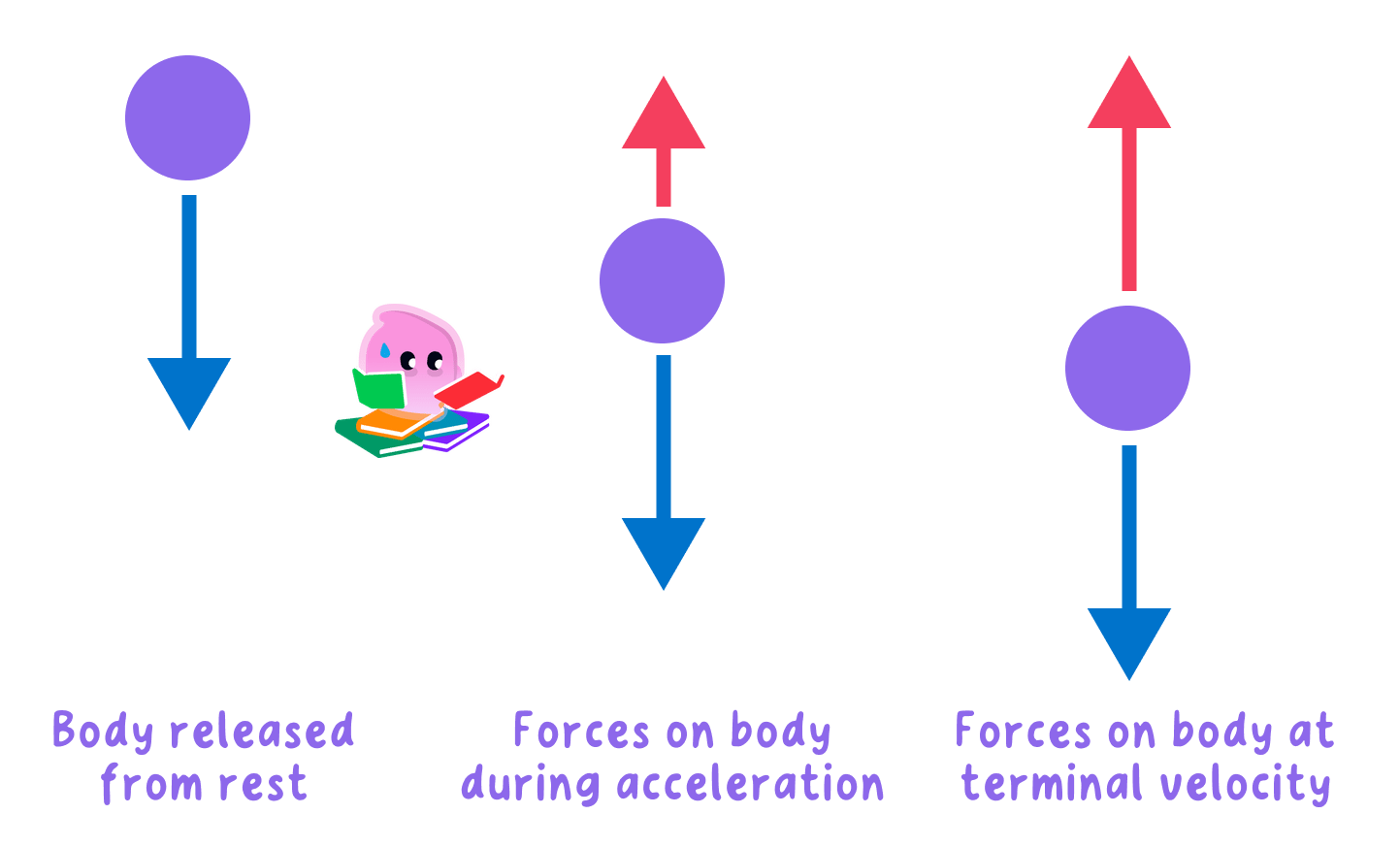
- At terminal velocity, weight equals drag.
- The resultant force is zero.
- The acceleration is zero.
- The velocity is constant and is not zero.
Velocity–time graphs for terminal velocity
- Plot time in seconds (s\text{s}s) on the horizontal axis and velocity in metres per second (m/s\text{m/s}m/s) on the vertical axis.
- For an object dropped from rest, the line starts at the origin with a steep positive gradient, then curves and gradually becomes less steep, ending in a horizontal section.
- The gradient represents acceleration: it is large at first because the resultant force is large, and it decreases as drag increases.
- When terminal velocity is reached, the graph is horizontal; its gradient is zero, showing zero acceleration, and the height of this section is the terminal velocity.
- A falling object speeds up from 0 m/s0\ \text{m/s}0 m/s to 12 m/s12\ \text{m/s}12 m/s during the first 3.0 s3.0\ \text{s}3.0 s, and later its velocity stays constant at 18 m/s18\ \text{m/s}18 m/s. Find its average acceleration during the first 3.0 s3.0\ \text{s}3.0 s and state its terminal velocity.
- Use a=v−uta = \dfrac{v - u}{t}a=tv−u.
- Substitute: a=12−03.0a = \dfrac{12 - 0}{3.0}a=3.012−0.
- Average acceleration: 4.0 m/s24.0\ \text{m/s}^24.0 m/s2.
- The terminal velocity is 18 m/s18\ \text{m/s}18 m/s, the constant velocity shown by the horizontal section of the graph.
Interpreting the motion from the forces
- The steep initial gradient corresponds to a large resultant force, because weight is much greater than drag.
- As the curve flattens, drag is increasing and the resultant force is falling, so the acceleration is decreasing.
- The horizontal section corresponds to drag equal to weight and a zero resultant force, so the object moves at a constant terminal velocity.
- A zero resultant force does not mean the object is stationary; at terminal velocity the object is still falling, but with zero acceleration because its velocity is constant.
- Do not say the forces disappear; weight and drag both still act, but they are equal in size and opposite in direction.
- Explain terminal velocity as a clear sequence that links the forces to the motion.
- Start by stating that weight is greater than drag, giving a resultant force downwards, so the object accelerates.
- Then explain that as the velocity increases the drag increases, so the resultant force and the acceleration decrease.
- Finish by stating that when drag equals weight the resultant force is zero and the object moves at a constant terminal velocity.
- For a velocity–time graph, refer to the gradient when discussing acceleration and identify the horizontal section as constant velocity.
- What two main forces act on an object falling through a fluid?
- Why does the drag force increase as the object speeds up?
- What is the resultant force at terminal velocity?
- What is the relationship between weight and drag at terminal velocity?
- Why is the terminal-velocity section of a velocity–time graph horizontal?
