7.2.1a Magnetic field around a current-carrying wire and solenoid
Magnetic field around a current-carrying wire
Definition
Magnetic field
A magnetic field is the region around a magnet or current-carrying wire where a magnetic material or compass experiences a force.
- When a current flows through a wire, a magnetic field is produced around the wire, called the magnetic effect of a current.
- For a straight wire, the field forms circles around the wire, with the wire passing through the centre of the circular field lines.
- The strength of the field depends on the size of the current and the distance from the wire.
- A larger current gives a stronger field, and the field is strongest close to the wire and weaker further away.
- The direction of the field depends on the direction of the current, so reversing the current reverses the field.
- The right-hand grip rule gives the direction: point the thumb of your right hand along the conventional current, and your curled fingers show the direction of the field.
Key Idea
A current-carrying wire produces a circular magnetic field around it, and increasing the current increases the strength of the field.
Demonstrating the magnetic effect of a current
- Pass a straight wire vertically through a piece of card.
- Place small plotting compasses on the card around the wire.
- Connect the wire to a power supply so that a current flows.
- The compass needles turn and line up with the field, showing the current has produced a magnetic field.
- Iron filings sprinkled on the card form circular patterns, showing the shape of the field.
- Reversing the current makes the compass needles point the opposite way, showing the field direction has reversed.
Drawing the field around a straight wire
- Draw circles centred on the wire.
- Add arrows on the circles to show the direction of the field.
- Draw the field lines closer together near the wire, because the field is stronger there.
- A dot means the current comes out of the page and a cross means it goes into the page, and the field direction must match the current.
Common Mistake
- Do not draw the field around a straight wire as straight lines going away from it, because the field lines are circular.
- The field is not strongest far from the wire; it is strongest close to the wire and weakens with distance.
Solenoids
Definition
Solenoid
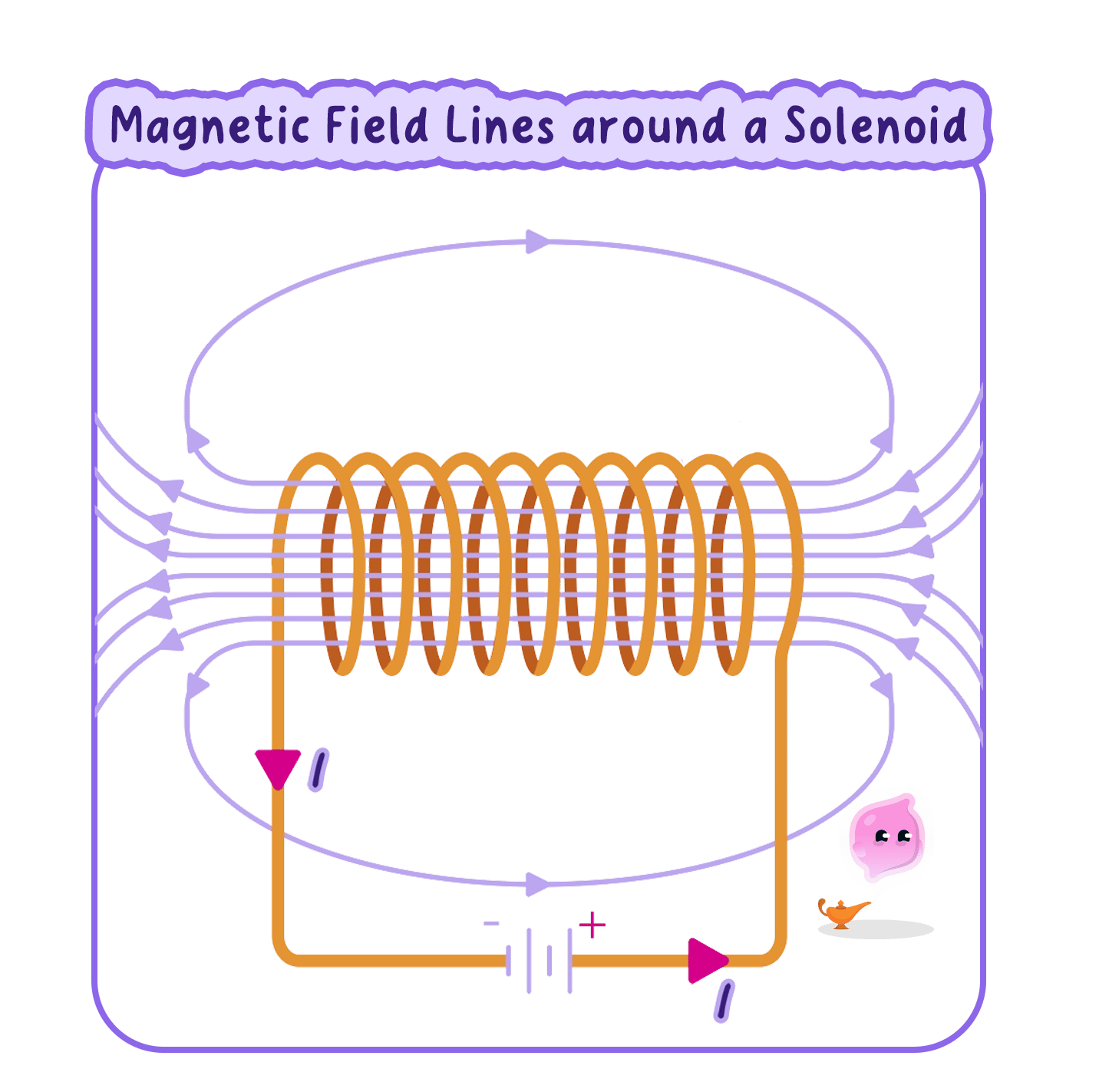
A solenoid is a coil of wire that produces a magnetic field when a current flows through it.
- Shaping a wire into a solenoid makes the field stronger, because the fields from the individual turns add together.
- Inside a solenoid the field is strong and uniform, meaning it has the same strength and direction throughout, shown by straight, parallel, evenly spaced field lines.
- Outside, the field has the same shape as a bar magnet, so the solenoid has a north pole and a south pole.
- The field lines run from north to south outside the solenoid, pass through the inside from south to north, and form complete loops.
Electromagnets
Definition
Electromagnet
An electromagnet is a solenoid with an iron core.
- Adding an iron core increases the field strength, because the iron becomes magnetised by the coil's field and adds to it.
- An electromagnet is only strongly magnetic while a current flows, and its magnetic effect is greatly reduced when the current is switched off.
Exam technique
- For a straight wire, say a current produces a circular field, that a larger current strengthens it, and that greater distance weakens it.
- For a solenoid, say the fields from the turns add together, and draw a bar-magnet-shaped field outside with a strong, uniform field inside, with arrows for direction.
Self review
- What is produced around a wire when a current flows through it?
- What shape are the magnetic field lines around a straight wire?
- How does increasing the current change the magnetic field?
- How does the field change as you move away from the wire?
- Why does a solenoid produce a stronger magnetic field than a straight wire?
- What is an electromagnet?
7.2.1b Interpreting electromagnetic device diagrams
Reading electromagnetic device diagrams
Definition
Motor effect
The motor effect is the force exerted on a current-carrying conductor when it is placed in a magnetic field.
- A device diagram usually shows how a current, a magnetic field and a force are arranged.
- The device works because a wire or coil carrying current sits in a magnetic field, so the motor effect produces a force that makes a part move.
- The magnetic field direction is from the north pole to the south pole.
- The force or movement is the direction the wire, coil or moving part is pushed.
Current direction in device diagrams
Definition
Conventional current
Conventional current is the direction of current from the positive terminal of a supply to the negative terminal.
- Always use conventional current, which flows from positive to negative.
- The force is at right angles to both the magnetic field and the current, which is why the three directions are drawn at right angles to each other.
Using Fleming's left-hand rule
- Hold the thumb, first finger and second finger of your left hand so they are all at right angles to each other.
- First finger points along the magnetic field, from north to south.
- Second finger points along the conventional current, from positive to negative.
- Thumb then points in the direction of the force or motion.
- If the diagram gives you two of the directions, the rule lets you work out the third.
- Reversing the current or the magnetic field reverses the force, which can change the direction a part moves.
Explaining how a device works from a diagram
- Identify the magnetic field direction.
- Identify where current flows through a conductor or coil.
- State that the motor effect produces a force.
- State the direction of the force or movement.
- Explain the result for the device, such as rotation or movement of a part.
- For a coil, the two sides carry current in opposite directions, so the forces on them are in opposite directions, producing a turning effect that makes the coil rotate.
Dots and crosses in diagrams
- A dot means the direction is out of the page towards you, like the tip of an arrow.
- A cross means the direction is into the page away from you, like the tail of an arrow.
- Apply the same logic with these symbols: field, current and force are three different directions, and the force is not automatically the same as the current or field.
Common Mistake
- Do not say the wire moves because it is magnetic; a current-carrying conductor in a magnetic field experiences a force.
- Do not confuse the three directions: field is north to south, current is positive to negative, and force is at right angles to both.
Exam technique
- Name the motor effect.
- Mention a current-carrying conductor in a magnetic field.
- Use the diagram to give the direction of force or movement.
- Link the force to what the device does, using the word because to connect current, field and force.
Self review
- What is the motor effect?
- Which way does the magnetic field point in a device diagram?
- Which direction is conventional current?
- What do the first finger, second finger and thumb represent in Fleming's left-hand rule?
- What happens to the force if you reverse the current or the field?
- Why can a current-carrying coil in a magnetic field rotate?
