5.6.3d Braking force, energy transfer and deceleration
Braking force and energy transfer
Braking force
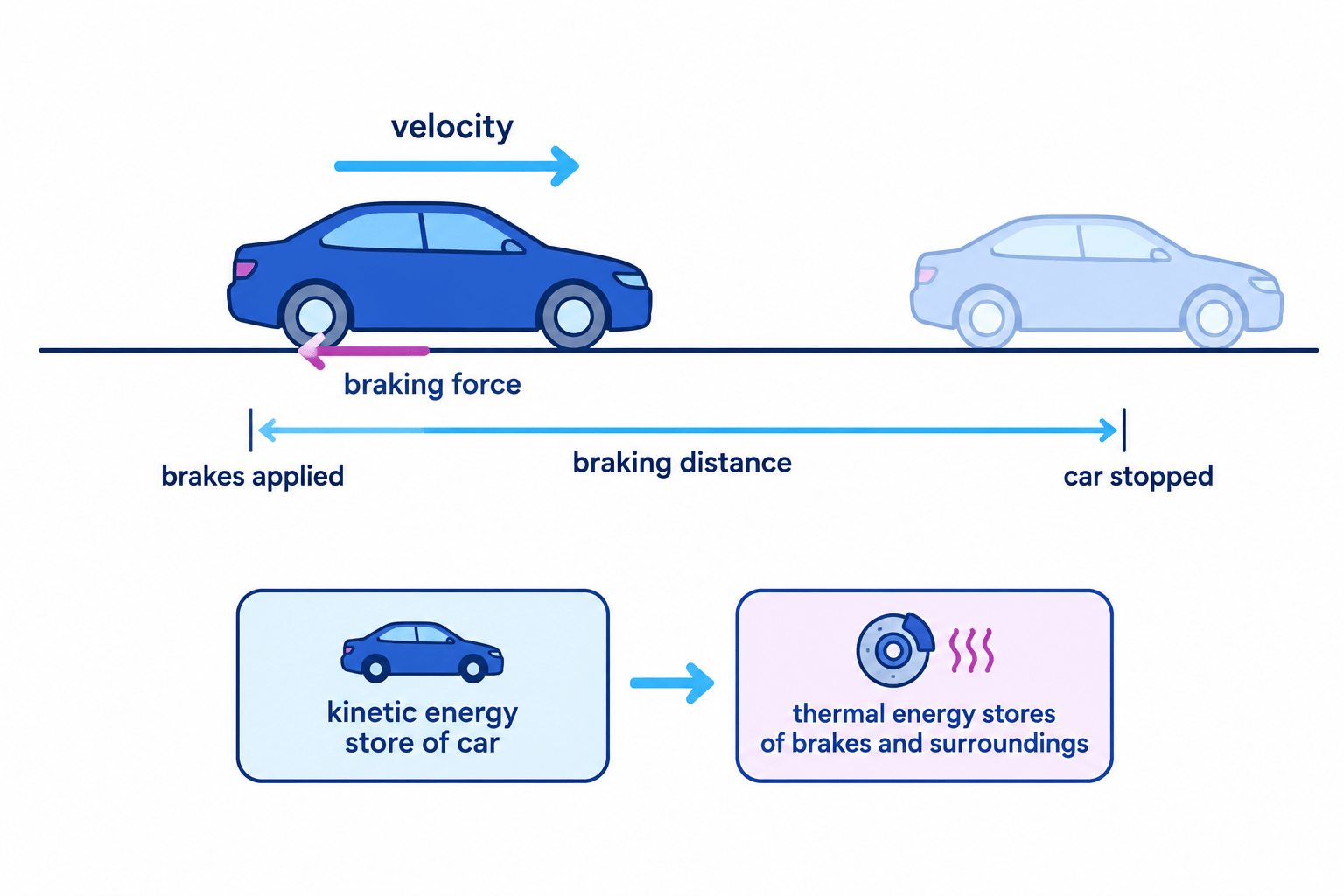
Braking force is the friction force that acts against the motion of a vehicle when its brakes are applied.
- When the brakes are applied, friction acts between the brakes and the parts connected to the wheels, and this friction force does work on the vehicle.
- This work done reduces the energy in the vehicle's kinetic energy store, so the vehicle slows down.
- Energy is not destroyed but transferred: it moves from the vehicle's kinetic energy store to the thermal energy stores of the brakes and the surroundings.
- As energy is transferred to the brakes, their temperature increases.
Braking transfers energy: kinetic energy of the vehicle → thermal energy of the brakes and surroundings.
Work done by the braking force
- The work done by a braking force is W=FsW=FsW=Fs, where WWW is the work done in joules (J\text{J}J), FFF is the braking force in newtons (N\text{N}N) and sss is the braking distance in metres (m\text{m}m).
- If the vehicle is brought to rest, the work done by the braking force equals the decrease in the vehicle's kinetic energy, provided other energy transfers are negligible.
- So the braking force multiplied by the braking distance is approximately the kinetic energy: braking force × braking distance ≈12mv2\approx \tfrac{1}{2}mv^2≈21mv2.
- A vehicle travelling at a greater speed has more kinetic energy, so more work must be done to stop it.
- To stop a faster vehicle within the same distance, the braking force must be greater, because from W=FsW=FsW=Fs a larger work done over the same distance needs a larger force.
A car has 240 000 J240\,000\ \text{J}240000 J of kinetic energy and is brought to rest over a braking distance of 40 m40\ \text{m}40 m. Assuming all of this energy is transferred by a constant braking force, calculate the braking force.
- Because the car stops, the work done equals the kinetic energy transferred, so W=240 000 JW=240\,000\ \text{J}W=240000 J.
- Rearrange W=FsW=FsW=Fs to make the force the subject: F=WsF=\frac{W}{s}F=sW.
- Substitute the values: F=240 00040F=\frac{240\,000}{40}F=40240000.
- This gives F=6000 NF=6000\ \text{N}F=6000 N.
- If the car were faster with 360 000 J360\,000\ \text{J}360000 J of kinetic energy, stopping in the same 40 m40\ \text{m}40 m would need F=360 00040=9000 NF=\frac{360\,000}{40}=9000\ \text{N}F=40360000=9000 N, a greater braking force.
Braking force and deceleration
Deceleration
Deceleration is acceleration in the opposite direction to an object's velocity, so its speed decreases; its magnitude is measured in m/s2\text{m/s}^2m/s2.
- Resultant force, mass and acceleration are linked by F=maF=maF=ma, where FFF is in newtons (N\text{N}N), mmm in kilograms (kg\text{kg}kg) and aaa in m/s2\text{m/s}^2m/s2.
- For a given vehicle the mass is constant, so a greater braking force produces a greater deceleration.
- A large braking force can bring a vehicle to rest quickly, but very large decelerations can be dangerous.
Do not say the vehicle's kinetic energy is "used up" or "lost". Energy is conserved: braking transfers it from the kinetic energy store to thermal energy stores.
Do not confuse deceleration with braking force. Deceleration is measured in m/s2\text{m/s}^2m/s2, while braking force is measured in newtons (N\text{N}N).
Dangers of large decelerations
- Injury to occupants: a large deceleration needs a large force to change the passengers' velocity; seat belts and restraints apply this force, but very large forces can still cause injury.
- Loss of control: a large braking force can make the tyres lose grip so the vehicle skids, and the driver may lose control of its direction.
- Overheating brakes: during heavy braking, kinetic energy is transferred rapidly to the thermal energy store of the brakes, so their temperature can become very high, especially during repeated braking.
- Reduced braking effectiveness: overheated brakes may become less effective, making it harder to slow down or stop safely.
- In an “explain the dangers” answer, give linked reasoning: a large braking force gives a large deceleration, which can cause skidding and loss of control, and rapid energy transfer that overheats the brakes.
- Describe the energy changes using stores: state that kinetic energy is transferred to thermal energy stores rather than being lost.
- When explaining dangers, link a large braking force to a large deceleration, then to skidding, loss of control and overheating brakes.
- Keep the ideas of deceleration and force separate, and always include the correct units.
- What energy store decreases when a moving vehicle brakes, and where does the energy go?
- Why does the temperature of the brakes increase during braking?
- Why is a greater braking force needed to stop a faster vehicle in the same distance?
- How does increasing the braking force affect the deceleration of the same vehicle?
- Explain why a large deceleration can cause injury, brake overheating or loss of control.
5.6.3e Estimating deceleration forces (HT)
Deceleration and resultant force
Deceleration
Deceleration is acceleration in the direction opposite to an object's velocity; it makes the object's speed decrease and is measured in m/s2\text{m/s}^2m/s2.
- A road vehicle decelerates when a resultant force acts opposite to its direction of motion.
- During braking, friction between the brakes and the wheels slows their rotation, while friction between the tyres and the road provides the force that slows the vehicle.
- The acceleration is found from a=v−uta=\frac{v-u}{t}a=tv−u, where uuu is the initial velocity, vvv the final velocity (both in m/s\text{m/s}m/s) and ttt the time in seconds (s\text{s}s).
- When a vehicle slows down vvv is less than uuu, so the acceleration is negative; the magnitude of the deceleration is u−vt\frac{u-v}{t}tu−v.
Estimating the decelerating force
- The resultant force on the vehicle is found from F=maF=maF=ma, with FFF in newtons (N\text{N}N), mmm in kilograms (kg\text{kg}kg) and aaa in m/s2\text{m/s}^2m/s2.
- A greater mass needs a greater force for the same deceleration, and stopping in a shorter time needs a greater force because the deceleration is larger.
- Useful approximate values are: a small or medium car has a mass of about 100010001000 to 1500 kg1500\ \text{kg}1500 kg; 30 mph30\ \text{mph}30 mph is roughly 13 m/s13\ \text{m/s}13 m/s; and a controlled stop takes a few seconds.
- Using these, the resultant decelerating force on a car is typically several thousand newtons, which shows the forces involved in braking are large.
- These are estimates: the actual force depends on the vehicle's mass, its initial speed, the stopping time and the road conditions, so answers should stay physically reasonable.
A car of mass 1200 kg1200\ \text{kg}1200 kg travels at about 13 m/s13\ \text{m/s}13 m/s. The driver brakes and it stops in 4.0 s4.0\ \text{s}4.0 s. Estimate the resultant force on the car.
- Find the acceleration: a=v−ut=0−134.0=−3.25 m/s2a=\frac{v-u}{t}=\frac{0-13}{4.0}=-3.25\ \text{m/s}^2a=tv−u=4.00−13=−3.25 m/s2.
- The negative sign shows the acceleration is opposite to the car's motion.
- Find the force: F=ma=1200×(−3.25)=−3900 NF=ma=1200\times(-3.25)=-3900\ \text{N}F=ma=1200×(−3.25)=−3900 N.
- The magnitude is about 4000 N4000\ \text{N}4000 N, acting opposite to the car's direction of motion.
- If the same car stopped in only 2.0 s2.0\ \text{s}2.0 s, the deceleration would be twice as large, so the resultant force would also be about twice as large.
Estimating with energy
- The force can also be estimated from energy, because the work done by the braking force equals the vehicle's kinetic energy when it stops: braking force × braking distance =12mv2=\tfrac{1}{2}mv^2=21mv2.
- Rearranging gives F=12mv2sF=\frac{\tfrac{1}{2}mv^2}{s}F=s21mv2, where sss is the braking distance in metres.
- For example, the 1200 kg1200\ \text{kg}1200 kg car at 13 m/s13\ \text{m/s}13 m/s has kinetic energy 12×1200×132≈101 000 J\tfrac{1}{2}\times1200\times13^2\approx101\,000\ \text{J}21×1200×132≈101000 J; over a braking distance of about 25 m25\ \text{m}25 m this gives F≈4000 NF\approx4000\ \text{N}F≈4000 N, agreeing with the F=maF=maF=ma estimate.
- Both methods give forces of the same order of magnitude, confirming that typical braking forces are large.
Getting estimates right
- Do not substitute the vehicle's speed directly into F=maF=maF=ma; first calculate the acceleration or deceleration from the change in velocity divided by time.
- Convert speeds to m/s\text{m/s}m/s before using them: for a speed in km/h\text{km/h}km/h divide by 3.63.63.6, and remember 30 mph≈13 m/s30\ \text{mph}\approx13\ \text{m/s}30 mph≈13 m/s.
- F=maF=maF=ma gives the resultant force, not the force from a single source; the negative sign only shows direction, so state the magnitude as a positive value.
- For an estimate, show a sensible method, give a realistic order of magnitude with units, and state that the resultant force acts opposite to the vehicle's motion.
- What is deceleration, and in what unit is it measured?
- How do you calculate acceleration from the initial and final velocity and the time?
- How is the resultant decelerating force calculated using F=maF=maF=ma?
- Why does a shorter stopping time or a greater mass need a larger resultant force?
- Roughly what order of magnitude is a typical decelerating force on a car?