7.2.2 The motor effect and Fleming's left-hand rule (HT)
The motor effect
Definition
The motor effect
The motor effect is the force produced when a conductor carrying a current is placed in a magnetic field.
- A current-carrying conductor produces its own magnetic field, which interacts with the field of a magnet.
- Because the two fields interact, the magnet and the conductor exert forces on each other.
- The force on the conductor can make it move, which is the effect used in electric motors.
Key Idea
- The motor effect needs a magnetic field.
- It also needs a current flowing through a conductor in that field.
Fleming's left-hand rule
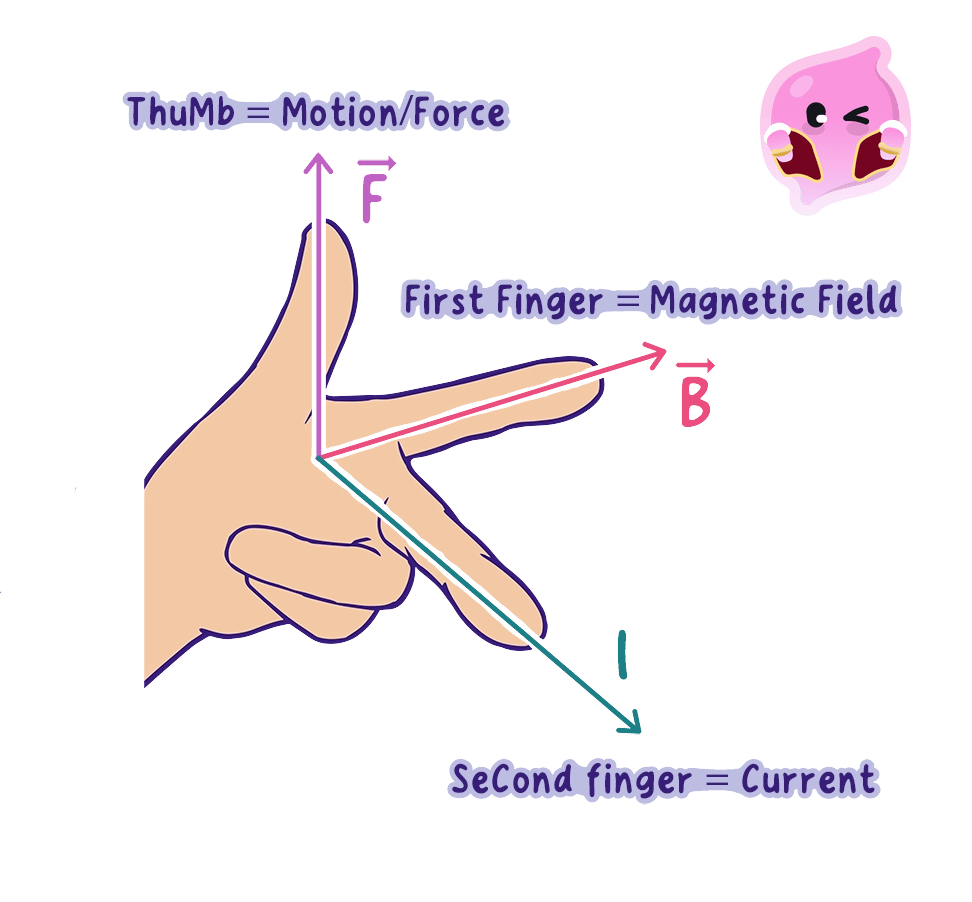
- Fleming's left-hand rule shows the relative directions of the magnetic field, the conventional current and the force on the conductor.
- Hold the thumb, first finger and second finger of your left hand so they are mutually perpendicular.
- First finger points along the magnetic field, from north to south.
- Second finger points along the conventional current.
- Thumb points along the force on the conductor.
- A useful memory aid is First finger = Field, seCond finger = Current, thuMb = Motion (force).
- Reversing either the current or the field reverses the force, but reversing both leaves the force unchanged.
Common Mistake
- The magnetic field is directed from north to south.
- Use conventional current, not the direction electrons move.
- The thumb gives the force on the conductor; the force on the magnet is in the opposite direction.
- Use your left hand for the motor effect.
Factors affecting the size of the force
Definition
Magnetic flux density
Magnetic flux density is a measure of the strength of a magnetic field, measured in tesla, T\text{T}T.
- The force is increased by increasing the magnetic flux density.
- The force is increased by increasing the current in the conductor.
- The force is increased by increasing the length of conductor inside the field.
- The force is greatest when the current is at right angles to the field, and there is no force when the current is parallel to the field.
Calculating the force
- For a conductor at right angles to the field, the force is given by F=BIlF = BIlF=BIl.
- FFF is the force in newtons, N\text{N}N.
- BBB is the magnetic flux density in tesla, T\text{T}T.
- III is the current in amperes, A\text{A}A.
- lll is the length of conductor inside the field in metres, m\text{m}m.
- The length lll is only the length of conductor actually inside the field, and the equation applies when the conductor is at right angles to the field.
- To find another quantity, rearrange the equation to B=FIlB = \dfrac{F}{Il}B=IlF, I=FBlI = \dfrac{F}{Bl}I=BlF or l=FBIl = \dfrac{F}{BI}l=BIF.
Example
- Question: A wire carries a current of 4.0 A4.0\ \text{A}4.0 A at right angles to a magnetic field of flux density 0.35 T0.35\ \text{T}0.35 T, with 0.080 m0.080\ \text{m}0.080 m of the wire inside the field. Calculate the force on the wire.
- Write the equation: F=BIlF = BIlF=BIl.
- Substitute the values: F=0.35×4.0×0.080F = 0.35 \times 4.0 \times 0.080F=0.35×4.0×0.080.
- Calculate: F=0.112 NF = 0.112\ \text{N}F=0.112 N, which is 0.11 N0.11\ \text{N}0.11 N to two significant figures.
Exam technique
- For a direction question, mark the field from north to south and the conventional current before applying Fleming's left-hand rule.
- For a calculation, check the conductor is at right angles to the field, convert the length to metres, then use F=BIlF = BIlF=BIl and give the answer in newtons.
Self review
- What is the motor effect?
- In Fleming's left-hand rule, what do the first finger, second finger and thumb represent?
- Name three factors that increase the size of the force on a conductor.
- When is the force on a current-carrying conductor greatest?
- State the equation linking force, magnetic flux density, current and length.
- What are the units of magnetic flux density?
