The diagram shows how a lens forms an image of an object. The grid has major grid lines every 1.0 cm and minor grid lines every 0.1 cm.
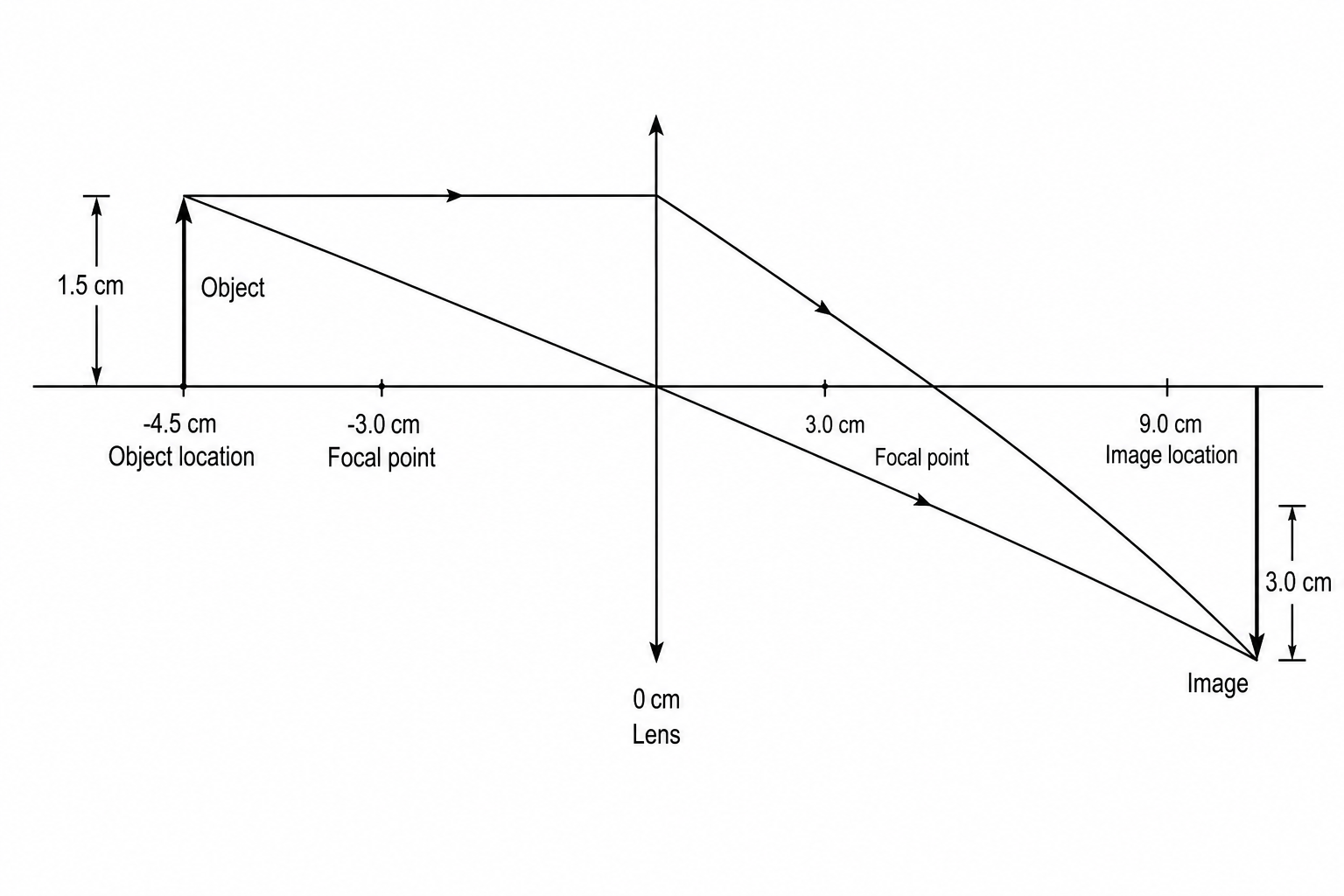
What type of lens is represented in the diagram?
- Concave
- Convex
- Diverging
Using the grid, find the image height and the object height.
- Image height = _____ cm\text{cm}cm
- Object height = _____ cm\text{cm}cm
Calculate the magnification produced by the lens using the formula: magnification=image heightobject height\text{magnification} = \frac{\text{image height}}{\text{object height}}magnification=object heightimage height
Which two words describe the image?
- Diminished
- Inverted
- Real
- Upright
- Virtual
The object was red. A student looked at the red object through a blue filter. Complete the sentences choosing from: black, blue, green, red, white.
- Looking at the red object through a blue filter makes the object appear ________.
- This is because the blue filter only transmits the light that is ________.
Electromagnetic waves Questions
Practise AQA GCSE Physics Electromagnetic waves with exam-style questions for Foundation and Higher tier. 52 questions covering Types of electromagnetic waves, Properties of electromagnetic waves 1, Properties of electromagnetic waves 2, Uses and applications of electromagnetic waves, Lenses (physics only), and Visible light (physics only), matched to the AQA GCSE Physics (8463) specification and written in Paper 1 and Paper 2 style. Every question includes a full worked solution and mark scheme, so you can see where marks are awarded rather than just whether you got the answer right.