Question 5
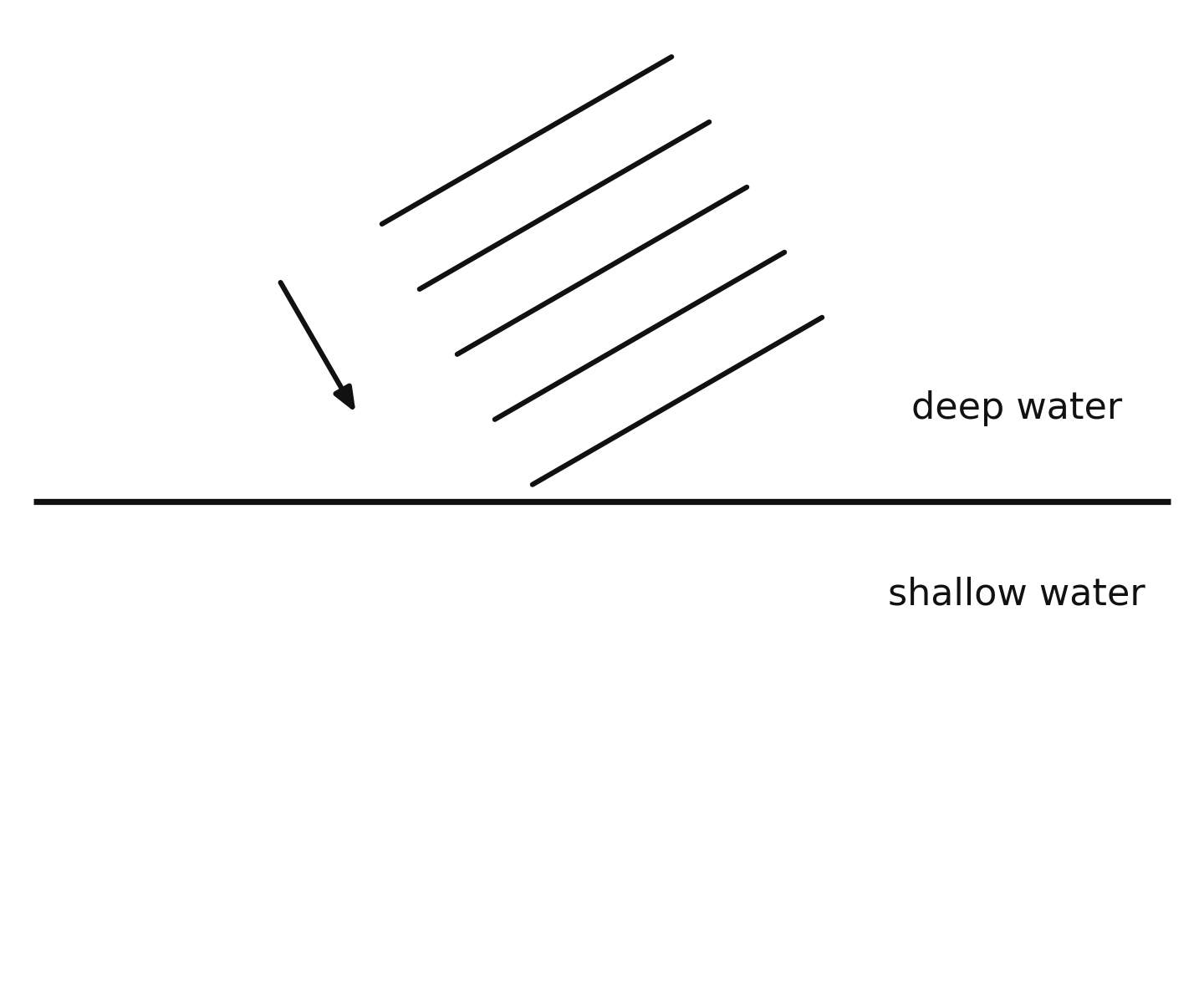
HFigure shows the wave fronts of a water wave travelling from deep water into shallow water. The wave travels more slowly in the shallow water.
Figure: Wave fronts of a water wave travelling from deep water towards a boundary with shallow water
a.[2]
Complete Figure 1 to show the wave fronts in the shallow water.
b.[3]
Explain, in terms of the speed of the wave, why the direction of travel of the wave changes at the boundary.
c.[1]
Electromagnetic waves also refract when they travel from one substance into another. Write the property of the wave that must change for refraction to happen.
6.2 Electromagnetic waves Questions
40 exam-style questions on AQA GCSE Physics 6.2 Electromagnetic waves, covering 6.2.1 Types of electromagnetic waves, 6.2.2 Properties of electromagnetic waves 1, 6.2.3 Properties of electromagnetic waves 2, 6.2.4 Uses and applications of electromagnetic waves, 6.2.5 Lenses, and 6.2.6 Visible light. Each one has a worked solution and a mark scheme showing where the marks go.