What you'll learn
- What a plane of movement is and what an axis of rotation is.
- How to match the three planes to the three axes.
- Why a somersault, cartwheel and full twist jump are classified differently.
- How to apply these terms accurately in GCSE PE answers.
Why this topic matters
In movement analysis, you are describing how the body moves. For this sub-topic, you need to link a sporting movement to:
- the plane it moves in
- the axis it rotates around
- a clear sporting example
This is especially important for gymnastics and trampolining movements, where the whole body rotates.
Planes and axes: the basics
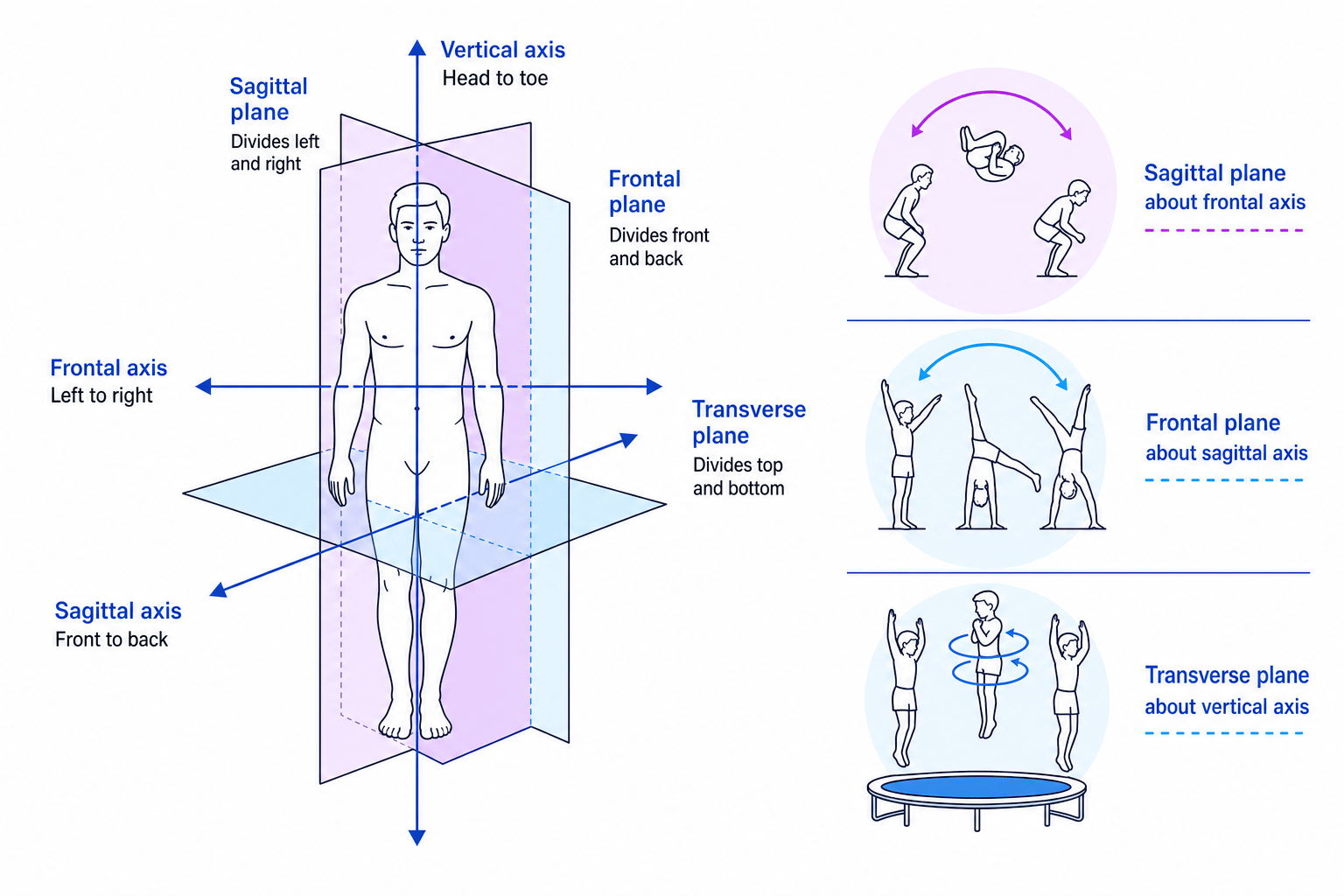
A plane is an imaginary flat surface that divides the body into sections. It helps you describe the direction a movement happens in.
Plane of movement
A plane of movement is an imaginary flat surface through the body that describes the direction in which movement takes place.
An axis is an imaginary straight line through the body. When the body rotates, it rotates around an axis.
Axis of rotation
An axis of rotation is an imaginary line through the body around which movement or rotation takes place.
A useful rule is that the axis is at right angles to the plane. So if you know the plane, you can often work out the axis.
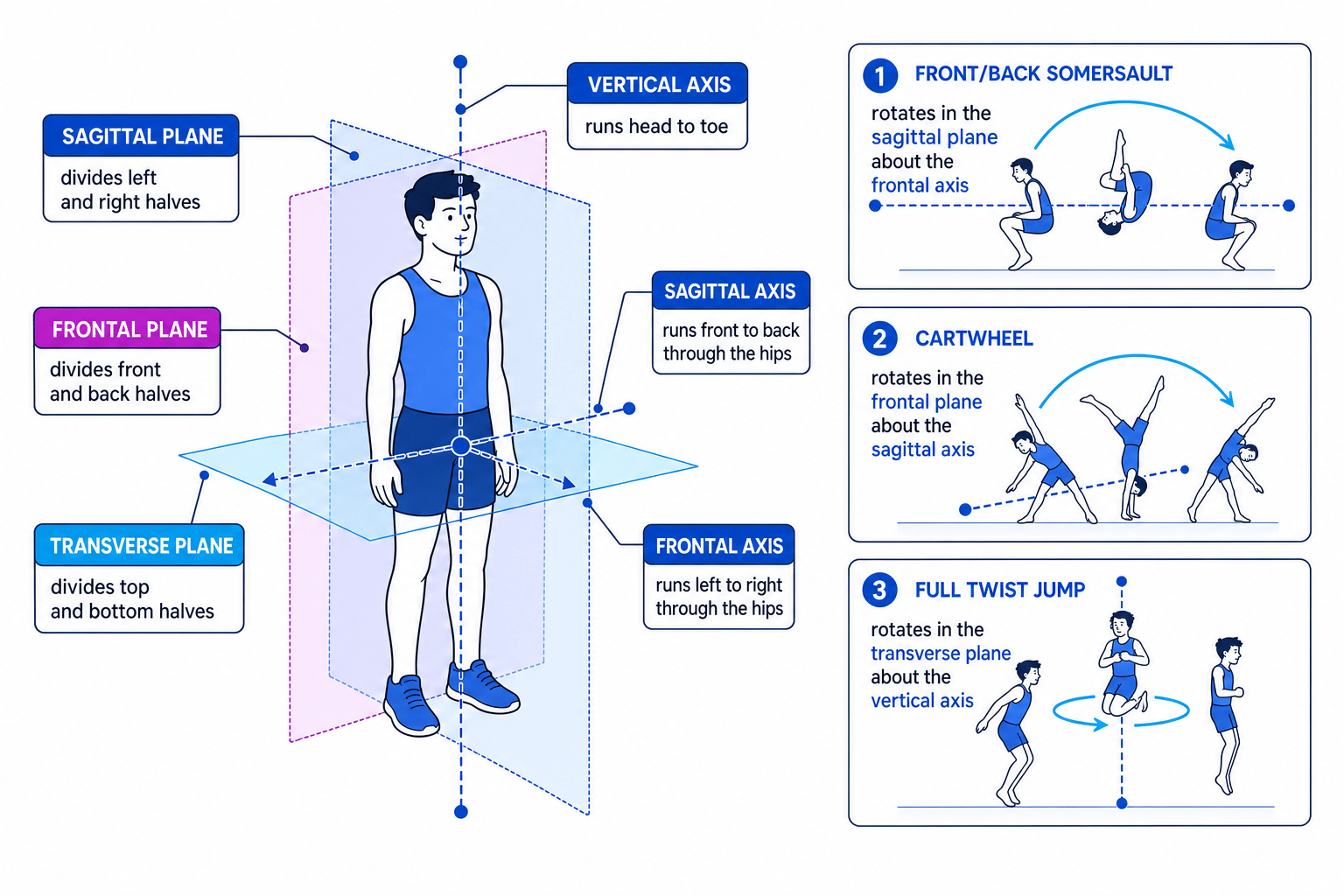
Plane plus axis
For GCSE PE, do not just name the plane. A stronger answer links the plane of movement and the axis of rotation to a sporting action.
The sagittal plane and frontal axis
The sagittal plane divides the body into left and right halves. Movements in this plane usually go forwards and backwards.
Sagittal plane
The sagittal plane divides the body into left and right sections. Movements in this plane happen forwards and backwards.
The frontal axis runs from left to right through the body, usually imagined through the hips or shoulders.
Frontal axis
The frontal axis is an imaginary line running from left to right through the body. The body can rotate forwards or backwards around this axis.
Sporting example: front and back somersaults
A somersault is a whole-body rotation where the performer turns forwards or backwards, often seen in gymnastics or trampolining.
In a front somersault, the performer rotates forwards. In a back somersault, the performer rotates backwards. In both, the body moves in the sagittal plane and rotates about the frontal axis.
A tucked somersault is performed with the knees drawn tightly towards the chest. A piked somersault is performed with the legs straight and the body folded at the hips.
Tucked and piked shapes
A tucked shape means the knees are bent and held close to the chest. A piked shape means the legs are straight and the body bends at the hips.
The tucked or piked shape changes how fast the performer rotates, but it does not change the plane and axis classification. A tucked front somersault and a piked front somersault are still in the sagittal plane about the frontal axis.
Classifying a front tucked somersault
-
The performer rotates forwards, with their head and feet moving through a forward circular path. This shows the movement is forwards and backwards, so it occurs in the sagittal plane.
-
The imaginary line of rotation runs from the performer’s left side to right side, like a bar through the hips. This is the frontal axis.
-
Therefore, a front tucked somersault is movement in the sagittal plane about the frontal axis.
Calling it the front plane
Do not say “front plane” because the correct term is frontal plane. For a front somersault, the word “front” describes the direction of the skill, not the name of the plane.
The frontal plane and sagittal axis
The frontal plane divides the body into front and back sections. Movements in this plane usually go side to side.
Frontal plane
The frontal plane divides the body into front and back sections. Movements in this plane happen sideways.
The sagittal axis runs from front to back through the body.
Sagittal axis
The sagittal axis is an imaginary line running from the front of the body to the back of the body. The body can rotate sideways around this axis.
Sporting example: cartwheel
A cartwheel is a gymnastic movement where the performer rotates sideways, usually placing hands and feet on the floor in sequence.
During a cartwheel, the performer moves sideways through the frontal plane and rotates about the sagittal axis.
Think about watching a cartwheel from the front: you can see the body travel side over side. That side-to-side rotation tells you it belongs in the frontal plane.
Classifying a cartwheel
-
The performer rotates sideways, with the body moving from one side to the other rather than forwards or backwards. This matches movement in the frontal plane.
-
The line the performer rotates around would run from the front of the body to the back of the body. This is the sagittal axis.
-
Therefore, a cartwheel is movement in the frontal plane about the sagittal axis.
Sideways clue
If the whole body is rotating sideways, as in a cartwheel, think frontal plane about sagittal axis.
The transverse plane and vertical axis
The transverse plane divides the body into top and bottom sections. Movements in this plane are usually rotations or twists.
Transverse plane
The transverse plane divides the body into top and bottom sections. Movements in this plane involve rotation around the body’s vertical line.
The vertical axis runs from head to toe through the body.
Vertical axis
The vertical axis is an imaginary line running from the top of the head down through the body to the feet. The body can twist around this axis.
Sporting example: full twist jump in trampolining
A full twist jump in trampolining is when the performer jumps and rotates once around their vertical line before landing.
The performer’s body turns as if spinning around a line from head to toe. This movement happens in the transverse plane about the vertical axis.
This is different from a somersault. In a somersault, the performer rotates forwards or backwards. In a full twist, the performer rotates around their own upright line.
Classifying a full twist jump
-
The performer spins around their own body line rather than rotating forwards, backwards or sideways. This shows the movement is a twist.
-
A twist happens in the transverse plane, because the movement turns around the body’s top-to-bottom line.
-
The axis running from head to toe is the vertical axis, so a full twist jump is movement in the transverse plane about the vertical axis.
Mixing up somersaults and twists
A somersault and a twist are not the same. A somersault rotates forwards or backwards in the sagittal plane. A twist rotates around the vertical axis in the transverse plane.
Putting the three pairings together
For this part of the specification, you need these three pairings:
| Movement example | Plane of movement | Axis of rotation |
|---|---|---|
| Front or back tucked/piked somersault | Sagittal plane | Frontal axis |
| Cartwheel | Frontal plane | Sagittal axis |
| Full twist jump in trampolining | Transverse plane | Vertical axis |
The three must-know examples
A somersault is sagittal plane about frontal axis, a cartwheel is frontal plane about sagittal axis, and a full twist jump is transverse plane about vertical axis.
How to reason it out if you forget
If you forget the table, ask yourself what the performer is mainly doing:
- Forward or backward rotation → sagittal plane → frontal axis
- Sideways rotation → frontal plane → sagittal axis
- Twisting rotation → transverse plane → vertical axis
This reasoning is better than guessing because it links the direction of movement to the plane and axis.
Choosing the correct plane and axis
-
Imagine a trampolinist jumps and spins once while staying upright. The key movement is a twist, not a forward roll or sideways cartwheel.
-
A twist happens around the body’s head-to-toe line, so the axis is the vertical axis.
-
The plane paired with the vertical axis is the transverse plane, so the movement is in the transverse plane about the vertical axis.
Memory shortcut
Use the movement clue: somersault = forward/back, cartwheel = sideways, twist = spin.
In the exam
-
Name both parts: the plane and the axis. For example, “sagittal plane about the frontal axis.”
-
Apply your answer to the sporting action. For example, “a back tucked somersault rotates backwards in the sagittal plane.”
-
Avoid vague phrases like “it spins round.” Use the correct technical language: rotates, plane, axis, sagittal, frontal, transverse, vertical.
Check yourself
- What plane and axis are used in a front piked somersault?
- Why is a cartwheel not classified as movement in the sagittal plane?
- What is the axis of rotation in a full twist jump in trampolining?