What you'll learn
- What a long-term training effect is, and how it differs from an immediate exercise response.
- How aerobic training improves the cardio-respiratory and muscular systems.
- How anaerobic training improves strength, power, speed and tolerance of fatigue.
- How these adaptations let you train for longer duration and at higher intensity.
Start point: what does “long-term” mean?
When you exercise once, your body responds immediately: your heart rate rises, you breathe faster, and your muscles get warmer. These are acute effects.
Long-term training effects are different. They are the changes your body makes after repeated training over weeks and months.
Long-term training effect
A long-term training effect is a physical adaptation caused by regular training over time, such as a lower resting heart rate, increased muscle size, or improved ability to tolerate lactic acid.
Acute vs long-term
Do not write “heart rate increases” as a long-term effect. During a training session, heart rate increases as an acute response. After weeks of training, resting heart rate may decrease because the heart has become more efficient.
The big idea: training causes adaptations
Your body adapts when training places a repeated demand on it. This is linked to progressive overload, which means gradually making training harder so the body is forced to improve.
For example, a swimmer might increase the number of lengths completed, reduce rest time between sets, or swim at a faster pace. Over time, the body adapts so the same session feels easier — or the swimmer can complete a harder session.
Training longer and harder
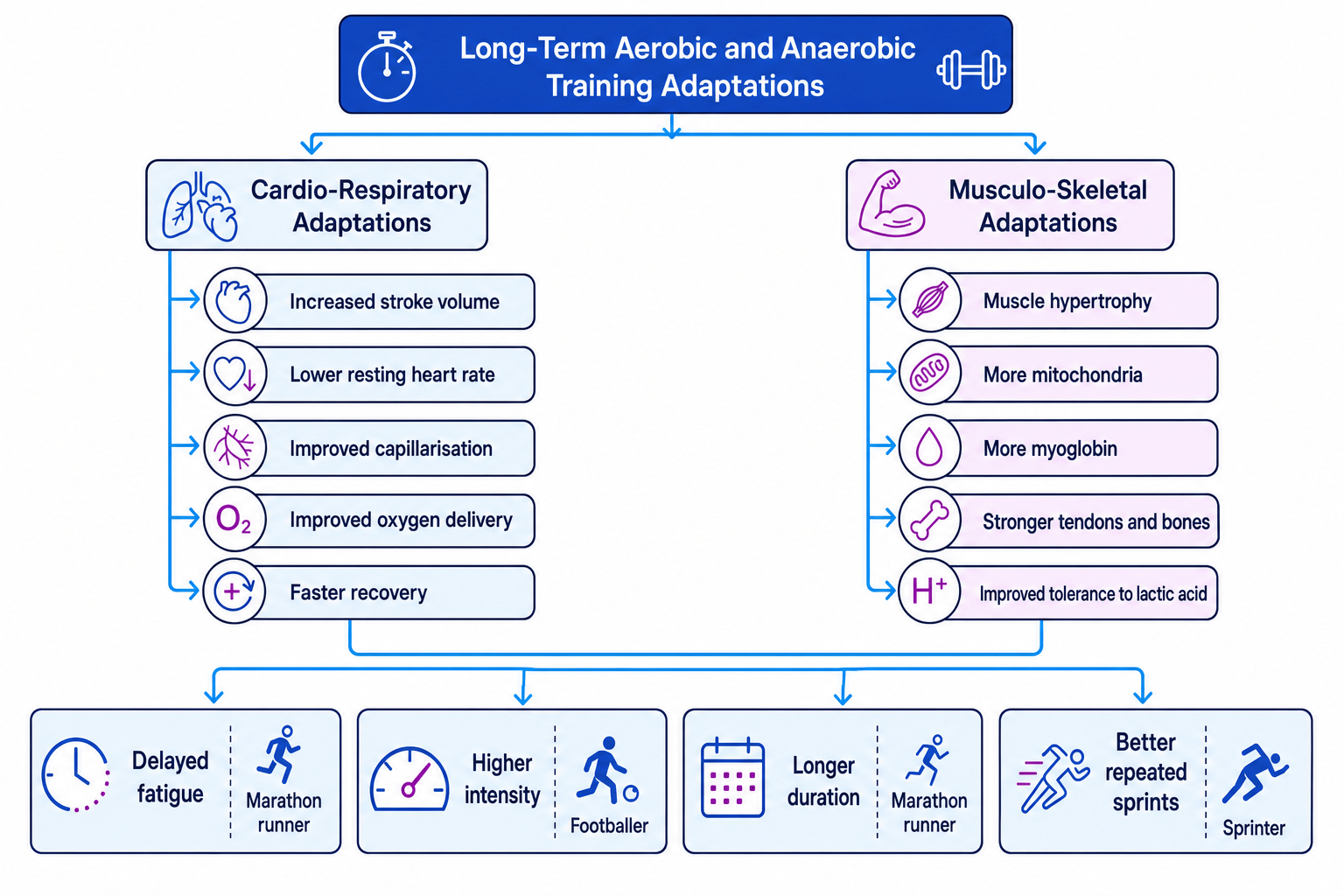
Long-term training effects mean your body can either keep working for longer before fatigue, or work at a higher intensity before reaching the same level of tiredness.
This diagram summarises the main adaptations and how they help performance.
Aerobic training: lasting longer
Aerobic training
Aerobic training is training where the body uses oxygen to release energy. It is important in longer-duration activities such as distance running, cycling, swimming, and team games where you keep moving for a long time.
Aerobic training mainly improves the cardio-respiratory system, which includes the heart, blood vessels, blood, lungs and breathing muscles.
Cardio-respiratory adaptations
Regular aerobic training can lead to:
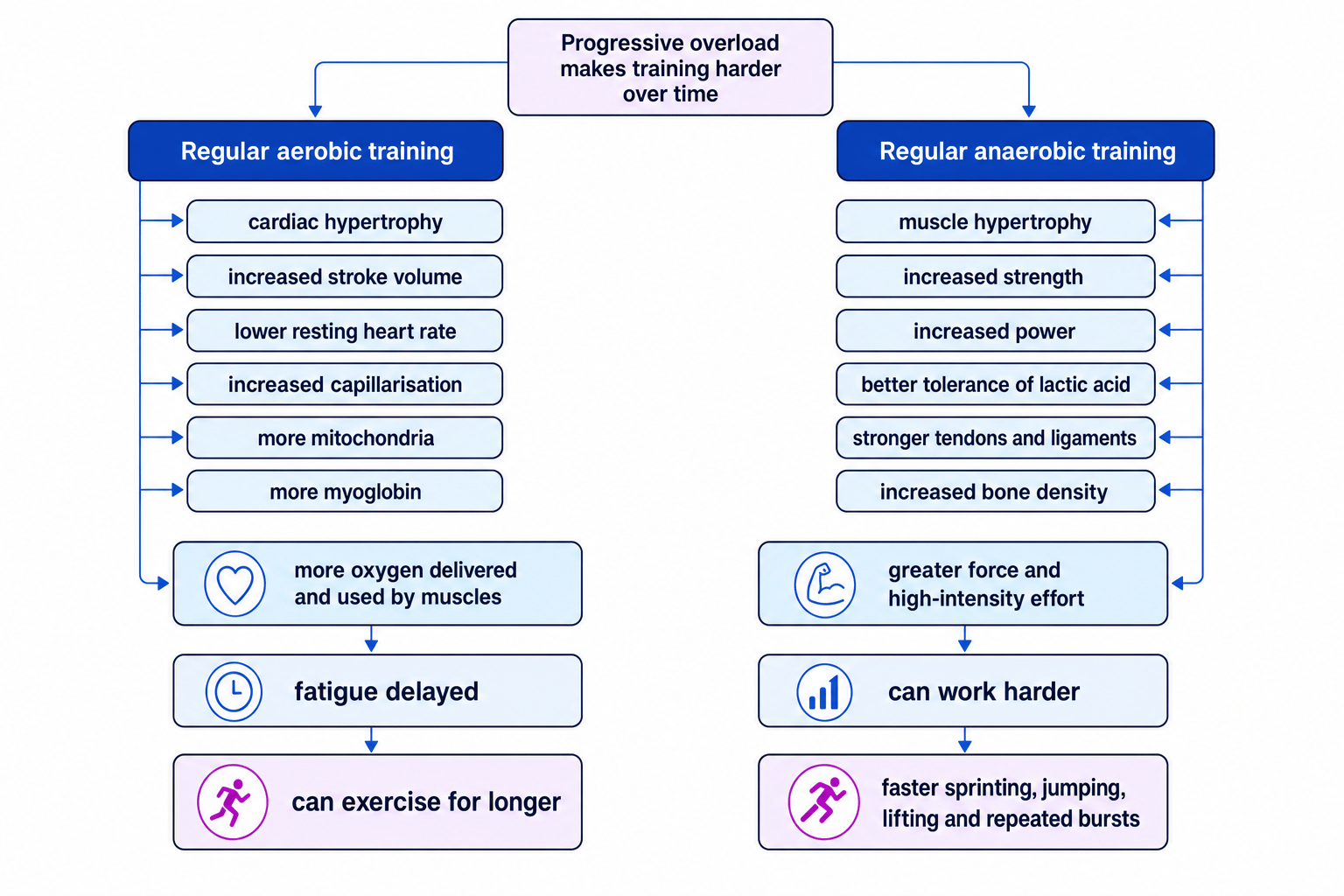
- Cardiac hypertrophy — the heart muscle becomes larger and stronger.
- Increased stroke volume — more blood is pumped out of the heart per beat.
- Lower resting heart rate — the heart does not need to beat as often at rest.
- Faster heart-rate recovery — heart rate returns to normal more quickly after exercise.
- Increased capillarisation — more capillaries around the muscles, improving oxygen delivery.
- Improved ability to transport and use oxygen.
Stroke volume
Stroke volume is the amount of blood pumped out of the heart with each beat.
If stroke volume increases, the heart can deliver the same amount of blood with fewer beats. That is why trained endurance performers often have a lower resting heart rate.
For a marathon runner, this means oxygen reaches the working leg muscles more efficiently, delaying fatigue and helping them maintain pace for longer.
Muscular adaptations from aerobic training
Aerobic training also changes the muscles themselves:
- More mitochondria, which are the parts of the muscle cells where aerobic energy release happens.
- More myoglobin, which helps store and transport oxygen inside muscle.
- Better use of fuels such as fats and carbohydrates.
- Improved muscular endurance, so muscles can keep contracting repeatedly.
Mitochondria
Mitochondria are structures inside cells where aerobic respiration takes place, releasing energy using oxygen.
A football midfielder benefits from these adaptations because they need to jog, sprint, recover, and repeat this pattern for the full match.
Using heart rate to judge training intensity
A 16-year-old cross-country runner wants to know whether 150 bpm is an aerobic training intensity.
-
Calculate maximum heart rate using the GCSE formula:
maximum heart rate=220−age=220−16=204 bpm\text{maximum heart rate} = 220 - \text{age} = 220 - 16 = 204 \text{ bpm}maximum heart rate=220−age=220−16=204 bpm -
Calculate 85% of maximum heart rate, which is around the upper end of the aerobic training zone:
204×0.85=173.4 bpm204 \times 0.85 = 173.4 \text{ bpm}204×0.85=173.4 bpm -
Compare the working heart rate with this value: 150 bpm is below about 173 bpm, so it fits within aerobic training intensity.
-
Apply this to performance: after long-term aerobic training, the runner may be able to run faster while still staying at a similar heart rate because their oxygen delivery and use have improved.
Anaerobic training: working harder
Anaerobic training
Anaerobic training is high-intensity training where the body releases energy without using oxygen quickly enough to meet the demand. It is important in short, powerful activities such as sprinting, jumping, throwing and heavy weight training.
Anaerobic training helps you train and perform at a higher intensity. It is especially useful when the activity involves explosive efforts or repeated bursts.
Musculo-skeletal adaptations
The musculo-skeletal system includes the muscles, bones, tendons, ligaments and joints.
Long-term anaerobic training can lead to:
- Muscle hypertrophy — muscles increase in size.
- Increased muscular strength.
- Increased muscular power.
- Stronger tendons and ligaments.
- Increased bone density, especially from weight-bearing exercise.
- Better tolerance of lactic acid during intense exercise.
Muscle hypertrophy
Muscle hypertrophy is an increase in muscle size, usually caused by resistance training or other high-intensity training.
For a 100 m sprinter, stronger leg muscles mean they can apply more force into the track. This helps with acceleration out of the blocks and maintaining speed.
For a rugby player, stronger muscles and connective tissues help them tackle, sprint and change direction at high intensity while reducing injury risk.
Linking anaerobic adaptations to sprint performance
A 200 m sprinter completes regular sprint interval training and resistance training.
-
Identify the demand of the event: 200 m is short and high intensity, so the performer needs speed, power and the ability to keep sprinting when fatigue builds.
-
Match the adaptations: muscle hypertrophy increases force production, while improved tolerance of lactic acid helps the sprinter maintain effort near the end of the race.
-
Apply to performance: the sprinter can accelerate more powerfully and slow down less in the final 50 m.
Lactic acid wording
Avoid saying “lactic acid gives the performer energy.” In GCSE PE, link lactic acid with fatigue during high-intensity exercise. Training helps the performer tolerate it better and recover more effectively.
How training lets you go for longer
You can train for longer when fatigue is delayed. This usually comes from aerobic adaptations.
A trained endurance performer may:
- Deliver more oxygen to working muscles.
- Use oxygen more efficiently in the muscles.
- Recover faster between efforts.
- Maintain technique for longer because muscles fatigue more slowly.
Sporting examples:
- A netball centre can keep moving into space late in the match.
- A cyclist can ride for 90 minutes instead of 60 minutes at a steady pace.
- A swimmer can complete more lengths before needing a rest.
Longer duration
Training for longer is mainly linked to improved aerobic fitness, better oxygen delivery, and improved muscular endurance.
How training lets you go harder
You can train harder when your body can cope with higher intensity.
This might mean:
- Running at a faster pace.
- Lifting a heavier weight.
- Sprinting with shorter rests.
- Completing more high-quality explosive efforts.
Anaerobic adaptations are especially important here, but aerobic fitness still helps because better recovery allows repeated bursts.
One-rep max
A one-rep max, or 1RM, is the maximum mass a performer can lift once with correct technique.
Showing how strength gains make training harder
A basketball player improves their squat 1RM from 60 kg to 75 kg after resistance training. They used to train with 45 kg.
-
Work out the old training load as a percentage of 1RM:
4560×100=75%\frac{45}{60} \times 100 = 75\%6045×100=75% -
Work out the same 45 kg load after their 1RM improves:
4575×100=60%\frac{45}{75} \times 100 = 60\%7545×100=60% -
Compare the two percentages: 45 kg has gone from 75% of 1RM to 60% of 1RM, so the same weight is now relatively easier.
-
Apply this to training harder: the player could increase the load to train strength at a higher intensity, helping them jump more powerfully for rebounds.
Aerobic and anaerobic training work together
Most sports are not purely aerobic or purely anaerobic.
A footballer needs aerobic fitness to keep working for 90 minutes, but also anaerobic power to sprint, shoot and jump. A 400 m runner needs anaerobic speed and power, but also enough endurance to resist fatigue near the end.
So, long-term training often improves both:
- The cardio-respiratory system, so oxygen delivery and recovery improve.
- The musculo-skeletal system, so muscles, bones and connective tissues cope with harder work.
Best exam-link structure
Use this chain: training type → body adaptation → performance benefit → sporting example.
For example: “Aerobic training increases capillarisation, so more oxygen reaches the leg muscles, delaying fatigue for a marathon runner.”
Bringing it together
Long-term training makes the body more efficient and more powerful. The key is to connect the adaptation to the performance outcome.
If you just write “increased stroke volume,” that is knowledge. To earn stronger marks, explain the effect: more blood is pumped per beat, more oxygen reaches the muscles, and the performer can continue exercising for longer before fatigue.
If you just write “muscle hypertrophy,” add the application: the performer can produce more force, helping a sprinter accelerate or a weightlifter lift a heavier load.
In the exam
- State whether the adaptation is mainly aerobic or anaerobic, then name the body system it affects.
- Always link the adaptation to a performance benefit, such as delayed fatigue, higher intensity, faster recovery, greater strength or more power.
- Use a clear sporting example, such as a marathon runner, sprinter, footballer, netball player, swimmer or weightlifter.
Check yourself
- How does increased stroke volume help an endurance performer train for longer?
- Why does muscle hypertrophy help a performer work at a higher intensity?
- Give one aerobic and one anaerobic adaptation that would help a footballer during a match.