Skip to content

Course home

Similar Shapes (Area and Volume)

Similar Shapes (Area and Volume)

MediumHard
1234567891011121314151617181920212223
Question 5

The diagram represents a large glass cone of height 12 cm and base diameter 18 cm. The large cone is made by placing a small cone P of height 8 cm and base diameter 12 cm on top of a frustum Q.
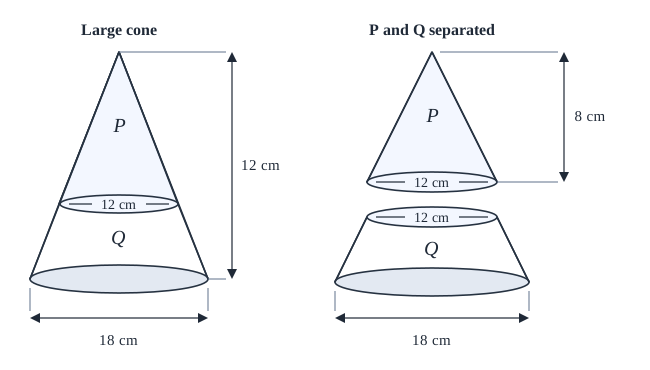
The diagram shows a large cone of height 12 cm and base diameter 18 cm, and shows small cone P of height 8 cm and base diameter 12 cm above frustum Q, both together and separated.

Volume of cone=13πr2h \text{Volume of cone} = \frac{1}{3}\pi r^2 h Volume of cone=31​πr2h Curved surface area of cone=πrl \text{Curved surface area of cone} = \pi r l Curved surface area of cone=πrl

Calculate the volume of the frustum Q. Give your answer in terms of π\piπ.

[4]
Markscheme

Similar Shapes (Area and Volume) Questions

  1. GCSE
  2. /Maths
  3. /Similar Shapes (Area and Volume)

40 exam-style questions on OCR GCSE Maths Similar Shapes (Area and Volume). Each one has a worked solution and a mark scheme showing where the marks go.

Question bank