Revision notes for Edexcel GCSE Maths Quadratic Simultaneous Equations. Open the guide for explanations and worked examples. Written against the Edexcel GCSE Maths (1MA1) specification, so the content matches what's examinable rather than general Maths background.
Quadratic Simultaneous Equations
What you'll learn
How to recognise a linear equation paired with a quadratic equation.
How substitution turns the pair into one quadratic in one variable.
How to solve by factorising or using the quadratic formula.
How to keep answer pairs matched, including when rounding to 3 significant figures.
1. The big picture
Definition
Simultaneous equations
Simultaneous equations are equations that must be true at the same time. A solution is an ordered pair, such as (x,y)(x, y)(x,y), that satisfies every equation in the set.
An ordered pair lists the xxx-value first and the yyy-value second. For example, (2,5)(2, 5)(2,5) means x=2x = 2x=2 and y=5y = 5y=5.
A linear equation has variables only to the first power, such as 2x+y=72x + y = 72x+y=7; its graph is a straight line. A quadratic equation has a squared term, such as x2+y2=34x^2 + y^2 = 34x2+y2=34 or 2x2−y2=142x^2 - y^2 = 142x2−y2=14; its graph is curved.
Example
Checking a possible solution
Suppose you are checking whether (2,5)(2, 5)(2,5) solves these equations:
$$
\begin{aligned}
x^2 + y^2 &= 29 \\
y &= x + 3
\end{aligned}
$$
2. Test the linear equation y=x+3y = x + 3y=x+3.
$$
5 = 2 + 3
$$
3. Test the quadratic equation x2+y2=29x^2 + y^2 = 29x2+y2=29.
$$
2^2 + 5^2 = 4 + 25 = 29
$$
4. Both equations are true, so (2,5)(2, 5)(2,5) is a solution.
2. The main method: substitution
Substitution means replacing a variable with an equal expression. The subject of an equation is the variable isolated on one side; in x=y−1x = y - 1x=y−1, xxx is the subject.
Key Idea
The method to remember
Use the linear equation to replace one variable in the quadratic equation. This gives you one quadratic equation in one variable.
Definition
Standard form of a quadratic
A quadratic in one variable is in standard form when it is written as ax2+bx+c=0ax^2 + bx + c = 0ax2+bx+c=0, where a≠0a \neq 0a=0.
Factorising means rewriting an expression as a product of brackets. The roots of an equation are its solutions.
Example
Substitution when a variable is already the subject
Solve the simultaneous equations:
$$
\begin{aligned}
x^2 + y^2 &= 25 \\
x &= y - 1
\end{aligned}
$$
2. Substitute x=y−1x = y - 1x=y−1 into x2+y2=25x^2 + y^2 = 25x2+y2=25.
$$
(y - 1)^2 + y^2 = 25
$$
3. Expand the bracket.
$$
y^2 - 2y + 1 + y^2 = 25
$$
4. Rearrange into standard form, then divide by 2.
Use x=y−1x = y - 1x=y−1 to find the matching xxx-values: if y=4y = 4y=4, then x=3x = 3x=3; if y=−3y = -3y=−3, then x=−4x = -4x=−4.
The solutions are (3,4)(3, 4)(3,4) and (−4,−3)(-4, -3)(−4,−3).
Common Mistake
Unpaired answers
Writing separate lists of xxx-values and yyy-values is not enough unless the pairings are clear. Always give coordinate pairs.
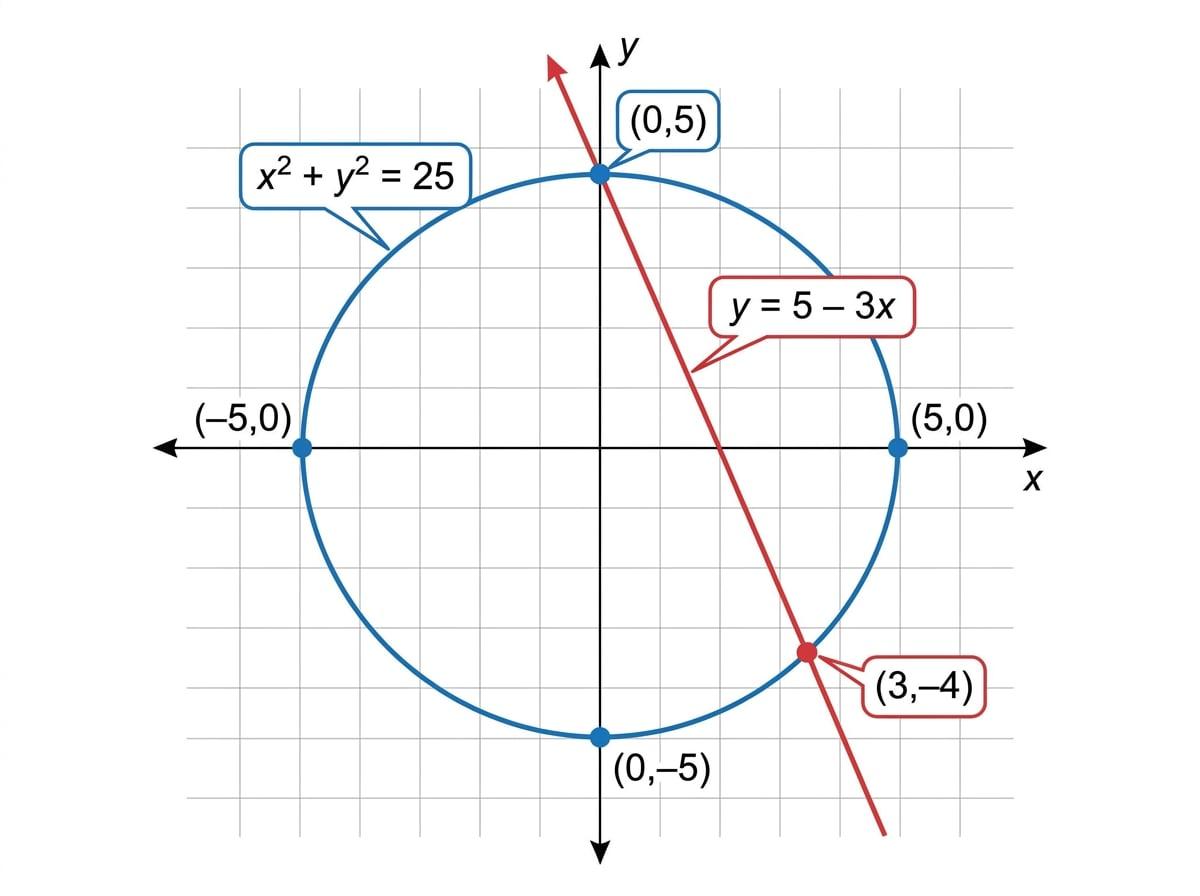
3. When the linear equation needs rearranging
Sometimes the linear equation is not already written as x=…x = \dotsx=… or y=…y = \dotsy=…. Rearrange it first, choosing the variable that looks easiest to substitute.
Use y=5−3xy = 5 - 3xy=5−3x: if x=0x = 0x=0, then y=5y = 5y=5; if x=3x = 3x=3, then y=−4y = -4y=−4.
The solutions are (0,5)(0, 5)(0,5) and (3,−4)(3, -4)(3,−4).
Common Mistake
Squaring a whole expression
When substituting y=5−3xy = 5 - 3xy=5−3x, write (5−3x)2(5 - 3x)^2(5−3x)2. Do not treat it as 5−3x25 - 3x^25−3x2.
4. When the quadratic does not factorise nicely
If factorising is awkward, use the quadratic formula. A coefficient is the number multiplying a term; in 5x2−16x−2=05x^2 - 16x - 2 = 05x2−16x−2=0, the coefficients are a=5a = 5a=5, b=−16b = -16b=−16 and c=−2c = -2c=−2.
The expression b2−4acb^2 - 4acb2−4ac is the discriminant. If it is positive, you get two real roots; if it is zero, you get one repeated root.
Common Mistake
When there are no real answers
If the discriminant b2−4acb^2 - 4acb2−4ac is negative, the square root is not a real number. That means the line does not meet the curve in real coordinate pairs.
5. Calculator values give x≈3.320…x \approx 3.320\ldotsx≈3.320… or x≈−0.120…x \approx -0.120\ldotsx≈−0.120….
Use y=4−2xy = 4 - 2xy=4−2x with the unrounded values: y≈−2.640…y \approx -2.640\ldotsy≈−2.640… or y≈4.240…y \approx 4.240\ldotsy≈4.240….
To 3 significant figures, the solutions are (3.32,−2.64)(3.32, -2.64)(3.32,−2.64) and (−0.120,4.24)(-0.120, 4.24)(−0.120,4.24).
Tip
Rounding safely
Keep full calculator values until the final line. Rounding too early can make the matching coordinate slightly inaccurate.
5. Harder algebraic examples
Definition
Solve algebraically
Solving algebraically means using equation steps such as rearranging, substituting, expanding and factorising, rather than reading answers from a graph or table.
Some Grade 8/9 questions include equations such as x2−2y2=7x^2 - 2y^2 = 7x2−2y2=7 or 2x2−y2=142x^2 - y^2 = 142x2−y2=14. The method is still the same: rearrange the line, substitute, then solve the quadratic.