Conditional Probability
x

Revision notes for Edexcel GCSE Maths Conditional Probability. Open the guide for explanations and worked examples. Written against the Edexcel GCSE Maths (1MA1) specification, so the content matches what's examinable rather than general Maths background.

Conditional Probability

What you'll learn

  • How to complete probability tree diagrams when the second probability depends on the first event.
  • How to calculate probabilities for “same colour”, “different colours”, and “one of each”.
  • How to use the rules “multiply along branches” and “add separate routes”.
  • How to combine Venn-style counting with conditional probability.

1. Tree diagrams and complements

A probability tree diagram is a branching diagram showing possible sequences of events. Each branch is labelled with a probability.

An event is something that may happen, such as “the first counter is red”. The complement of an event is its opposite, such as “not red”.

Branches leaving the same point must add to 1.

Example

Completing missing branches

A student chooses either a blue pen or a black pen on Monday and Tuesday. On Monday, the probability of blue is 0.65. If Monday is blue, the probability of blue on Tuesday is 0.4. If Monday is black, the probability of blue on Tuesday is 0.7.

Completed probability tree for choosing a blue or black pen on Monday and Tuesday, with each pair of branches adding to 1.

  1. Monday has only two options, so the probability of black on Monday is:

    1−0.65=0.351 - 0.65 = 0.351−0.65=0.35
  2. If Monday is blue, Tuesday blue has probability 0.4, so Tuesday black has probability:

    1−0.4=0.61 - 0.4 = 0.61−0.4=0.6
  3. If Monday is black, Tuesday blue has probability 0.7, so Tuesday black has probability:

    1−0.7=0.31 - 0.7 = 0.31−0.7=0.3
Tip

Complements are quick marks

If there are only two possible outcomes, you usually only need to subtract from 1 to find the missing branch.

2. What conditional probability means

Definition

Conditional probability

A conditional probability is the probability of something happening given that something else has already happened. It is written as P(B∣A)P(B \mid A)P(B∣A), meaning “the probability of B given A”.

Conditional probability is especially important when objects are chosen without replacement, meaning the first object is not put back before the second choice. The total number left goes down by one.

Example

Updating a bag after the first counter

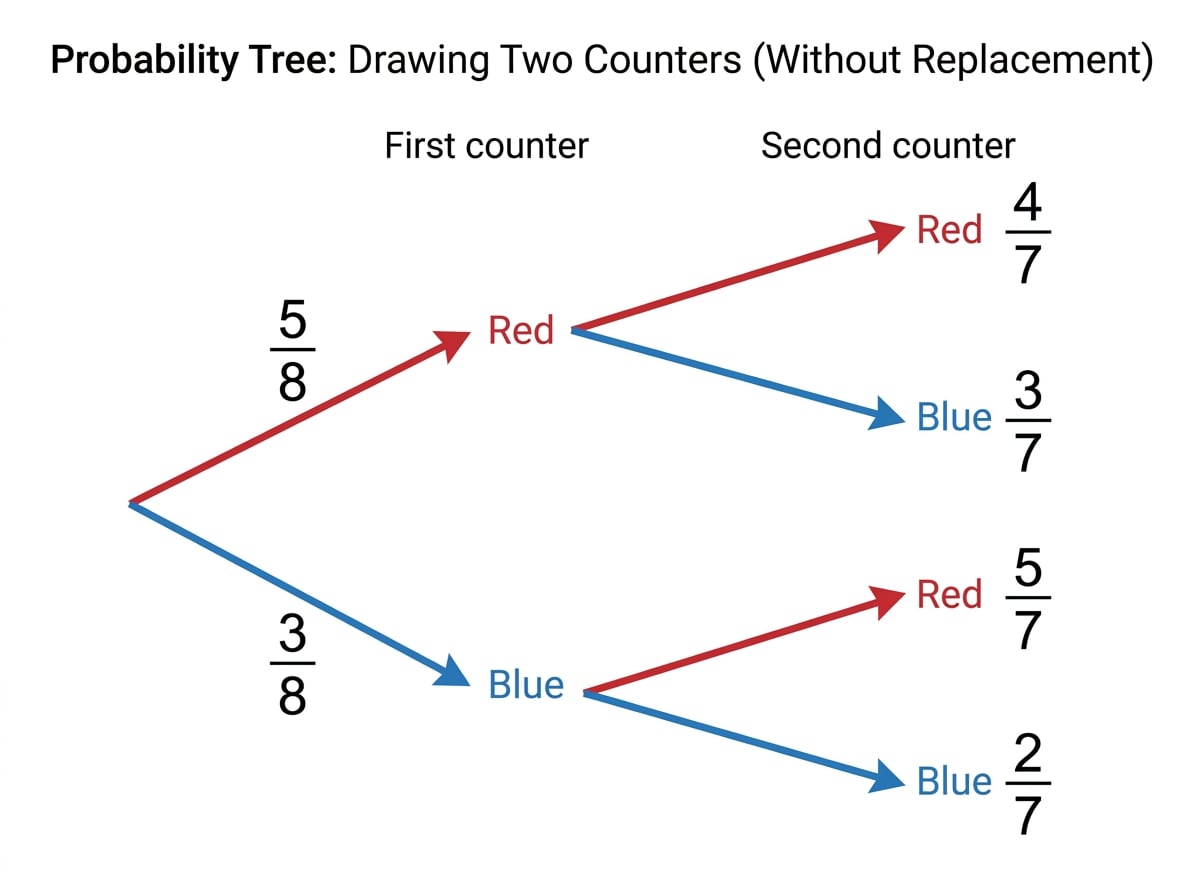
A bag contains 5 red counters and 3 blue counters. Two counters are chosen without replacement. Work out the probabilities on the second set of branches.

Without replacement, the second-branch probabilities depend on which colour was chosen first.

  1. At the start, there are 8 counters, so:

    P(red first)=58,P(blue first)=38P(\text{red first})=\frac{5}{8}, \quad P(\text{blue first})=\frac{3}{8}P(red first)=85​,P(blue first)=83​
  2. If the first counter is red, there are now 4 red and 3 blue counters left, from 7 counters:

    P(red second∣red first)=47,P(blue second∣red first)=37P(\text{red second} \mid \text{red first})=\frac{4}{7}, \quad P(\text{blue second} \mid \text{red first})=\frac{3}{7}P(red second∣red first)=74​,P(blue second∣red first)=73​
  3. If the first counter is blue, there are now 5 red and 2 blue counters left, from 7 counters:

    P(red second∣blue first)=57,P(blue second∣blue first)=27P(\text{red second} \mid \text{blue first})=\frac{5}{7}, \quad P(\text{blue second} \mid \text{blue first})=\frac{2}{7}P(red second∣blue first)=75​,P(blue second∣blue first)=72​
Common Mistake

Forgetting the bag has changed

After a counter is taken without replacement, both the number of counters of that colour and the total number of counters change.

3. Multiplying along a route

A route in a tree diagram is one complete path through the tree, such as “red then blue”.

Key Idea

The AND rule

For a sequence of events, multiply along the branches:

P(A and B)=P(A)×P(B∣A)P(A \text{ and } B)=P(A)\times P(B \mid A)P(A and B)=P(A)×P(B∣A)
Example

Two counters the same colour

A bag has 7 red counters and 5 green counters. Two counters are chosen without replacement. Find the probability that both counters are the same colour.

The same-colour event is made from two separate tree routes: red then red or green then green.

  1. “Same colour” can happen in two separate ways: red then red, or green then green.

  2. Multiply along the red-red route:

    712×611=42132\frac{7}{12}\times\frac{6}{11}=\frac{42}{132}127​×116​=13242​
  3. Multiply along the green-green route:

    512×411=20132\frac{5}{12}\times\frac{4}{11}=\frac{20}{132}125​×114​=13220​
  4. Add the two routes because they are separate possibilities:

    42132+20132=62132=3166\frac{42}{132}+\frac{20}{132}=\frac{62}{132}=\frac{31}{66}13242​+13220​=13262​=6631​

4. Adding separate routes

Two outcomes are mutually exclusive if they cannot both happen at the same time. For example, “red then red” and “green then green” are mutually exclusive routes.

When a question says “one of each” or “different colours”, remember there are usually two possible orders.

Example

Different colours on two days

On Monday, the probability that Sam wears a black tie is 0.55. If he wears black on Monday, the probability he wears black on Tuesday is 0.3. If he does not wear black on Monday, the probability he wears black on Tuesday is 0.8. Find the probability he wears different coloured ties.

Different-colour ties come from two routes: black then not black, or not black then black.

  1. Different colours means black then not black, or not black then black.

  2. Find the useful complements:

    P(not black on Monday)=1−0.55=0.45P(\text{not black on Monday})=1-0.55=0.45P(not black on Monday)=1−0.55=0.45
  3. If Monday is black, the probability Tuesday is not black is:

    1−0.3=0.71-0.3=0.71−0.3=0.7
  4. Multiply along both routes and add:

    (0.55×0.7)+(0.45×0.8)=0.385+0.36=0.745(0.55\times 0.7)+(0.45\times 0.8)=0.385+0.36=0.745(0.55×0.7)+(0.45×0.8)=0.385+0.36=0.745
Common Mistake

Only counting one order

For “one red and one blue”, you need red then blue and blue then red, unless the question fixes the order.

5. More than two categories

If there are three colours or several different number cards, treat each colour or number as its own category. For “same”, add all matching routes. For “second greater than first”, consider what could come second after each possible first card.

Example

Second card greater than the first

There are five cards: 1, 1, 2, 2, and 4. Two cards are chosen without replacement. Find the probability that the second card is greater than the first.

Grouping the first card as 1, 2, or 4 shows how many greater cards can remain for the second pick.

  1. If the first card is 1, there are 3 greater cards left: 2, 2, and 4.

    25×34=620\frac{2}{5}\times\frac{3}{4}=\frac{6}{20}52​×43​=206​
  2. If the first card is 2, there is 1 greater card left: 4.

    25×14=220\frac{2}{5}\times\frac{1}{4}=\frac{2}{20}52​×41​=202​
  3. If the first card is 4, there are no greater cards left.

    15×0=0\frac{1}{5}\times 0=051​×0=0
  4. Add the possible routes:

    620+220+0=820=25\frac{6}{20}+\frac{2}{20}+0=\frac{8}{20}=\frac{2}{5}206​+202​+0=208​=52​

6. Survey and Venn-style questions

A Venn diagram sorts people or objects into overlapping groups. An overlap means someone is in both groups.

In these questions, first work out how many people are in the group you need. Then use probability without replacement.

Tip

Watch the wording

“Tea and coffee” usually includes people who also like a third drink. “Tea and coffee but not juice” means that exact overlap only.

Example

Finding the group first

40 students are asked whether they like tea, coffee, and juice. Everyone likes at least one. 12 like all three. 26 like tea. 22 like juice. 17 like tea and coffee. 5 like tea and juice but not coffee. 3 like coffee and juice but not tea. Two students are chosen at random. Find the probability that both like coffee.

The completed three-circle Venn diagram gives 29 students in the coffee circle before the without-replacement probability is used.

  1. Tea and coffee includes the 12 who like all three, so tea and coffee only is:

    17−12=517-12=517−12=5
  2. Tea only is found from the tea total:

    26−5−5−12=426-5-5-12=426−5−5−12=4
  3. Juice only is found from the juice total:

    22−5−3−12=222-5-3-12=222−5−3−12=2
  4. Find coffee only by subtracting all known regions from 40:

    40−(4+2+5+5+3+12)=940-(4+2+5+5+3+12)=940−(4+2+5+5+3+12)=9
  5. So the total number who like coffee is:

    9+5+3+12=299+5+3+12=299+5+3+12=29
  6. Both chosen students must like coffee, without replacement:

    2940×2839=203390\frac{29}{40}\times\frac{28}{39}=\frac{203}{390}4029​×3928​=390203​
Exam technique

In the exam

  1. Write the routes you need before calculating, such as “RR or BB” or “black then red or red then black”.
  2. Multiply along a route, then add different routes.
  3. For without replacement, update the numerator and denominator after the first choice.
Self review

Check yourself

  • If a red counter is taken and not replaced, what changes before the second pick?
  • Why does “one of each colour” usually have two routes?
  • In a Venn-style question, what is the difference between “A and B” and “A and B but not C”?

Recap questions

Test yourself with 5 quick questions on this guide. Answer them all correctly to complete it.

You've reached the end

Test yourself on this topic, or move on to the next guide.

Practice questionsTake a quick quiz on this topicFlashcardsSelf-test with active recall
Quadratic Simultaneous EquationsUp next

How was this guide?

Conditional Probability Revision Guide

  1. GCSE
  2. /Maths
  3. /Conditional Probability