- How to count choices without listing every possibility.
- When to multiply the number of options.
- How to deal with unknown numbers of choices, like xxx drinks.
- When to divide by 2 for pairs, matches and handshakes.
In counting questions, you often make a decision in parts.
A stage is one part of a decision, such as choosing a sandwich first, then choosing a drink.
Options and outcomes
- An option is one possible choice at a single stage.
- An outcome is one complete result after all stages have been chosen.
For example, if you choose one sandwich and one drink, then “cheese sandwich with orange juice” is one complete outcome.
Listing first to see the pattern
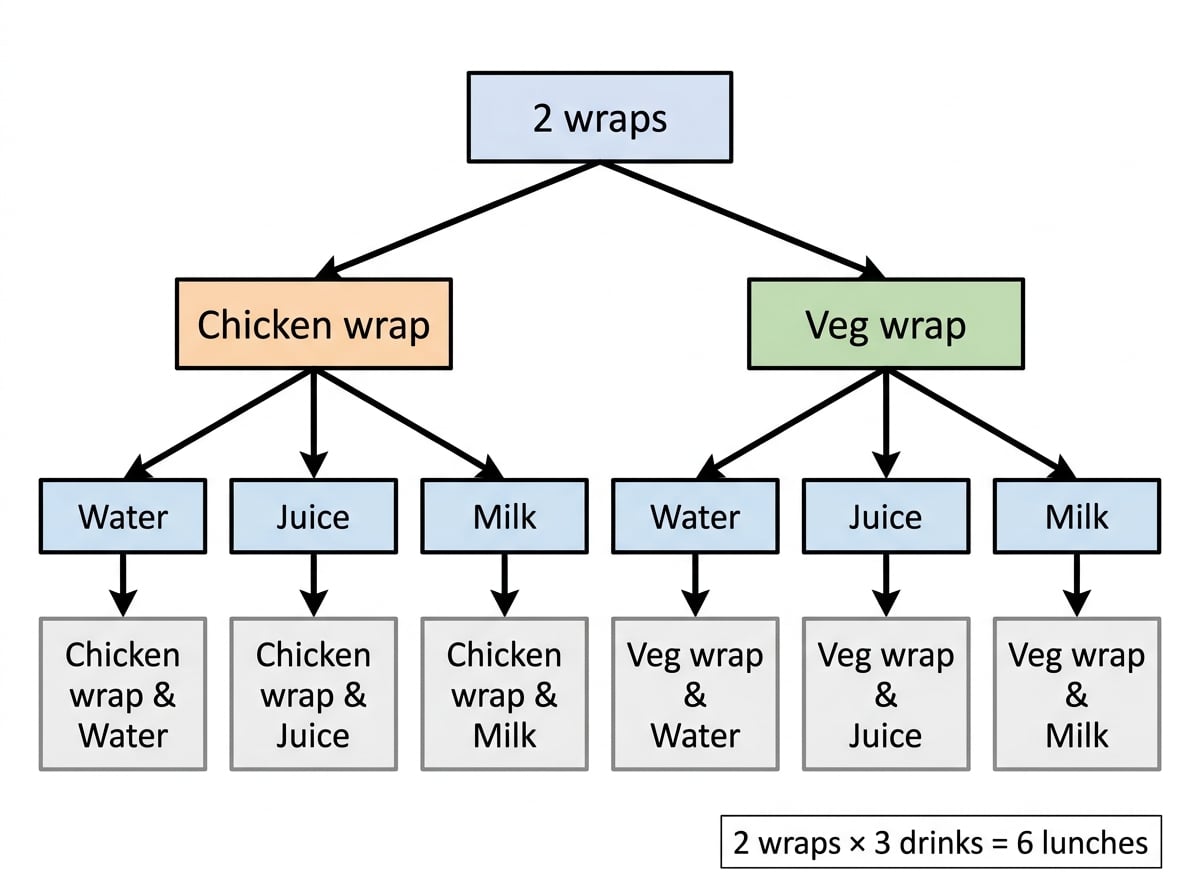
A lunch offer has 2 wraps and 3 drinks. How many different lunches are possible?

-
Start with the first wrap. It can go with any of the 3 drinks.
-
Start with the second wrap. It can also go with any of the 3 drinks.
-
So there are 3 outcomes for the first wrap and 3 outcomes for the second wrap.
-
The total number of lunches is 6.
Listing is fine for small numbers, but it gets slow very quickly. That is where the product rule helps.
The product rule for counting
If a task has one stage with aaa options and another stage with bbb options, and every option from the first stage can go with every option from the second stage, then the number of outcomes is a×ba \times ba×b.
One from each group means multiply
When you choose one item from each separate group, multiply the number of choices in each group.
Choosing one boy and one girl
A club has 11 boys and 13 girls. One boy and one girl are chosen for a presentation. How many different pairs are possible?

-
There are 11 choices for the boy.
-
For each boy, there are 13 choices for the girl.
-
Multiply the number of choices:
11×13=14311 \times 13 = 14311×13=143
-
There are 143 possible boy-and-girl pairs.
Adding instead of multiplying
Do not do 11 + 13 here. Adding would only tell you how many students there are altogether, not how many boy-and-girl pairs can be made.
The product rule works for more than two choices as well. If you choose a starter, then a main course, then a dessert, that is 3 stages.
You multiply all the stage counts together.
Choosing a three-course meal
A restaurant offers 4 starters, 6 main courses and 3 desserts. How many different three-course meals can be chosen?

-
There are 4 choices for the starter.
-
For each starter, there are 6 choices for the main course.
-
For each starter-and-main combination, there are 3 choices for dessert.
-
Multiply all three numbers:
4×6×3=724 \times 6 \times 3 = 724×6×3=72
-
There are 72 possible three-course meals.
Read the word “and” carefully
In these questions, “choose a starter and a main and a dessert” usually means one from each group, so you multiply the choices.
Check all combinations are allowed
The product rule works directly when every option at one stage can go with every option at the next stage. If some combinations are not allowed, you may need to subtract or count cases separately.
Sometimes a question gives the total number of outcomes and asks whether a claim could be correct.
If the unknown number of choices is written as xxx, set up a multiplication equation using the product rule.
A number of choices must be a whole number, such as 0, 1, 2, 3 and so on. It cannot be a decimal.
Checking whether a claim could be correct
A meal deal has 8 sandwich choices and xxx drink choices. Sam says there are 90 possible meal deals. Could Sam be correct?

-
Use the product rule:
8×x=908 \times x = 908×x=90
-
Find xxx by dividing 90 by 8:
x=90÷8=11.25x = 90 \div 8 = 11.25x=90÷8=11.25
-
The number of drink choices must be a whole number.
-
Since 11.25 drinks is impossible, Sam cannot be correct.
Stopping after the division
In “could this be correct?” questions, you must say whether the value of xxx makes sense. A decimal number of people, drinks or desserts is not possible.
Some counting questions involve choosing from the same group more than once.
For example, if you deal cards from a deck, once a card has been given out, it cannot be chosen again.
Without replacement
Without replacement means that once an item has been chosen, it is not put back, so there is one fewer option next time.
Giving cards to two named people
A full deck has 52 cards. One card is given to Maya and one card is given to Leo. How many different ways can this happen?

-
Maya can receive any one of the 52 cards.
-
After Maya has received a card, there are 51 cards left for Leo.
-
Multiply the choices:
52×51=265252 \times 51 = 265252×51=2652
-
There are 2652 different ways.
Here, the people are named. Maya getting the ace and Leo getting the king is different from Maya getting the king and Leo getting the ace.
Forgetting the choice has gone
Do not use 52 choices for both people. The second person only has 51 choices because one card has already been given away.
Sometimes you are just choosing a pair, with no first person and second person.
An unordered pair is a pair where the order does not matter. For example, Alex and Ben is the same pair as Ben and Alex.
If there are nnn items and you choose 2 of them as a pair, the product rule first gives n(n−1)n(n-1)n(n−1), but that counts every pair twice.
So the number of pairs is:
n(n−1)2\frac{n(n-1)}{2}2n(n−1)
Pairs are counted twice
For pairs, matches and handshakes, divide by 2 because each pair can be listed in two orders.
Choosing two students for the same prize
There are 28 students in a year group. Two students are chosen to receive the same prize. How many different pairs could be chosen?

-
If the students were chosen as first and second, there would be 28 choices, then 27 choices.
-
Multiply and then divide by 2 because the order does not matter:
28×272=378\frac{28 \times 27}{2} = 378228×27=378
-
There are 378 possible pairs of students.
The same idea applies to teams playing matches and people shaking hands. A match between Team A and Team B is the same match as Team B against Team A.
Counting games between teams
There are 9 teams in a league. Each team plays every other team once. How many games are played?

-
Choose the first team in 9 ways.
-
Choose the second team in 8 ways.
-
This counts each game twice, so divide by 2:
9×82=36\frac{9 \times 8}{2} = 3629×8=36
-
There are 36 games in total.
Counting both directions as new games
For ordinary matches or handshakes, Team A against Team B is not a different event from Team B against Team A. Divide by 2 unless the roles are different.
In the exam
-
Identify the stages: what is being chosen first, second, third?
-
Multiply when you need one choice from each separate group.
-
If items are chosen from the same group, reduce the number of options each time.
-
Ask whether order matters. If you are just making pairs, divide by 2.
-
If there is an unknown like xxx, solve for it and check it is a whole number.
Check yourself
-
Why do you multiply for a meal with one starter and one main course?
-
When giving two cards to two named people, why does the second person have fewer choices?
-
Why do handshake questions usually involve dividing by 2?