Revision notes for Edexcel GCSE Maths Spheres and Cones. Open the guide for explanations and worked examples. Written against the Edexcel GCSE Maths (1MA1) specification, so the content matches what's examinable rather than general Maths background.
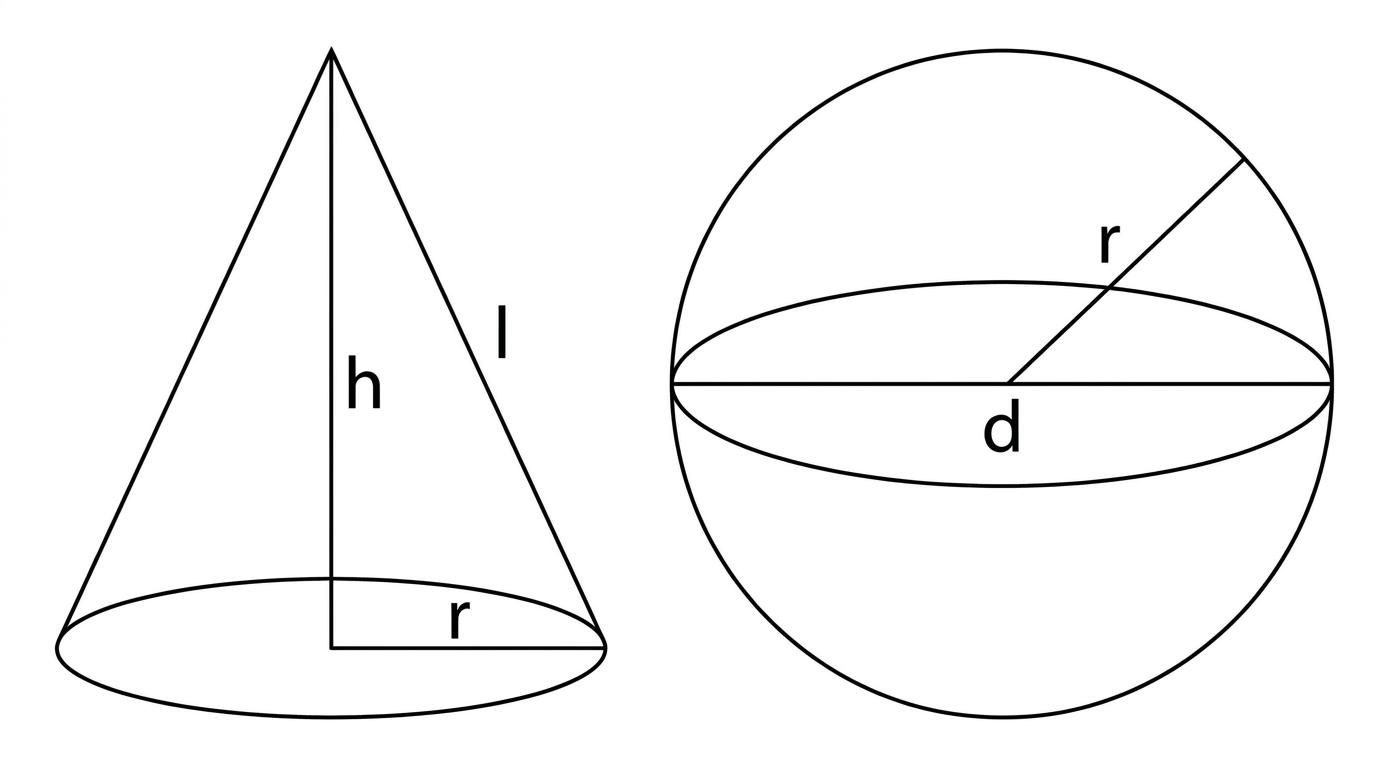
The letters in the formulas

Find the radius first
Most sphere and cone formulas use the radius, not the diameter. If you are given a diameter, halve it before using a formula.
Reading a cone diagram
A cone has base diameter 14 cm and vertical height 20 cm. Find the values of rrr and hhh.

The vertical height is already given.
h=20h=20h=20Halve the diameter to find the radius.
r=142=7r=\frac{14}{2}=7r=214=7Use r=7r=7r=7 and h=20h=20h=20 in any cone formula.
For a cone:
Vcone=13πr2hV_{\text{cone}}=\frac{1}{3}\pi r^2hVcone=31πr2hFor a sphere:
Vsphere=43πr3V_{\text{sphere}}=\frac{4}{3}\pi r^3Vsphere=34πr3A hemisphere is half a sphere, so its volume is half the sphere volume.
Volume of a cone
A cone has height 18 cm and base diameter 10 cm. Work out its volume to 3 significant figures.

Find the radius.
r=102=5r=\frac{10}{2}=5r=210=5Substitute into the cone volume formula.
V=13π×52×18V=\frac{1}{3}\pi \times 5^2 \times 18V=31π×52×18Calculate.
V=150π≈471.239V=150\pi \approx 471.239V=150π≈471.239The volume is 471 cm³ to 3 significant figures.
Rounding
Do all calculator work first, then round at the end. Rounding too early can make your final answer less accurate.
Surface area words
For a sphere:
Asphere=4πr2A_{\text{sphere}}=4\pi r^2Asphere=4πr2For a solid hemisphere, take half the sphere surface area, then add the flat circular base:
Atotal hemisphere=2πr2+πr2=3πr2A_{\text{total hemisphere}}=2\pi r^2+\pi r^2=3\pi r^2Atotal hemisphere=2πr2+πr2=3πr2Total surface area of a hemisphere
A solid hemisphere has radius 7 cm. Work out its total surface area in terms of π\piπ.

Use the total surface area formula for a solid hemisphere.
A=3πr2A=3\pi r^2A=3πr2Substitute r=7r=7r=7.
A=3π×72A=3\pi \times 7^2A=3π×72Simplify.
A=147πA=147\piA=147πThe total surface area is 147π147\pi147π cm².
For a cone:
Acurved cone=πrlA_{\text{curved cone}}=\pi rlAcurved cone=πrlSo for a solid cone:
Atotal cone=πrl+πr2A_{\text{total cone}}=\pi rl+\pi r^2Atotal cone=πrl+πr2Forgetting the flat circle
For a solid cone or solid hemisphere, total surface area includes the flat circular face. Curved surface area alone is not the total surface area.
Sometimes a cone question gives the vertical height, not the slant height.
Pythagoras' theorem
In a right-angled triangle, the square of the longest side equals the sum of the squares of the other two sides. In a cone cross-section, lll is the longest side, so l2=h2+r2l^2=h^2+r^2l2=h2+r2.

Cone surface area when height is given
A solid cone has vertical height 8 cm and base diameter 12 cm. Work out its total surface area in terms of π\piπ.

Find the radius.
r=122=6r=\frac{12}{2}=6r=212=6Use Pythagoras to find the slant height.
l2=82+62=100l^2=8^2+6^2=100l2=82+62=100Square root to find lll.
l=10l=10l=10Add curved area and base area.
A=π×6×10+π×62=96πA=\pi \times 6 \times 10+\pi \times 6^2=96\piA=π×6×10+π×62=96πThe total surface area is 96π96\pi96π cm².
Compound solid
A compound solid is a 3D shape made by joining simpler 3D shapes. For volume, add the volumes of the separate parts.
Cone on a hemisphere
A shape is made from a cone on top of a hemisphere. Both have diameter 8 cm. The cone has height 9 cm. Find the total volume in terms of π\piπ.

Find the shared radius.
r=82=4r=\frac{8}{2}=4r=28=4Find the cone volume.
Vcone=13π×42×9=48πV_{\text{cone}}=\frac{1}{3}\pi \times 4^2 \times 9=48\piVcone=31π×42×9=48πFind the hemisphere volume.
Vhemisphere=12×43π×43=1283πV_{\text{hemisphere}}=\frac{1}{2}\times \frac{4}{3}\pi \times 4^3=\frac{128}{3}\piVhemisphere=21×34π×43=3128πAdd the two volumes.
Vtotal=48π+1283π=2723πV_{\text{total}}=48\pi+\frac{128}{3}\pi=\frac{272}{3}\piVtotal=48π+3128π=3272πThe total volume is 2723π\frac{272}{3}\pi3272π cm³.
In terms of pi
If the question asks for an answer in terms of π\piπ, leave π\piπ in your answer instead of converting to a decimal.
Sometimes you know the volume and need to find the radius. A cube root undoes cubing.
Sphere and cube with equal volume
A cube has side length 6 cm. A sphere has the same volume as the cube. Find the radius of the sphere to 3 significant figures.
Find the cube volume.
Vcube=63=216V_{\text{cube}}=6^3=216Vcube=63=216Set the sphere volume equal to 216.
43πr3=216\frac{4}{3}\pi r^3=21634πr3=216Rearrange to find r3r^3r3.
r3=216×34π=162πr^3=\frac{216\times 3}{4\pi}=\frac{162}{\pi}r3=4π216×3=π162Cube root to find rrr.
r=162π3≈3.72r=\sqrt[3]{\frac{162}{\pi}}\approx 3.72r=3π162≈3.72The radius is 3.72 cm.
When a solid sinks fully under water, it pushes up the water by its own volume.
rise=volume of solidarea of container base\text{rise}=\frac{\text{volume of solid}}{\text{area of container base}}rise=area of container basevolume of solidRise in water level
A rectangular container has base 12 cm by 10 cm. A metal sphere of radius 3 cm sinks fully under the water. Find the rise in water level to 3 significant figures.

Find the area of the base of the container.
Abase=12×10=120A_{\text{base}}=12\times 10=120Abase=12×10=120Find the volume of the sphere.
V=43π×33=36πV=\frac{4}{3}\pi \times 3^3=36\piV=34π×33=36πDivide by the base area.
rise=36π120≈0.942\text{rise}=\frac{36\pi}{120}\approx 0.942rise=12036π≈0.942The water rises by 0.942 cm.
In the exam
Check yourself
Test yourself with 5 quick questions on this guide. Answer them all correctly to complete it.
Test yourself on this topic, or move on to the next guide.
How was this guide?