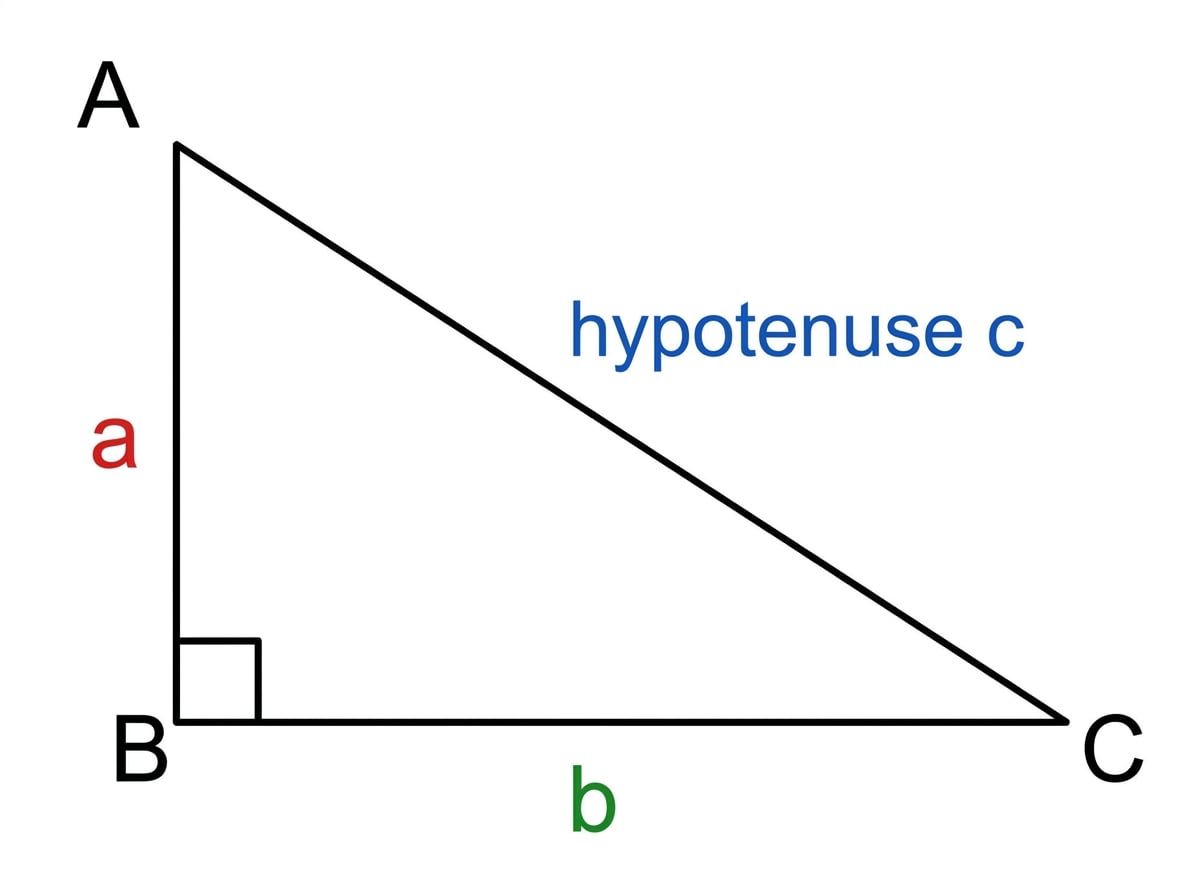
Revision notes for Edexcel GCSE Maths Pythagoras. Open the guide for explanations and worked examples. Written against the Edexcel GCSE Maths (1MA1) specification, so the content matches what's examinable rather than general Maths background.
Pythagoras is only for right-angled triangles. So before doing any calculation, check that the triangle has a 90° angle.
Right-angled triangle
A right-angled triangle is a triangle with one right angle, which is an angle of 90°.
Hypotenuse
The hypotenuse is the side opposite the right angle. It is always the longest side in a right-angled triangle.

Spotting the hypotenuse
A triangle PQRPQRPQR has a right angle at QQQ. Which side is the hypotenuse?

Find the right angle. It is at QQQ.
Look at the side opposite QQQ.
The side opposite QQQ is PRPRPR, so the hypotenuse is PRPRPR.
To use Pythagoras, you need squares and square roots.
Squares and square roots
Pythagoras' theorem
In any right-angled triangle, if aaa and bbb are the two shorter sides and ccc is the hypotenuse, then a2+b2=c2a^2 + b^2 = c^2a2+b2=c2.

Right angles only
Pythagoras' theorem works only when you have a right angle. If there is no 90° angle, do not use it unless you can create one in the diagram.
If the missing side is the hypotenuse, square the two shorter sides, add them, then square root.
Finding the longest side
A right-angled triangle has a right angle at BBB. The two shorter sides are AB=5.4 cmAB = 5.4 \text{ cm}AB=5.4 cm and BC=7.2 cmBC = 7.2 \text{ cm}BC=7.2 cm. Find ACACAC.

The right angle is at BBB, so the hypotenuse is ACACAC.
Use Pythagoras with ccc as the hypotenuse:
c2=5.42+7.22=29.16+51.84=81\begin{aligned} c^2 &= 5.4^2 + 7.2^2 \\ &= 29.16 + 51.84 \\ &= 81 \end{aligned}c2=5.42+7.22=29.16+51.84=81Square root to find the length:
c=81=9c = \sqrt{81} = 9c=81=9So AC=9 cmAC = 9 \text{ cm}AC=9 cm.
If the hypotenuse is already given, the missing side must be one of the shorter sides. This time, subtract the square of the known shorter side from the square of the hypotenuse.
Add or subtract?
Add when you are finding the hypotenuse. Subtract when the hypotenuse is already known and you are finding a shorter side.
Finding a shorter side
A right-angled triangle has hypotenuse DF=16 cmDF = 16 \text{ cm}DF=16 cm and one shorter side DE=7 cmDE = 7 \text{ cm}DE=7 cm. Find EFEFEF to 1 decimal place.

The hypotenuse is DFDFDF, so it goes first in the subtraction.
Work out the square of the missing side:
EF2=162−72=256−49=207\begin{aligned} EF^2 &= 16^2 - 7^2 \\ &= 256 - 49 \\ &= 207 \end{aligned}EF2=162−72=256−49=207Square root the answer:
EF=207=14.387…EF = \sqrt{207} = 14.387\ldotsEF=207=14.387…To 1 decimal place, EF=14.4 cmEF = 14.4 \text{ cm}EF=14.4 cm.
Adding every time
Do not always add the squares. If the longest side is already given, you need to subtract to find the missing shorter side.
Other shapes often hide right-angled triangles. A diagonal is a line joining two opposite corners of a shape. In a rectangle, the diagonal is the hypotenuse of a right-angled triangle.
A trapezium is a four-sided shape with one pair of parallel sides. In trapezium questions, look for right angles or draw in a height to create a right-angled triangle.
Diagonal of a rectangle
A rectangle is 16 cm long and 9 cm wide. Find the length of its diagonal to 1 decimal place.

The diagonal splits the rectangle into two right-angled triangles.
The diagonal is the hypotenuse, so add the squares of 16 and 9:
d2=162+92=256+81=337\begin{aligned} d^2 &= 16^2 + 9^2 \\ &= 256 + 81 \\ &= 337 \end{aligned}d2=162+92=256+81=337Square root:
d=337=18.357…d = \sqrt{337} = 18.357\ldotsd=337=18.357…To 1 decimal place, the diagonal is 18.4 cm.
Isosceles triangles
An isosceles triangle has two equal sides. If you draw the perpendicular height from the top, it usually splits the base into two equal halves, making a right-angled triangle.
Some questions contain two right-angled triangles joined together. You may need to find a shared side first, then use it in the second triangle.
Two joined right-angled triangles
Two right-angled triangles share side ACACAC. In the first triangle, AB=12 mAB = 12 \text{ m}AB=12 m, BC=13 mBC = 13 \text{ m}BC=13 m, and the right angle is at AAA. In the second triangle, CD=6 mCD = 6 \text{ m}CD=6 m and the right angle is at CCC. Find ADADAD to 3 significant figures.

Start with triangle ABCABCABC, because it has two known sides and lets you find ACACAC.
In triangle ABCABCABC, BCBCBC is the hypotenuse:
AC2=132−122=25AC^2 = 13^2 - 12^2 = 25AC2=132−122=25Find ACACAC:
AC=25=5AC = \sqrt{25} = 5AC=25=5Now use triangle ACDACDACD. The sides ACACAC and CDCDCD meet at the right angle, so ADADAD is the hypotenuse:
AD2=52+62=61AD^2 = 5^2 + 6^2 = 61AD2=52+62=61Square root and round:
AD=61=7.810…AD = \sqrt{61} = 7.810\ldotsAD=61=7.810…To 3 significant figures, AD=7.81 mAD = 7.81 \text{ m}AD=7.81 m.
Real-life questions often describe a right-angled triangle without drawing one. Vertical means straight up and down. Horizontal means flat, like the ground. Vertical and horizontal lines meet at 90°.
Sketch first
For journeys, “North then East” makes a right angle. For ladders, the wall and ground make a right angle, and the ladder is the hypotenuse.
A ladder against a wall
A ladder reaches 2.4 m up a wall. Its base is 90 cm from the wall. Find the length of the ladder to 3 significant figures.

The wall and ground form a right angle, so the ladder is the hypotenuse.
Convert 90 cm into metres: 90 cm is 0.9 m.
Use Pythagoras:
l2=2.42+0.92=5.76+0.81=6.57\begin{aligned} l^2 &= 2.4^2 + 0.9^2 \\ &= 5.76 + 0.81 \\ &= 6.57 \end{aligned}l2=2.42+0.92=5.76+0.81=6.57Square root:
l=6.57=2.563…l = \sqrt{6.57} = 2.563\ldotsl=6.57=2.563…To 3 significant figures, the ladder is 2.56 m long.
In the exam
Mark the right angle and label the hypotenuse before writing the formula.
Decide whether to add or subtract: find the hypotenuse means add; find a shorter side means subtract.
Keep full calculator values until the final line, then round to the accuracy asked for.
Check yourself
Test yourself with 5 quick questions on this guide. Answer them all correctly to complete it.
Test yourself on this topic, or move on to the next guide.
How was this guide?