Coordinates
x

Revision notes for Edexcel GCSE Maths Coordinates. Open the guide for explanations and worked examples. Written against the Edexcel GCSE Maths (1MA1) specification, so the content matches what's examinable rather than general Maths background.

Coordinates

What you'll learn

  • How to read and plot points on a coordinate grid.
  • How to use negative coordinates correctly.
  • How to find the midpoint of a line segment.
  • How to draw simple lines such as x=−1x=-1x=−1 and y=6y=6y=6.

The coordinate grid

A coordinate grid has two number lines crossing each other. You use it to describe exact positions of points.

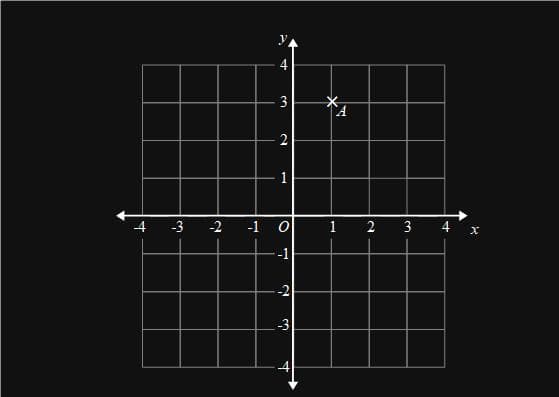
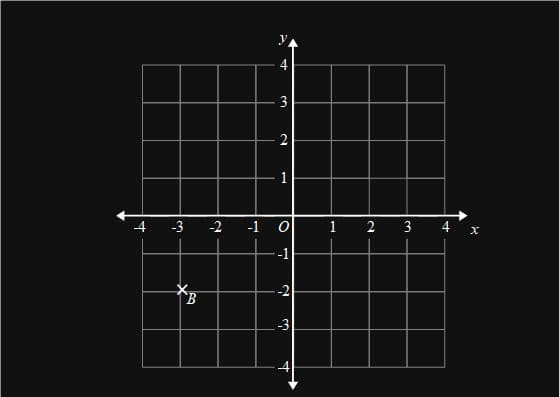
A coordinate grid with the x-axis, y-axis and origin clearly labelled.

Definition

Coordinate grid

  • The x-axis is the horizontal line going left and right.

  • The y-axis is the vertical line going up and down.

  • The origin is the point where the axes meet. It is at (0,0)(0,0)(0,0).

A coordinate grid showing the horizontal x-axis, vertical y-axis, and origin at (0,0).

  • A coordinate pair tells you a point’s position and is written as (x,y)(x,y)(x,y).
Key Idea

Across first, then up or down

Coordinates are always read in this order: x first, then y.

Reading coordinates

To read a point from a grid, start at the origin.

  • The first number tells you how far left or right the point is.
  • The second number tells you how far up or down the point is.
  • Positive x means right.
  • Negative x means left.
  • Positive y means up.
  • Negative y means down.
Example

Writing down the coordinates of a marked point

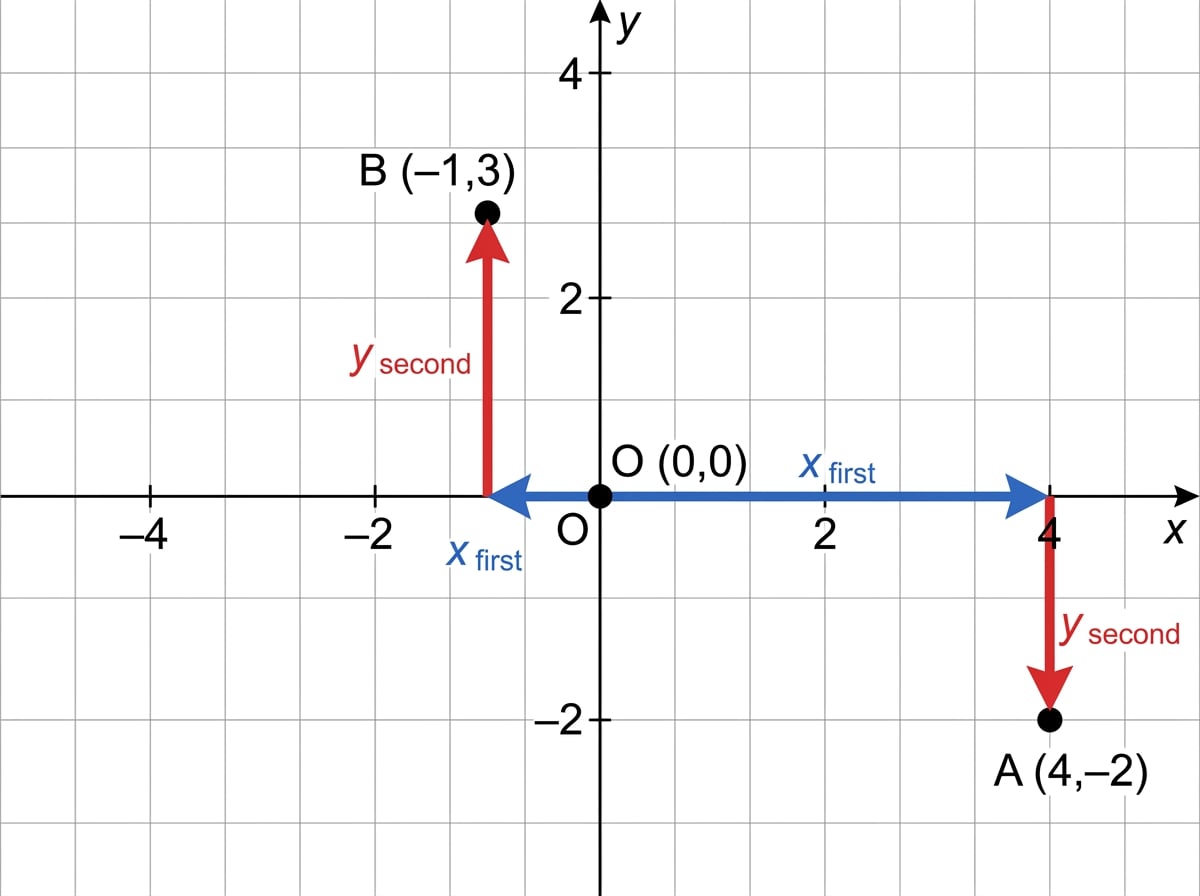
Point A is 4 squares right of the origin and 2 squares below the x-axis, so its coordinates are (4,-2).

  1. Suppose point A is 4 squares to the right of the origin.

  2. That means the x-coordinate is 4.

  3. Point A is also 2 squares below the x-axis.

  4. That means the y-coordinate is -2.

  5. So the coordinates of point A are (4,−2)(4,-2)(4,−2).

Point A is 4 squares right of the origin and 2 squares below the x-axis, so it is at (4,-2).

Common Mistake

Swapping the coordinates

A very common mistake is writing the y-coordinate first. Remember: coordinates are always written as across, then up/down.

Plotting a point

To plot a point means to put it in the correct place on the grid.

Always start at the origin, then count across first, then up or down.

Example

Plotting point B at (−1,3)

To plot B(-1,3), move 1 square left from the origin and then 3 squares up.

  1. Start at the origin, (0,0)(0,0)(0,0).

  2. The x-coordinate is -1, so move 1 square left.

  3. The y-coordinate is 3, so move 3 squares up.

  4. Put a cross at that position.

  5. Label the point B.

To plot B(-1,3), move 1 square left from the origin and then 3 squares up.

Tip

Negative directions

Negative x goes left. Negative y goes down. If both are negative, you move left and down.

Midpoints

Sometimes you are given two points joined by a line segment. A line segment is a straight line between two endpoints.

Definition

Midpoint

The midpoint is the point exactly halfway between two endpoints.

To find a midpoint, you find the middle of the x-coordinates and the middle of the y-coordinates.

Another way to say this is: add the two x-coordinates and divide by 2, then add the two y-coordinates and divide by 2.

Key Idea

Midpoint rule

Find the average of the x-coordinates and the average of the y-coordinates.

Example

Finding the midpoint of B and C

The midpoint of B(-3,3) and C(3,0) lies halfway along the line segment at (0,1.5).

  1. Let B be at (−3,3)(-3,3)(−3,3) and C be at (3,0)(3,0)(3,0).

  2. Find the middle of the x-coordinates. The x-coordinates are -3 and 3.

  3. Add them and divide by 2:

    (−3+3)÷2=0(-3+3)\div 2=0(−3+3)÷2=0
  4. Find the middle of the y-coordinates. The y-coordinates are 3 and 0.

  5. Add them and divide by 2:

    (3+0)÷2=1.5(3+0)\div 2=1.5(3+0)÷2=1.5
  6. So the midpoint is (0,1.5)(0,1.5)(0,1.5).

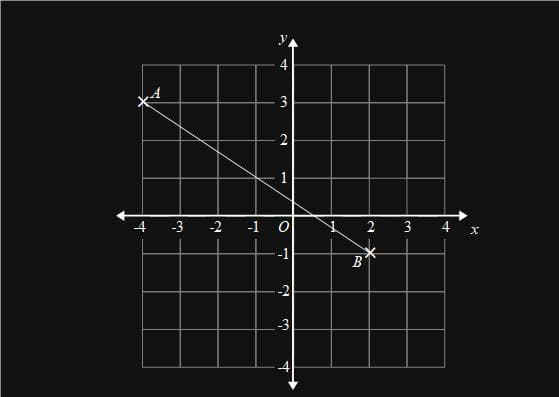
The midpoint of B(-3,3) and C(3,0) lies halfway along the line segment between them at (0,1.5).

Common Mistake

Only finding one coordinate

A midpoint needs two coordinates. Make sure you find both the x-value and the y-value.

Drawing lines like x=−1x=-1x=−1 and y=6y=6y=6

An equation is a mathematical statement with an equals sign.

For example, x=−1x=-1x=−1 tells you that every point on the line has an x-coordinate of -1.

Definition

Equation of a line

An equation of a line tells you which points are on that line.

Lines where x is fixed

A line such as x=3x=3x=3 is vertical. Every point on the line has x-coordinate 3.

A line with equation x=3 is vertical because every point on it has the same x-coordinate.

Example

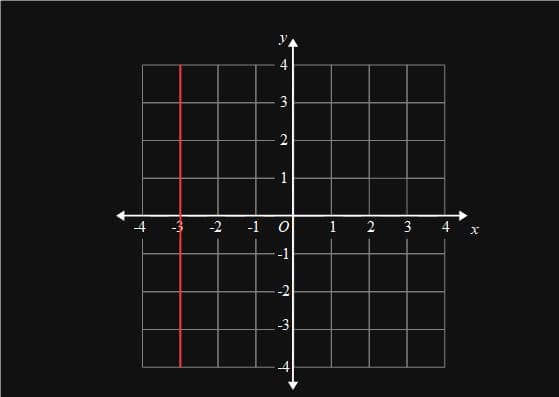
Drawing the line x=−2

  1. Find -2 on the x-axis.

  2. Draw a straight vertical line through -2.

  3. The line goes up and down through the grid.

  4. Check with a point on the line, such as (−2,4)(-2,4)(−2,4). Its x-coordinate is -2.

The line x=-2 is vertical because every point on it has x-coordinate -2.

Lines where y is fixed

A line such as y=6y=6y=6 is horizontal. Every point on the line has y-coordinate 6.

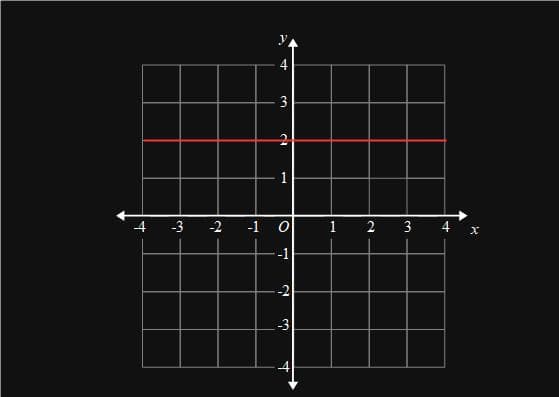
A line with equation y=4 is horizontal because every point on it has the same y-coordinate.

Example

Drawing the line y=4

  1. Find 4 on the y-axis.

  2. Draw a straight horizontal line through 4.

  3. The line goes left and right through the grid.

  4. Check with a point on the line, such as (1,4)(1,4)(1,4). Its y-coordinate is 4.

The line y=4 is horizontal because every point on it has y-coordinate 4.

Tip

Remember vertical and horizontal

Lines written as x=numberx=\text{number}x=number are vertical. Lines written as y=numbery=\text{number}y=number are horizontal.

Completing a square on a grid

A square is a shape with 4 equal sides and 4 right angles.

If you are given three corners of a square, you can find the missing corner by matching the movement from one side.

For a square called ABCD, the letters usually go around the shape in order.

Example

Finding the missing corner D

  1. Suppose A is at (−1,3)(-1,3)(−1,3), B is at (3,2)(3,2)(3,2), and C is at (2,−2)(2,-2)(2,−2).

  2. Look at the move from B to C.

  3. From B to C, you move 1 square left and 4 squares down.

  4. To find D, repeat that same move from A.

  5. From A, move 1 square left and 4 squares down.

  6. So D is at (−2,−1)(-2,-1)(−2,−1).

Repeating the move from B to C starting at A gives the missing corner D(-2,-1) of the square.

Tip

Use the matching side

In a square ABCD, the side AD matches the side BC. So the movement from B to C is repeated from A to D.

Exam technique

In the exam

  1. Always read coordinates in the order x first, then y.

  2. When plotting, start at the origin and count carefully.

  3. For a midpoint, average the x-coordinates and average the y-coordinates separately.

  4. For x=numberx=\text{number}x=number draw a vertical line; for y=numbery=\text{number}y=number draw a horizontal line.

Self review

Check yourself

  • Can you plot the point (−3,2)(-3,2)(−3,2) on a grid?

  • What is the midpoint of (4,−2)(4,-2)(4,−2) and (4,6)(4,6)(4,6)?

  • Is the line x=2x=2x=2 horizontal or vertical?

Recap questions

Test yourself with 5 quick questions on this guide. Answer them all correctly to complete it.

You've reached the end

Test yourself on this topic, or move on to the next guide.

Practice questionsTake a quick quiz on this topicFlashcardsSelf-test with active recall
PictogramsUp next

How was this guide?

Coordinates Revision Guide

  1. GCSE
  2. /Maths
  3. /Coordinates