What you'll learn
- Why the UK’s future climate is likely to change, but cannot be predicted perfectly.
- How climate change may affect people, places and landscapes across the UK.
- The difference between mitigation and adaptation responses.
- How to use named UK examples to build strong Geography explanations.
The starting point: climate change and the UK
Weather means the day-to-day conditions of the atmosphere, such as temperature, rainfall, wind and cloud. Climate means the average pattern of weather over a much longer period, usually 30 years or more.
Climate change
Climate change is a long-term shift in average climate conditions, including temperature, rainfall patterns, sea level and the frequency of extreme weather events.
Global climate change is mainly linked to increasing greenhouse gases — gases such as carbon dioxide and methane that trap heat in the atmosphere. These gases are released by activities such as burning fossil fuels, transport, industry, farming and deforestation.
For the UK, climate change does not simply mean “hotter weather all the time”. It means changing averages and changing risks: more frequent heatwaves, wetter winters, more intense rainfall events, rising sea levels, and possible pressure on water supplies in drier summers.
Future UK climate: likely trends, uncertain details
Scientists use climate models, which are computer simulations of the atmosphere, oceans, ice and land, to estimate future climate. These estimates are called climate projections, not exact predictions.
Climate projection
A climate projection is a model-based estimate of how climate could change in the future under a particular set of conditions, especially future greenhouse gas emissions.
The UK’s future climate is uncertain because we do not know exactly how much greenhouse gas the world will emit, how quickly societies will reduce emissions, or how natural climate variability will interact with long-term warming.
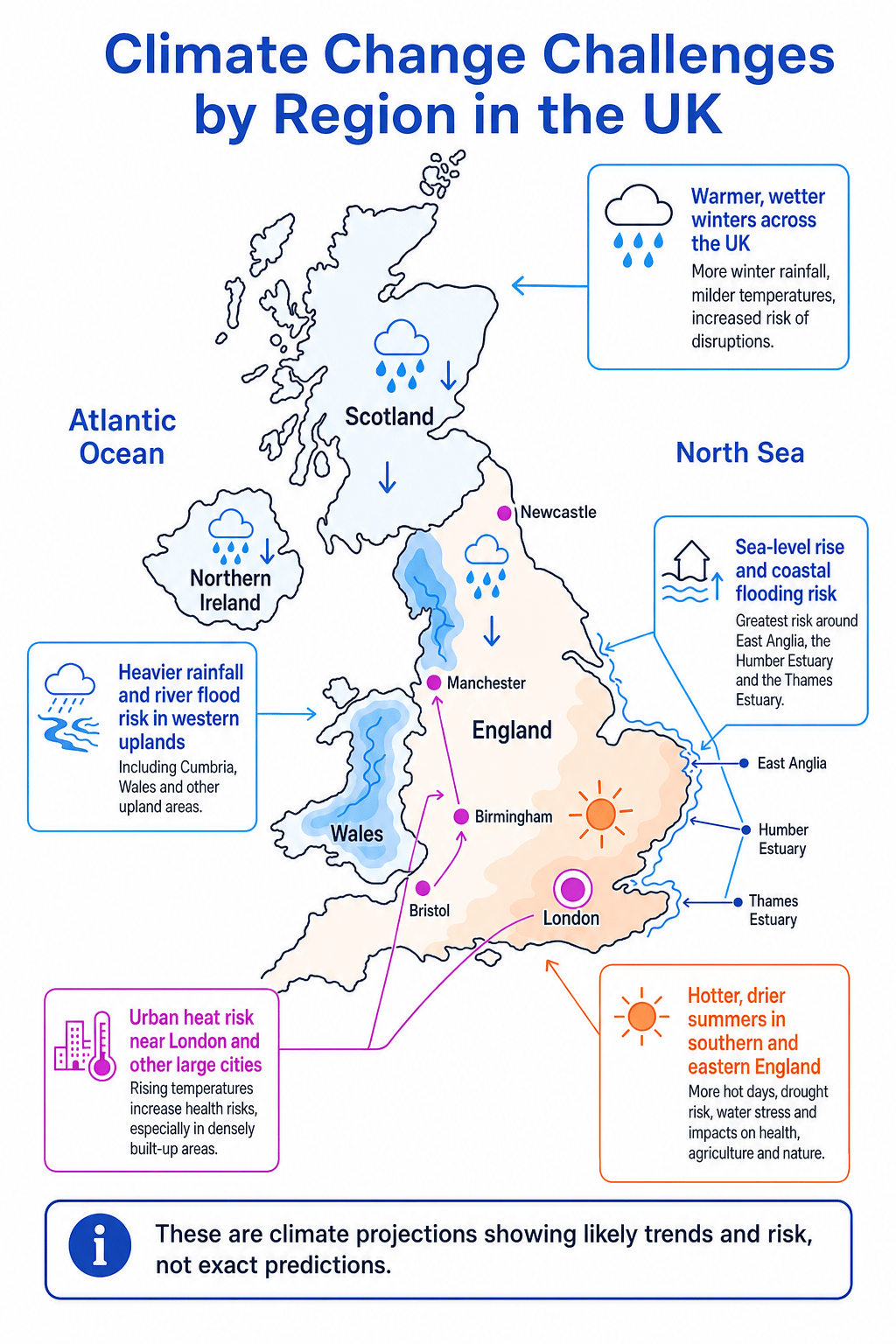
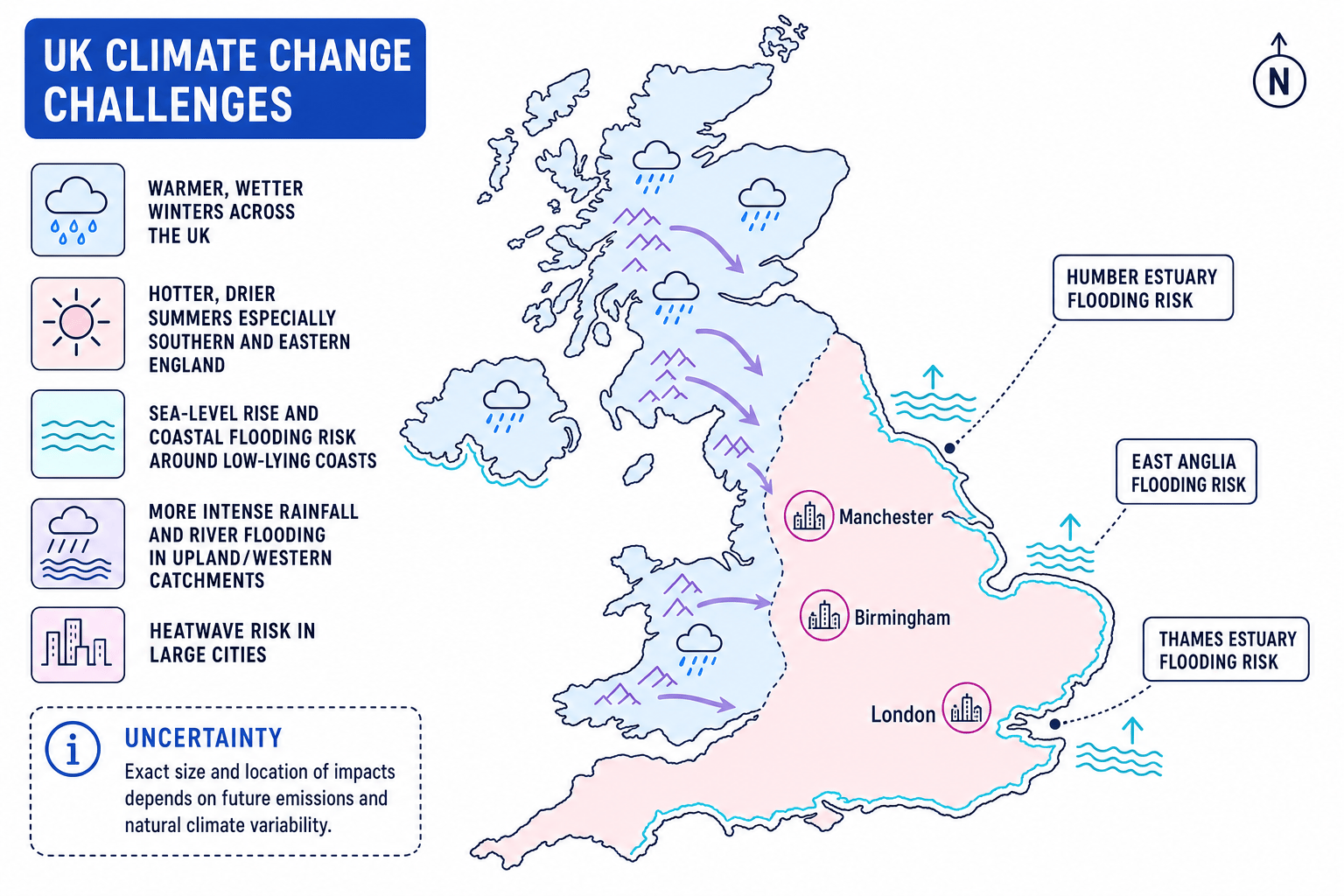
Even with uncertainty, the broad UK pattern is clear: warmer temperatures, milder and wetter winters, hotter and often drier summers, more intense rainfall events, and rising sea levels. Southern and eastern England are often expected to face greater summer heat and drought pressure, while many western and upland areas may face heavier rainfall and river flood risk.
Trend, not exact forecast
For the UK, climate change is best explained as a shift in probability and risk. A single storm or heatwave is weather, but climate change can make some types of event more likely, more intense, or more damaging.
Why projections have ranges
You may see future climate data written as a range, for example “summer rainfall could decrease by 10–40%”. This does not mean scientists are guessing randomly. It shows that different models and emissions scenarios produce different results.
The main sources of uncertainty are:
- Future emissions — whether global emissions fall quickly or remain high.
- Model uncertainty — models agree on major trends but differ in detail.
- Natural variability — the UK climate is naturally changeable because of the jet stream, the North Atlantic and changing pressure systems.
- Local differences — climate impacts vary between regions, cities, coasts, uplands and river catchments.
Calculating percentage change from climate data
A projection dataset says a UK city could increase from 18 summer days above 25°C per year to 45 days per year by the 2050s. Calculate the percentage increase.
-
Find the change in the number of hot days: 45 - 18 = 27 extra days.
-
Divide the change by the original value and multiply by 100:
- Interpret the result geographically: a 150% increase in hot days would raise heat-health risks, increase demand for cooling, and make shade, green space and heatwave planning more important.
Saying ‘the UK will become Mediterranean’
The UK may have hotter, drier summers in many areas, but it will still have a maritime climate influenced by the Atlantic Ocean. Avoid exaggerating: use words such as likely, projected, risk and could.
Impacts on people in the UK
Climate change affects people through hazards, which are events or processes that may cause harm, and vulnerability, which means how exposed and able people are to cope.
Heat and health
Heatwaves can increase dehydration, heatstroke and pressure on hospitals. Older people, babies, people with existing illnesses, outdoor workers and people living in poorly insulated homes are more vulnerable.
A strong named example is the UK heatwave of July 2022, when the UK recorded over 40°C for the first time, with 40.3°C measured at Coningsby in Lincolnshire. The event disrupted railways, increased fire risk and led to health warnings.
Flooding of homes, businesses and transport
Warmer air can hold more moisture, so heavy rainfall events may become more intense. This increases the risk of surface water flooding, where drains cannot cope, and river flooding, where rivers overtop their banks.
In Cumbria during Storm Desmond in December 2015, very heavy rainfall caused severe flooding in places such as Carlisle, Keswick and Cockermouth. Climate change does not “cause” every individual storm, but a warmer atmosphere can increase the chance of very intense rainfall.
Water supply and farming
Hotter, drier summers can increase pressure on water supplies, especially in south and east England where population density is high and rainfall can be lower. Agriculture may gain from a longer growing season, but farmers may also face drought, heat stress in livestock, crop failure and more pests.
Unequal impacts
Climate change does not affect everyone equally. Wealthier households may be able to insure homes, install cooling or recover from flooding. Lower-income households may live in more exposed housing, have fewer savings, and find adaptation more difficult.
Tracing a flood impact chain
A winter storm brings intense rainfall to a UK river catchment. Explain how this could affect people.
-
Connect the physical event to the immediate hazard: intense rainfall increases surface runoff, river discharge rises quickly, and the river may overflow onto the floodplain.
-
Link the hazard to primary impacts: homes and shops may be flooded, roads and railways may close, and electricity or water services may be disrupted.
-
Extend to secondary impacts: businesses lose income, families may be displaced for months, insurance costs can rise, and stress or illness may continue after the floodwater has gone.
Impacts on UK landscapes
A landscape is the visible character of an area, shaped by physical processes and human activity. Climate change can alter landscapes by changing erosion, flooding, ecosystems and land use.
Coasts
Rising sea levels increase the risk of coastal flooding and can make erosion more damaging during storm surges. Low-lying coastal areas such as East Anglia, the Humber Estuary and the Thames Estuary are especially important because they contain homes, farmland, infrastructure and habitats.
Some coasts may experience coastal squeeze, where habitats such as saltmarsh are trapped between rising sea levels and hard sea defences. If the habitat cannot move inland, it may shrink.
Rivers and floodplains
More intense rainfall can increase river flood peaks, especially in steep upland catchments where water flows rapidly into channels. Floodplains may flood more often, which affects settlements, farmland and transport routes.
Uplands, peat and ecosystems
Hotter, drier periods can dry out peatland. Healthy peat stores carbon and holds water, but damaged dry peat can release carbon and become more vulnerable to wildfire. Species may also shift northwards or to higher altitudes as temperatures rise.
Use a chain of reasoning
For landscape impacts, try to write in chains: climate change trend → physical process → landscape change → human consequence. For example: sea-level rise → more frequent coastal flooding → saltmarsh loss → reduced natural protection for nearby settlements.
Responses to climate change in the UK
UK responses can be grouped into mitigation and adaptation.
Mitigation and adaptation
Mitigation means reducing the causes of climate change, mainly by cutting greenhouse gas emissions. Adaptation means adjusting to the impacts of climate change that are already happening or are expected in the future.
Both types are needed
Mitigation reduces future climate change, while adaptation reduces damage from climate change already built into the system. The UK needs both at the same time.
National-scale responses
At the national scale, the UK government sets laws, funding priorities and long-term plans. Examples include:
| Response | Type | How it helps |
|---|---|---|
| Climate Change Act 2008 and net zero target by 2050 | Mitigation | Sets legally binding emissions reduction goals |
| Carbon budgets | Mitigation | Limits total UK greenhouse gas emissions over five-year periods |
| Renewable energy expansion, such as offshore wind | Mitigation | Reduces reliance on fossil fuels for electricity |
| National Adaptation Programme | Adaptation | Plans for risks such as flooding, heat, water shortage and infrastructure stress |
| Flood and coastal erosion risk management | Adaptation | Funds defences, warning systems and coastal planning |
A major national issue is balancing cost, fairness and effectiveness. For example, flood defences protect some communities but are expensive, and not every coastline can be defended forever.
Local-scale responses
At the local scale, councils, communities, businesses and households make practical changes in specific places. Examples include:
- Sustainable drainage systems, often called SuDS, such as permeable paving, ponds and swales, which slow runoff in urban areas.
- Tree planting and parks to provide shade, reduce the urban heat island effect and absorb rainfall.
- Home insulation and heat pumps to reduce energy demand.
- Local flood warning schemes and community emergency plans.
- Coastal management choices, such as maintaining defences, beach nourishment, or managed realignment where land is allowed to flood to create new saltmarsh.
Classifying climate responses
A council installs permeable paving, plants street trees and supports home insulation grants. Classify the responses as mitigation, adaptation, or both.
-
Permeable paving mainly reduces surface water flooding by allowing rainfall to soak into the ground, so it is adaptation.
-
Street trees provide shade during heatwaves and intercept rainfall, so they are adaptation. They also store some carbon, but the main urban purpose is usually risk reduction.
-
Home insulation reduces energy demand for heating, so it cuts emissions and is mitigation. It can also help households cope with cold weather, but the strongest climate-change link is emissions reduction.
Only writing about individual actions
Personal actions matter, but GCSE answers need responses at different scales. Include national policies, local council planning, and community or household actions where relevant.
How to evaluate UK responses
A strong answer does not just list responses. It judges them. Useful criteria include:
- Effectiveness — does it reduce emissions or reduce risk?
- Cost — who pays, and is it affordable long term?
- Timescale — does it work quickly, or only after decades?
- Equity — does it protect vulnerable groups?
- Environmental impact — does it damage or support ecosystems?
- Scale — is it national policy, regional planning, local action or household behaviour?
For example, offshore wind is strong mitigation at a national scale, but it does not directly protect homes from flooding. SuDS can reduce local flood risk, but they cannot solve global emissions. This is why balanced climate strategy combines several responses.
In the exam
-
Use cautious language for the future: write projected, likely, could increase risk, and depends on emissions, rather than making over-certain claims.
-
Build chains of explanation: link the climate trend to a physical process, then to impacts on people or landscapes, then to a named UK place.
-
For responses, always identify the scale and type: national or local, mitigation or adaptation, then briefly judge how effective it is.
Check yourself
- Why are UK climate projections uncertain even though scientists agree the UK is warming?
- How could sea-level rise affect both people and coastal landscapes in a place such as East Anglia?
- What is the difference between mitigation and adaptation? Give one UK example of each.