Use the information from Figures 5a to 5d, as well as your own geographical knowledge and understanding from your course, to discuss the following view:
"Top-down, national infrastructure projects and regulatory policies are far more critical than localized, community-led initiatives in successfully managing the UK's climate change challenges."
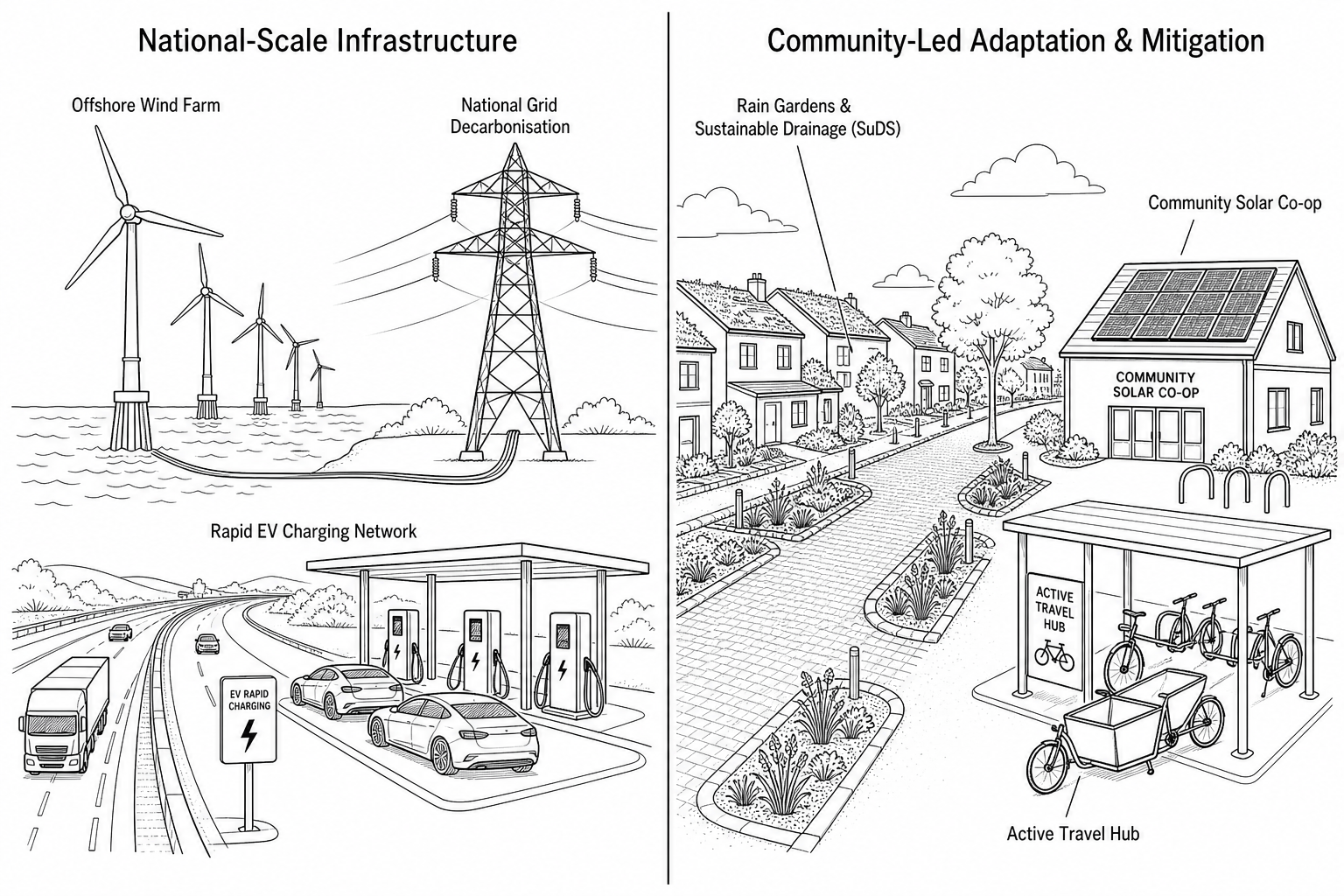
"In 2008, the UK's total greenhouse gas emissions from the energy supply sector were approximately 220 million tonnes of CO2 CO_2\,CO2 equivalent (MtCO2eMtCO_2eMtCO2e). By 2023, these emissions had fallen to approximately 55 MtCO2eMtCO_2eMtCO2e, primarily driven by top-down regulatory phase-out of coal power stations, massive investment in North Sea offshore wind infrastructure, and carbon pricing mechanisms."
"An analysis of 45 community-owned solar and wind cooperatives across Wales showed that 100% of the operating surpluses are legally ring-fenced to fund local fuel poverty mitigation, home insulation retrofits, and biodiversity projects. These initiatives also reported a 35% average increase in local climate-resilience awareness among participating residents."
"Following severe flooding events in West Yorkshire, community-led initiatives in Hebden Bridge integrated sustainable drainage systems (SuDS) such as street-level rain gardens, green roofs, and community woodland management. These micro-scale nature-based interventions reduced peak local surface water runoff during storm events by up to 28%, protecting over 400 vulnerable properties."

