

What you'll learn
- The main physical characteristics of tropical rainforests, including climate, soils, vegetation layers and nutrient cycling.
- How climate, water, soils, plants, animals and people depend on each other in a rainforest ecosystem.
- Why deforestation happens, using the Amazon rainforest in Brazil as a case study.
- How tropical rainforests can be managed more sustainably.
Where are tropical rainforests found?
Tropical rainforests are found close to the Equator, mainly between the Tropic of Cancer and the Tropic of Capricorn. Major areas include the Amazon Basin in South America, the Congo Basin in central Africa, and parts of South East Asia such as Indonesia and Malaysia.
Tropical rainforest
A tropical rainforest is a dense, evergreen forest found in hot, wet tropical areas, with very high rainfall, high biodiversity and year-round plant growth.
They are hot and wet because the Sun’s rays are intense near the Equator. Warm, moist air rises, cools and condenses, producing convectional rainfall — heavy rainfall caused by heated air rising.
Physical characteristics of tropical rainforests
Climate
Tropical rainforests usually have:
- High temperatures all year, often around 25–30°C.
- Very high annual rainfall, commonly over 2,000 mm.
- High humidity, meaning the air contains lots of water vapour.
- Little seasonal temperature change, so there is no real winter.
This creates almost continuous growing conditions.
Forest structure
Rainforests have a layered structure because plants compete strongly for light. The main layers are the emergent layer, canopy, understorey, shrub layer and forest floor.
The diagram shows how rainforest layers create different habitats, from bright and windy treetops to the dark, damp forest floor.
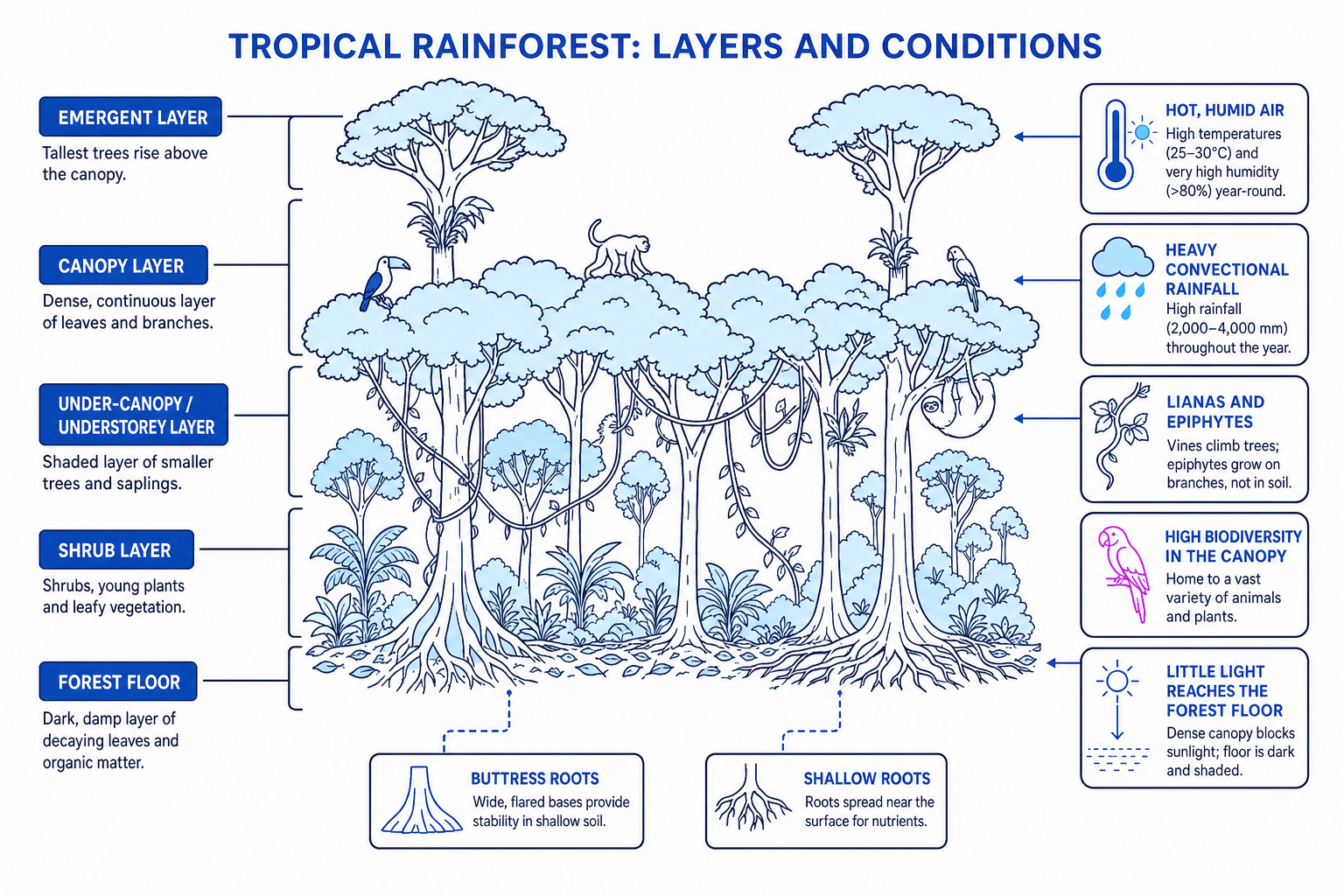
The canopy is especially important because it contains many leaves, fruits, flowers, insects, birds and mammals. A huge amount of rainforest life is found above the ground rather than on it.
Soils and nutrients
Rainforest soils are often called latosols: deeply weathered red tropical soils. They can look rich, but many nutrients are actually stored in living plants rather than in the soil.
Nutrient cycle
The nutrient cycle is the movement of nutrients between living plants, dead organic matter, and the soil.
Dead leaves and branches form litter on the forest floor. In hot, wet conditions, decomposers such as bacteria and fungi break this litter down very quickly. Plants then take up the nutrients through their roots.
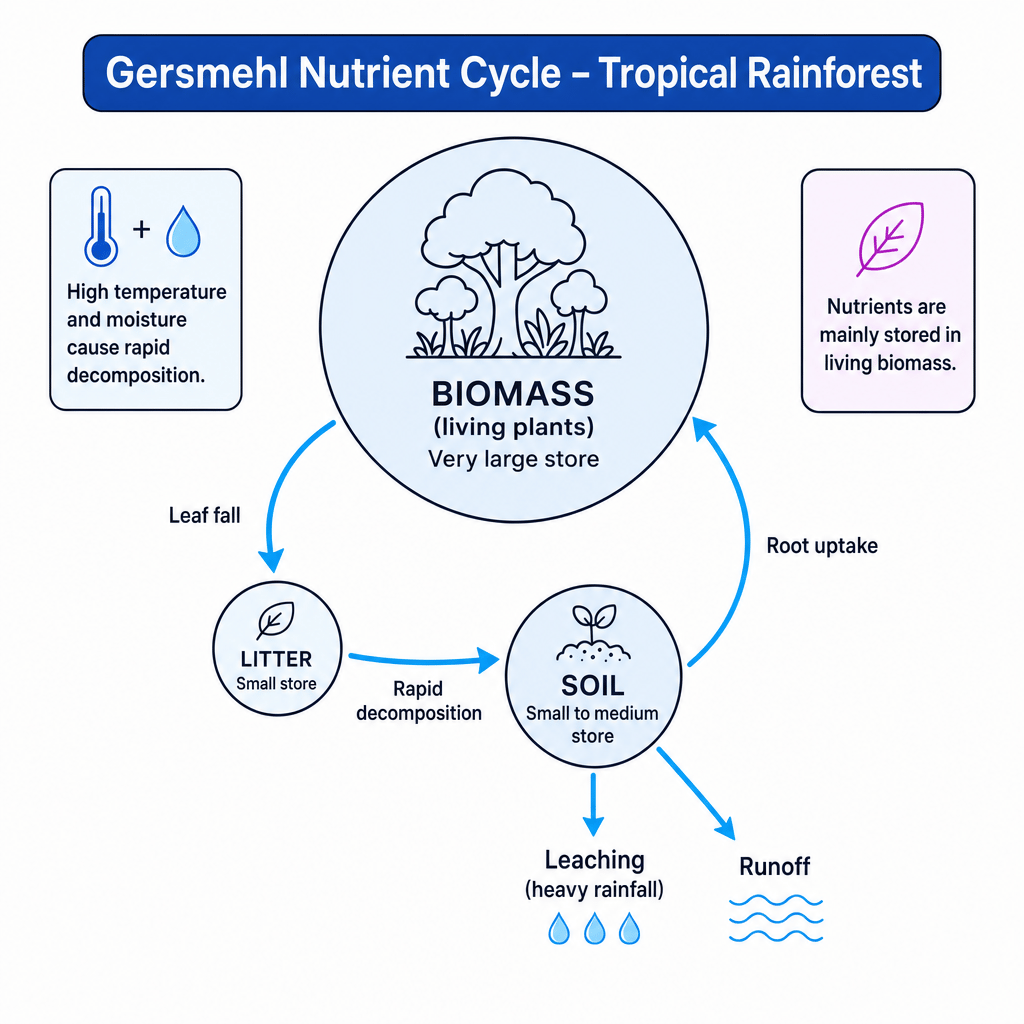
Rainforest nutrients
In a tropical rainforest, the biggest nutrient store is usually biomass — the living plants — not the soil. If the forest is cleared, the nutrient cycle is quickly disrupted.
Assuming rainforest soils are naturally fertile
Rainforest soils are not automatically fertile for farming. Heavy rainfall can cause leaching, where nutrients are washed down through the soil and away from plant roots, especially after trees are removed.
Linking climate to nutrient cycling
- Hot, wet conditions speed up decomposition because bacteria and fungi work quickly in warmth and moisture.
- Nutrients released from dead leaves are rapidly taken up by shallow rainforest roots, so little nutrient stays in the soil for long.
- If trees are removed, fewer roots take up nutrients and heavy rainfall increases leaching, so soil fertility falls quickly.
Interdependence in the rainforest ecosystem
An ecosystem is a community of living things and the non-living environment they interact with. In a tropical rainforest, the parts of the ecosystem are strongly connected.
Interdependence
Interdependence means that different parts of an ecosystem rely on each other, so a change to one part can affect many others.
Examples include:
- Climate and plants: hot, wet conditions allow rapid plant growth.
- Plants and water: trees release water vapour through transpiration, helping to maintain humid air and rainfall.
- Plants and soil: tree roots bind soil together and reduce erosion.
- Animals and plants: animals pollinate flowers and spread seeds.
- People and forests: local and indigenous communities may rely on forests for food, medicine, shelter and culture.
When one part changes, the whole system can be affected. For example, cutting down trees reduces transpiration, exposes soil to heavy rain, destroys habitats and can reduce rainfall locally.
Tracing a change through the ecosystem
- Road building removes a strip of forest and opens up access for logging, farming and settlement.
- Less forest cover means less interception of rainfall by leaves and fewer roots holding soil together.
- Heavy rain hits bare ground directly, increasing surface runoff and soil erosion.
- Sediment enters rivers, which can damage aquatic habitats and affect people using rivers for fishing or water supply.
Adaptations of plants and animals
An adaptation is a feature that helps a plant or animal survive in its environment.
Plant adaptations
Rainforest plants are adapted to intense competition for light and very wet conditions:
- Drip-tip leaves help rainwater run off quickly, reducing fungal growth.
- Buttress roots support tall trees in shallow soils.
- Shallow spreading roots take up nutrients quickly from the topsoil.
- Lianas are woody climbing plants that use trees to reach sunlight.
- Epiphytes grow on branches rather than in soil, helping them access light in the canopy.
- Smooth, thin bark is common because trees do not need protection from frost.
Animal adaptations
Rainforest animals are often adapted to life in trees and dense vegetation:
- Some monkeys have strong limbs or prehensile tails for gripping branches.
- Sloths move slowly and have algae-tinted fur, helping camouflage them in trees.
- Toucans have large beaks for reaching fruit on thin branches.
- Many insects use camouflage or warning colours to avoid predators.
- Some animals are nocturnal, meaning active at night, which reduces competition and avoids daytime heat.
Adaptations need a reason
In the exam, do not just name an adaptation. Link it to the condition it helps with, such as heavy rainfall, low light, shallow soils or competition in the canopy.
Biodiversity: why rainforests matter
Biodiversity
Biodiversity means the variety of living organisms in an area, including different species of plants, animals, fungi and microorganisms.
Tropical rainforests have extremely high biodiversity because they have warm, wet conditions all year and many different habitats within the forest layers. The Amazon alone contains millions of species, although exact totals vary because many species have not yet been recorded.
Rainforest biodiversity matters because it:
- Provides food, materials and medicines.
- Supports pollination, seed dispersal and nutrient cycling.
- Stores carbon in trees and soils.
- Helps regulate the water cycle.
- Supports indigenous communities and local livelihoods.
- Increases ecosystem resilience, meaning the ability to recover from disturbance.
The main issue is that deforestation can cause habitat loss and fragmentation, where a large continuous habitat is split into smaller isolated patches. This can lead to species decline or extinction.
Deforestation: causes, rates and impacts
Deforestation
Deforestation is the large-scale removal of trees, usually to use the land for another purpose such as farming, mining, roads or settlement.
Rates of deforestation have changed over time. In Brazil, Amazon deforestation was very high in the late 20th century and early 2000s, then fell strongly after tighter monitoring and enforcement, before rising again in some later years. Exact figures depend on the data source and years chosen, so focus on the overall trend and quote data carefully when given.
Calculating a change in deforestation
A graph shows annual deforestation falling from 27,000 km² to 4,500 km².
- Calculate the decrease: 27,000−4,500=22,50027,000 - 4,500 = 22,50027,000−4,500=22,500, so forest loss fell by 22,500 km².
- Divide by the original value: 22,50027,000≈0.83\frac{22,500}{27,000} \approx 0.8327,00022,500≈0.83.
- Convert to a percentage: 0.83×100≈83%0.83 \times 100 \approx 83\%0.83×100≈83%, so deforestation decreased by about 83%.
Case study: deforestation in the Amazon rainforest, Brazil
The Amazon rainforest is a large tropical rainforest in South America. Brazil contains the largest share of it, so it is commonly used as a GCSE case study of deforestation.
Causes of deforestation
- Subsistence farming: small-scale farming where people grow food mainly for their own families. Some farmers clear forest using slash-and-burn methods.
- Commercial farming: farming for profit. In Brazil, cattle ranching and soya production are major drivers of forest clearance.
- Logging: valuable tropical hardwoods are removed for timber. Even selective logging can open up the forest and create access routes.
- Road building: roads such as the Trans-Amazonian Highway and BR-163 improve access, encouraging farming, logging and settlement.
- Mineral extraction: mining for resources such as iron ore, bauxite and gold clears land and can pollute rivers.
- Energy development: hydroelectric power dams flood forested valleys and require new infrastructure.
- Settlement and population growth: more people can increase demand for land, jobs, housing and services.
Impacts of deforestation
Deforestation can support economic development by creating jobs, exports, electricity, tax income and transport links. However, benefits may be uneven, and indigenous communities can lose land and resources.
It also causes soil erosion. Once the canopy and roots are removed, heavy rainfall hits bare soil directly. Soil is washed into rivers, reducing fertility and increasing river sediment.
Deforestation contributes to climate change because burning trees releases carbon dioxide, and fewer trees remain to absorb carbon through photosynthesis. Reduced transpiration may also make regional climates drier.
Only writing negative impacts
Deforestation has environmental costs, but exam answers should also recognise economic benefits, such as jobs, exports and energy. Strong answers then judge whether those benefits are sustainable.
Sustainable management of tropical rainforests
Sustainable management
Sustainable management means using rainforest resources in a way that meets people’s needs now without damaging the ecosystem for future generations.
Rainforests are valuable to people and the environment because they store carbon, protect soils, regulate rainfall, support biodiversity, provide medicines and materials, and support local cultures and livelihoods.
Selective logging and replanting
Selective logging removes only certain mature trees rather than clearing the whole forest. It causes less damage than clear-felling, especially when routes are planned carefully. Replanting helps replace removed trees, although new trees take many years to mature.
Conservation and education
Protected areas, national parks and indigenous reserves can limit damaging activities. Education helps local people, tourists and companies understand sustainable use, such as avoiding illegal timber and protecting wildlife.
Ecotourism
Ecotourism is small-scale tourism designed to protect the environment and benefit local people. It can create jobs and fund conservation, but it must be managed carefully so visitors do not damage fragile habitats.
International agreements and debt reduction
International agreements about tropical hardwoods aim to reduce illegal logging and encourage sustainably sourced timber. Certification schemes such as FSC help consumers identify wood from better-managed forests.
Debt reduction, including debt-for-nature swaps, happens when part of a country’s debt is cancelled in return for protecting rainforest areas.
Evaluating ecotourism
- Environmentally, ecotourism can encourage forest protection because intact rainforest becomes worth more than cleared land.
- Economically, it can provide jobs for guides, lodge workers and transport providers, giving local people an income linked to conservation.
- Socially, it is only sustainable if local communities keep a fair share of profits and have control over decisions.
- Overall, ecotourism works best when visitor numbers are limited, profits stay local, and conservation rules are enforced.
In the exam
- For rainforest characteristics, link physical conditions to processes: hot and wet climate → rapid decomposition → fast nutrient cycling.
- For deforestation questions, use a named case study and build chains of explanation from cause to impact.
- For management questions, balance environmental, economic and social effects before making a judgement about sustainability.
Check yourself
- Why are most nutrients in a tropical rainforest stored in biomass rather than in the soil?
- How can road building lead to more deforestation in the Amazon?
- Which sustainable management strategy do you think is most effective, and why?
