What you'll learn
- What an ecosystem is, and how biotic and abiotic components interact.
- How to use a small-scale UK ecosystem, such as Epping Forest, to explain food chains, food webs and nutrient cycling.
- Why changing one component can affect the balance of the whole ecosystem.
- Where the world’s major natural ecosystems are found, and their main characteristics.
1. Ecosystems are natural systems
An ecosystem is a natural system made up of living things and the non-living environment around them. Ecosystems can be tiny, such as a pond, or huge, such as a tropical rainforest.
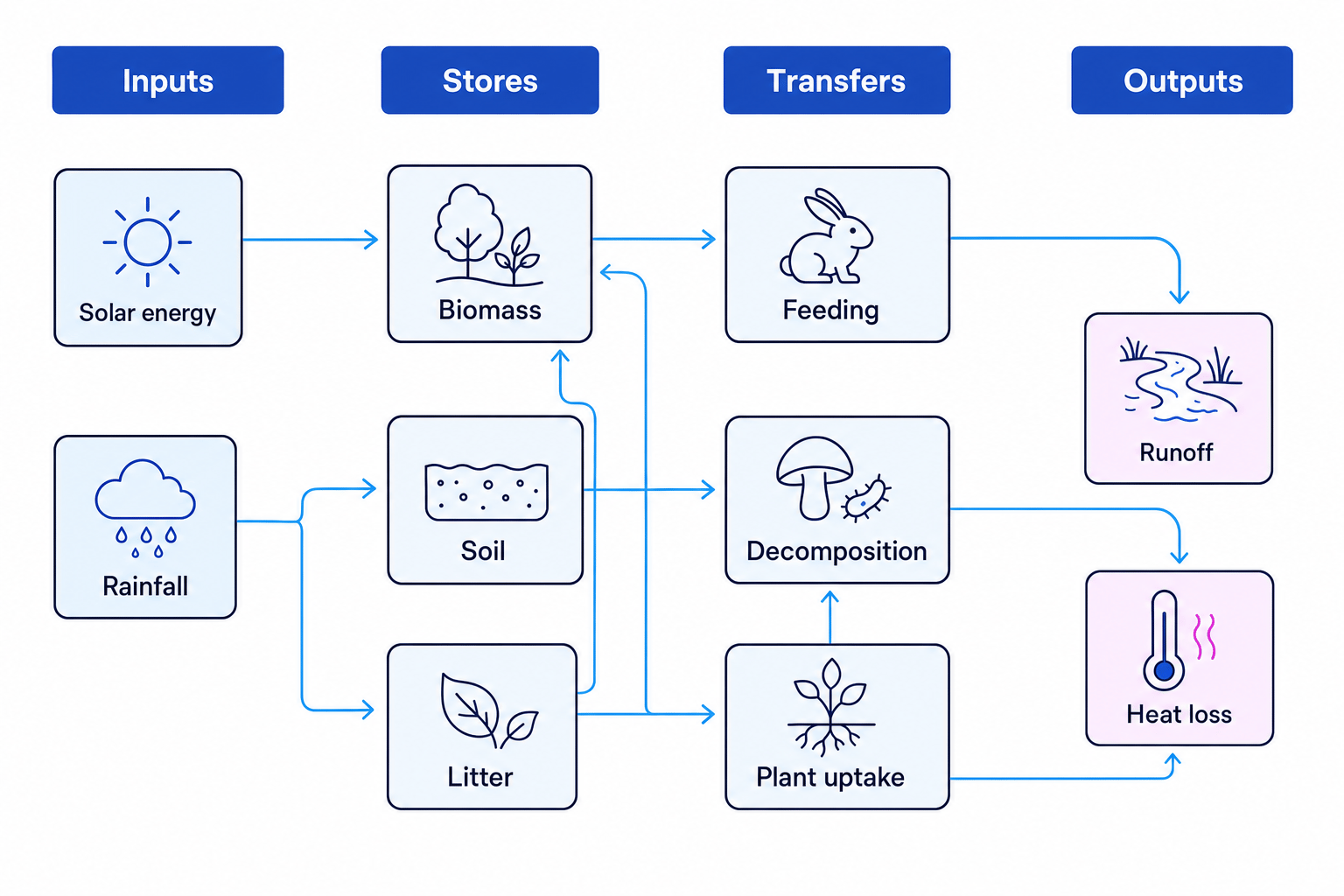
A system is a set of connected parts that work together. In Geography, you often think about systems using inputs coming in, stores where material or energy is held, transfers moving between stores, and outputs leaving the system.
Ecosystem basics
- Biotic components are the living parts of an ecosystem, such as trees, insects, birds, fungi and bacteria.
- Abiotic components are the non-living parts, such as sunlight, rainfall, temperature, soil, water and rocks.
- Interdependence means components rely on each other. For example, plants rely on soil nutrients, while animals rely on plants for food or shelter.
Ecosystems exist at a range of scales. A local scale ecosystem might be a woodland, pond or hedgerow. A global scale ecosystem, also called a biome, covers very large areas with similar climate, plants and animals.
Think connections
The key idea is not just “what lives there?” but “how are the parts connected?” In an ecosystem, a change to one component can create knock-on effects through the whole system.
2. Small-scale UK ecosystem example: Epping Forest
A strong small-scale UK example is Epping Forest, an ancient deciduous woodland on the north-east edge of London and into Essex. Deciduous trees lose their leaves in autumn, which affects food supply, light levels and nutrient cycling through the year.
In Epping Forest, abiotic factors include sunlight, rainfall, temperature, soil moisture and soil nutrients. Biotic components include oak, beech, holly, brambles, grasses, insects, birds, deer, rabbits, foxes, fungi, bacteria and earthworms.
Producers, consumers and decomposers
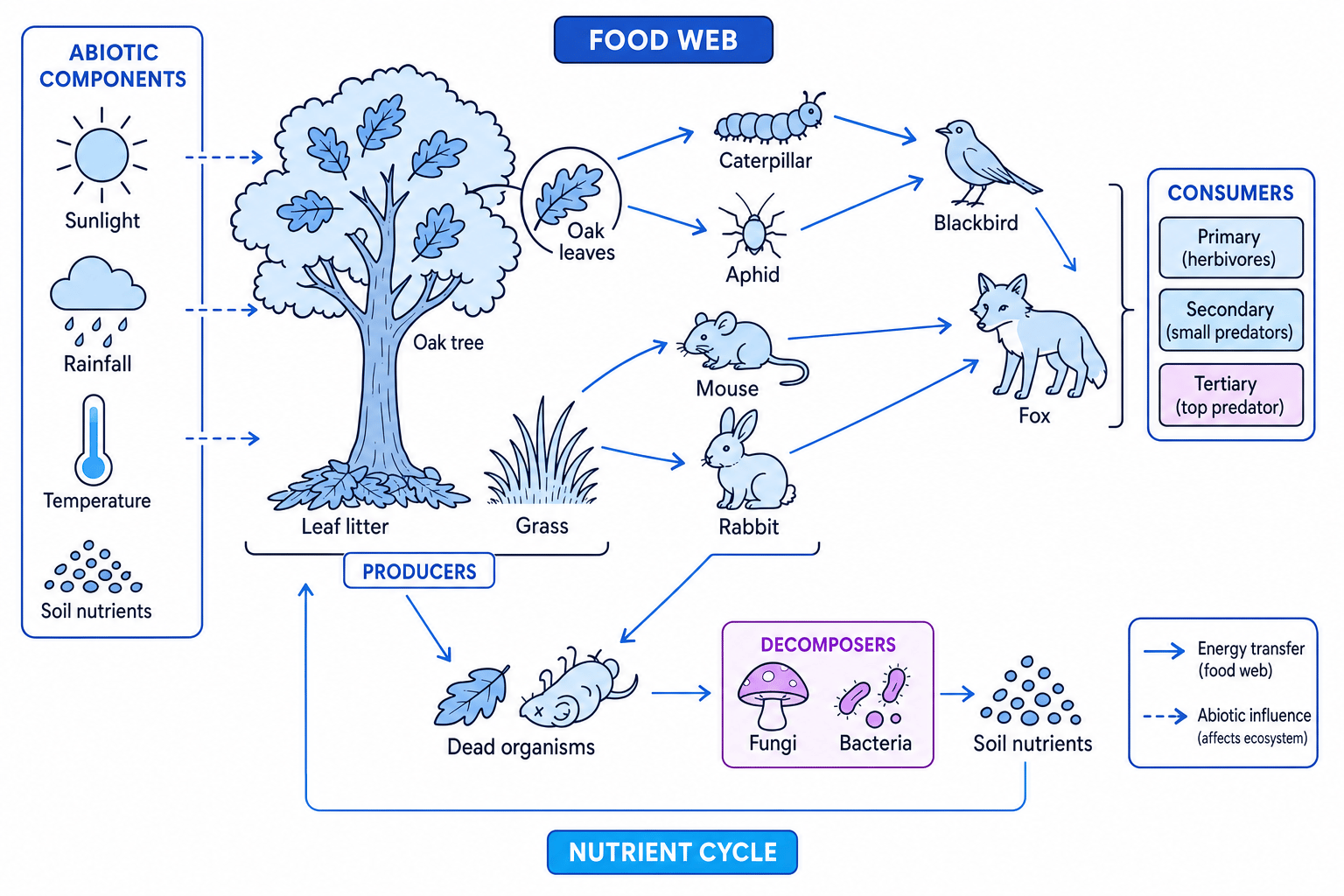
A producer is an organism that makes its own food, usually by photosynthesis, the process where plants use sunlight, carbon dioxide and water to make food. In a woodland, trees, shrubs and grasses are producers.
A consumer is an organism that gets energy by eating other organisms. A primary consumer eats producers, such as a caterpillar eating oak leaves. A secondary consumer eats primary consumers, such as a bird eating caterpillars. A tertiary consumer is a higher-level predator, such as a fox or bird of prey.
A decomposer is an organism, such as fungi, bacteria or earthworms, that breaks down dead material and waste.
A food chain shows one route through which energy is transferred, for example: oak leaves → caterpillar → blackbird → fox. A food web is a network of connected food chains, which is more realistic because most organisms have more than one food source.
Food-chain arrows
Food-chain arrows show the direction of energy transfer. The arrow points from the food to the organism that eats it, not from the predator to its prey.
Interpreting a woodland food web
Imagine caterpillar numbers fall sharply in a deciduous woodland.
- Follow the direct feeding link: fewer caterpillars means less food for birds such as blackbirds or blue tits, so their numbers may fall if they cannot find enough alternative food.
- Follow the link back to producers: fewer caterpillars means less feeding damage to oak leaves, so young leaves may survive better.
- Look for alternative pathways: if birds can also eat aphids, worms or berries, the impact may be reduced because the food web has other routes for energy transfer.
- Judge the overall effect: a small temporary fall may be absorbed by the ecosystem, but a severe long-term fall could reduce bird populations and affect predators that feed on birds.
3. Nutrient cycling
A nutrient is a substance that living things need to grow, such as nitrogen or minerals in the soil. Nutrient cycling is the movement of nutrients between living material, dead material and the soil.
In a deciduous woodland, leaves fall in autumn and form leaf litter, which means dead leaves and twigs on the ground. Decomposers break this down into humus, a dark organic material that helps make soil fertile. Plant roots then take nutrients from the soil, so nutrients move back into living biomass. Biomass means the total mass of living material in plants and animals.
Energy flows, nutrients cycle
Energy mainly flows through an ecosystem from the Sun to producers and then consumers. Nutrients are different: they are recycled between plants, animals, decomposers and soil.
Tracing nutrient cycling after leaf fall
In Epping Forest, many leaves fall during autumn.
- Identify the new store: fallen leaves increase the litter store on the woodland floor.
- Apply the decomposition process: fungi, bacteria and earthworms break down the leaf litter into humus.
- Link to the soil store: nutrients released from humus enter the soil, improving soil fertility.
- Complete the cycle: tree roots take up these nutrients, supporting new plant growth in spring.
4. Balance between components
An ecosystem is in balance when its components are broadly stable over time. This does not mean nothing changes. Populations rise and fall naturally with seasons, weather and food supply. A better term is dynamic equilibrium, meaning the system changes but tends to return to a stable state.
Balance depends on interrelationships. For example, if there are enough plants, herbivores have food. If there are enough predators, herbivore numbers are controlled. If decomposers are active, nutrients return to the soil and support plant growth.
Predicting the impact of fewer foxes
Imagine fox numbers fall in a woodland ecosystem.
- Start with the direct effect: foxes eat animals such as rabbits and mice, so fewer foxes may allow rabbit and mouse numbers to increase.
- Follow the effect on producers: more rabbits may graze more grass and young seedlings, reducing plant growth in some areas.
- Connect to abiotic conditions: less ground vegetation can leave soil more exposed to erosion and drying out.
- Consider longer-term balance: if plant cover falls, food for herbivores may later become limited, causing their numbers to fall again.
Avoid one-step answers
For ecosystem questions, do not stop after one effect. Strong answers use chains of reasoning, such as “fewer predators → more herbivores → more grazing → less vegetation → more exposed soil”.
5. Large-scale natural global ecosystems
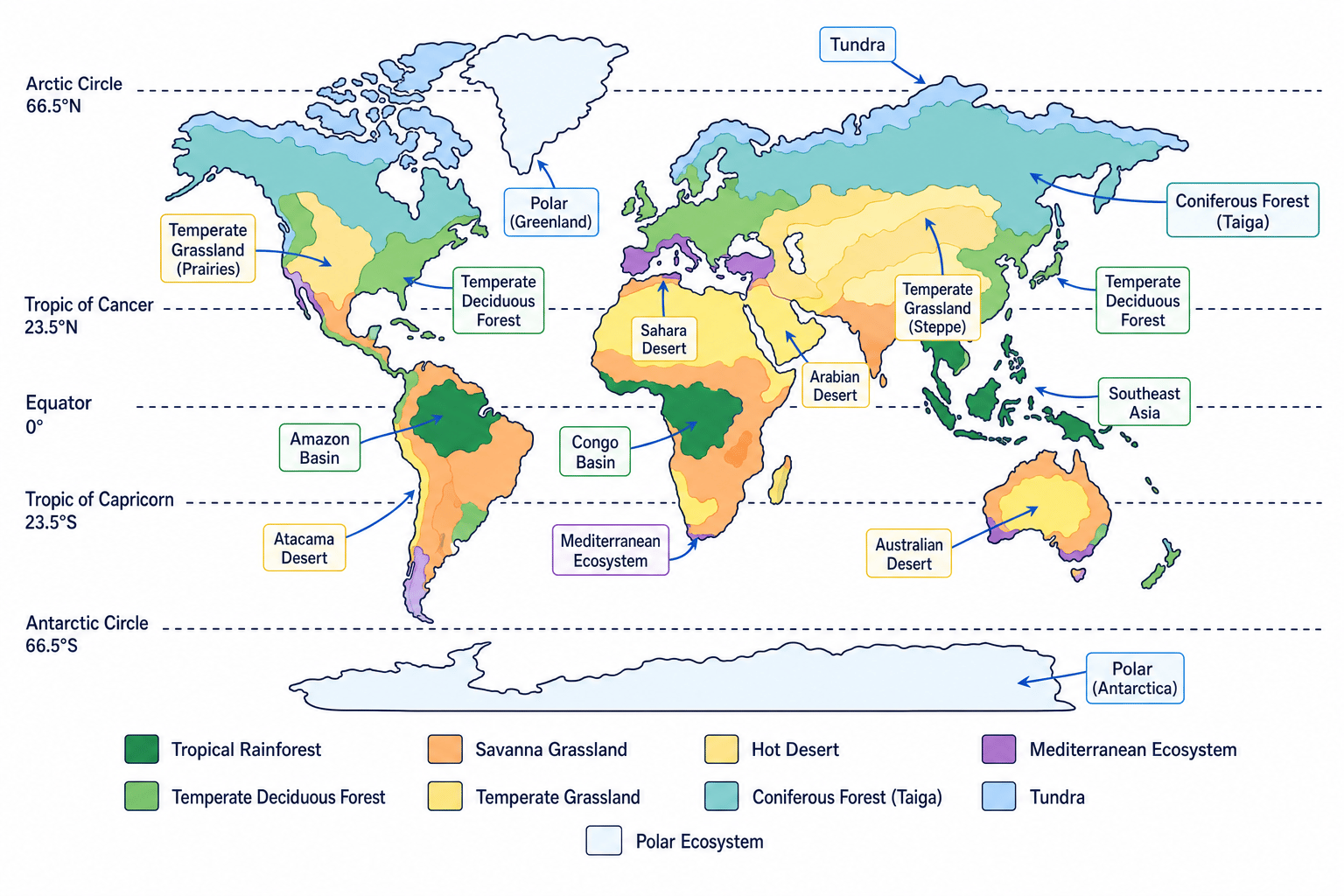
A biome is a large-scale natural ecosystem with plants and animals adapted to a particular climate. The distribution of biomes means where they are found. Their characteristics are their main features, such as rainfall, temperature, vegetation and biodiversity.
Biome distribution is strongly linked to latitude, which is distance north or south of the Equator. Near the Equator, high temperatures and heavy rainfall support tropical rainforests. Around 20 to 30 degrees north and south of the Equator, dry descending air helps create many hot deserts. Towards the poles, lower temperatures support taiga, tundra and polar ecosystems.
Overview of major biomes
| Global ecosystem | Typical distribution | Main characteristics |
|---|---|---|
| Tropical rainforest | Close to the Equator, including the Amazon Basin, Congo Basin and Southeast Asia | Hot and wet all year; dense evergreen forest; very high biodiversity; rapid nutrient cycling |
| Savanna grassland | Either side of tropical rainforests, especially in Africa, South America and northern Australia | Warm all year; wet and dry seasons; grasses with scattered trees; many plants adapted to drought and fire |
| Hot desert | Around 20 to 30 degrees north and south, including the Sahara, Arabian Desert, Australian Desert and Atacama | Very low rainfall; sparse vegetation; plants and animals adapted to water shortage |
| Temperate deciduous forest | Mid-latitudes, including western and central Europe, eastern North America and east Asia | Four seasons; moderate rainfall; broadleaf trees lose leaves in autumn; fairly fertile soils |
| Temperate grassland | Continental interiors, such as the North American Prairies and Eurasian Steppe | Grasses dominate; rainfall often too low for forests; fertile soils in many areas |
| Mediterranean ecosystem | Around the Mediterranean Basin, California, central Chile, South Africa’s Cape region and south-west Australia | Hot dry summers; mild wet winters; drought-resistant shrubs and woodland |
| Coniferous forest or taiga | High latitudes across Canada, Scandinavia and Russia | Long cold winters; short cool summers; evergreen conifer trees; acidic soils |
| Tundra | Arctic fringes north of the taiga | Very cold; low precipitation; permafrost; mosses, lichens and low shrubs |
| Polar ecosystem | Antarctica, Greenland and the high Arctic | Permanent ice or snow in many areas; extremely cold and dry; very limited vegetation |
In AQA Living World, this overview leads into tropical rainforests for everyone. Your class then studies either hot deserts or cold environments, so these global patterns will help whichever optional route you take.
Biome boundaries are not walls
Biome maps are simplified. In reality, ecosystems often merge gradually, and local factors such as altitude, ocean currents and distance from the sea can change conditions.
Identifying a biome from map evidence
A location is in North Africa near the Tropic of Cancer and has very low annual rainfall.
- Use latitude: the Tropic of Cancer is around 23.5 degrees north, within the belt where many hot deserts occur.
- Use climate evidence: very low rainfall matches desert conditions rather than rainforest or deciduous forest.
- Use place evidence: North Africa includes the Sahara, the world’s largest hot desert.
- Make the decision: the most likely biome is hot desert.
In the exam
- Use precise vocabulary: include terms such as biotic, abiotic, producer, consumer, decomposer, food web and nutrient cycle where relevant.
- Develop chains of effects: for “changing one component” questions, explain at least two knock-on effects rather than giving a single statement.
- Use named places: for the small-scale ecosystem, name a real UK example such as Epping Forest and link your points to woodland features.
Check yourself
- What is the difference between a food chain and a food web?
- How do decomposers help maintain nutrient cycling in a woodland ecosystem?
- Why are hot deserts commonly found around 20 to 30 degrees north and south of the Equator?