

What you'll learn
- How development and quality of life vary worldwide, and how geographers measure them.
- Why development is uneven, including physical, economic and historical causes.
- How strategies such as aid, tourism, fairtrade and debt relief can reduce the development gap.
- How rapid development in one LIC or NEE, and economic change in the UK, affect people and places.
1. Development and quality of life
Economic development means progress in wealth, jobs, technology and living standards. Quality of life is wider: it includes health, education, safety, freedom, environment, community and happiness.
Development gap
The development gap is the difference in levels of development and quality of life between richer and poorer countries, and also between regions within countries.
Countries are often classified as:
- LICs — low-income countries, with low GNI per head and usually lower social indicators.
- NEEs — newly emerging economies, where industry and trade are growing quickly.
- HICs — high-income countries, with high GNI per head and usually stronger health and education systems.
Older terms like “First World” and “Third World” are now avoided because they are outdated and over-simple.
2. Measuring development
You need to know both economic and social indicators.
GNI per head
Gross national income per head is the total income earned by a country’s people and businesses, divided by the population. It is usually given in US$ per person.
Key measures include:
| Measure | What it suggests |
|---|---|
| GNI per head | Average income and economic output |
| Birth rate | Number of births per 1,000 people per year |
| Death rate | Number of deaths per 1,000 people per year |
| Infant mortality | Deaths of children under 1 per 1,000 live births |
| Life expectancy | Average age a person is expected to live to |
| People per doctor | Access to healthcare |
| Literacy rate | Percentage of adults who can read and write |
| Access to safe water | Basic health and infrastructure |
| HDI | Combined development score from 0 to 1, using income, education and life expectancy |
Use more than one indicator
No single measure proves how developed a country is. Strong answers compare several indicators, such as income, health and education together.
Limitations of development measures
Development data can be useful, but it has weaknesses. Averages hide inequality: a country may have a high GNI per head because a small elite is very rich, while many people remain poor. Data can also be out of date or unreliable, especially where informal work is common.
HDI is useful because it combines income, education and life expectancy, but it still misses things like political freedom, gender equality, culture, pollution and happiness.
Relying on income alone
Do not write that a country is “developed” just because GNI per head is high. Always ask whether people also have good health, education, water, housing and opportunities.
Calculating percentage change
Tourism income in a country rises from US1.8billiontoUS1.8 billion to US1.8billiontoUS2.7 billion. Calculate the percentage increase.
percentage change=new value−old valueold value×100\text{percentage change} = \frac{\text{new value} - \text{old value}}{\text{old value}} \times 100percentage change=old valuenew value−old value×100- Find the change by subtracting the old value from the new value: 2.7 minus 1.8 gives US$0.9 billion.
- Divide the change by the old value: 0.9 divided by 1.8 gives 0.5.
- Convert 0.5 to a percentage, giving a 50% increase.
3. The Demographic Transition Model
The Demographic Transition Model, or DTM, shows how birth rates, death rates and population change as a country develops.
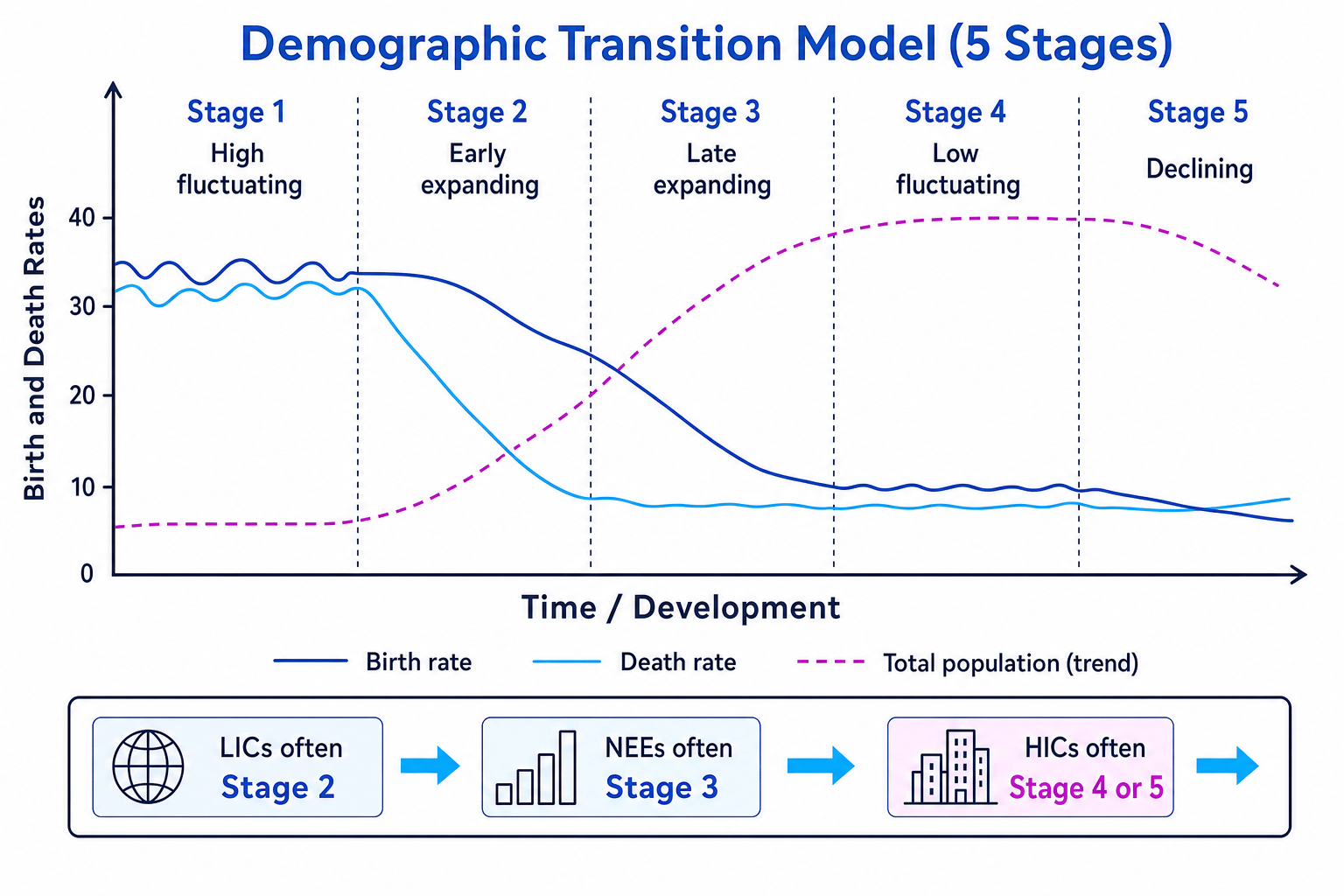
In general, LICs are often in Stage 2, where death rates fall because healthcare, food supply and sanitation improve, but birth rates remain high. NEEs are often in Stage 3, where birth rates begin to fall as education, urban living and access to contraception increase. HICs are usually in Stage 4 or 5, with low birth and death rates.
Linking DTM stage to development
A country has a birth rate of 25 per 1,000 and a death rate of 7 per 1,000. Birth rates have been falling for 20 years.
- Compare the two rates: births are still higher than deaths, so the population is growing.
- Notice the trend: the birth rate is falling, which suggests families are choosing to have fewer children.
- Link this to the model: falling birth rates and low death rates suggest Stage 3, typical of many NEEs.
4. Why development is uneven
Uneven development means some places become wealthier and healthier faster than others.
Physical causes
Climate, relief and natural hazards can make development harder. For example, drought in parts of the Sahel can reduce crop yields, while landlocked countries may face higher transport costs because they lack direct sea access.
Economic causes
Countries dependent on exporting raw materials, such as copper, cocoa or oil, can suffer when world prices fall. Poor infrastructure, debt and limited education can also reduce investment and job opportunities.
Historical causes
Colonialism often shaped trade patterns, borders and ownership of resources. Many former colonies were used to supply raw materials rather than develop balanced economies with strong manufacturing and services.
Consequences
Uneven development creates disparities in wealth and health. People in poorer regions may have lower incomes, fewer doctors, less safe water and shorter life expectancy. It also encourages international migration, as people move for jobs, safety, education or healthcare.
Migration
Migration is the movement of people from one place to another. It can be voluntary, such as moving for work, or forced, such as fleeing conflict or disaster.
5. Reducing the development gap
There is no single solution. Most countries need a mix of strategies.
| Strategy | How it can help | Possible limitation |
|---|---|---|
| Investment | Builds factories, roads, ports and services | Profits may leave the country |
| Industrial development | Creates jobs, exports and tax revenue | Can cause pollution or poor working conditions |
| Tourism | Brings foreign currency and jobs | Jobs may be seasonal or low paid |
| Aid | Supports health, education, water and emergency relief | Can create dependency or be misused |
| Intermediate technology | Low-cost, local, easy-to-repair technology | May be too small-scale for national growth |
| Fairtrade | Gives farmers a fairer price and a social premium | Certification can be expensive |
| Debt relief | Frees money for schools, hospitals and infrastructure | Benefits depend on good governance |
| Microfinance loans | Small loans help people start businesses | Loans may not solve wider poverty |
Intermediate technology
Intermediate technology is technology that is affordable, appropriate to local skills and resources, and easy to maintain, such as hand pumps or small-scale solar power.
Example: tourism in an LIC or NEE
A common example is Jamaica, an NEE in the Caribbean. Tourism around Montego Bay, Ocho Rios and Negril creates hotel, restaurant, transport and tour-guide jobs. It also earns foreign currency and encourages investment in airports, roads and ports.
Tourism can create a multiplier effect: tourists spend money, businesses employ more workers, workers spend wages locally, and the government collects tax to improve services.
However, some profits leak overseas through foreign-owned hotel chains and airlines. Tourism can also increase pressure on water supplies, coral reefs and coastal ecosystems, and it is vulnerable to hurricanes, global recessions and pandemics.
Tourism evaluation
A strong tourism answer balances benefits with limits: jobs and infrastructure are positives, but leakage, seasonal work and environmental damage reduce the long-term impact.
6. Case study: rapid development in one LIC or NEE
You need one detailed case study of an LIC or NEE. A widely used example is Nigeria, a newly emerging economy in West Africa.
Nigeria’s location and importance
Nigeria lies on the Gulf of Guinea and borders Benin, Niger, Chad and Cameroon. It has a population of over 200 million, making it Africa’s most populous country. It is regionally important through trade, politics and culture, and globally important as an oil producer and a major African economy.
Wider context
Nigeria is socially and culturally diverse, with more than 250 ethnic groups and major Christian and Muslim populations. It has a youthful population and globally recognised film and music industries, including Nollywood.
Politically, Nigeria gained independence from Britain in 1960 and has been a democracy since 1999, although corruption and conflict remain challenges. Environmentally, it includes semi-arid northern areas, tropical rainforest, savanna and the oil-rich Niger Delta.
Industrial structure and development
As countries develop, their employment structure usually changes from primary work to manufacturing, services and high-skilled research.
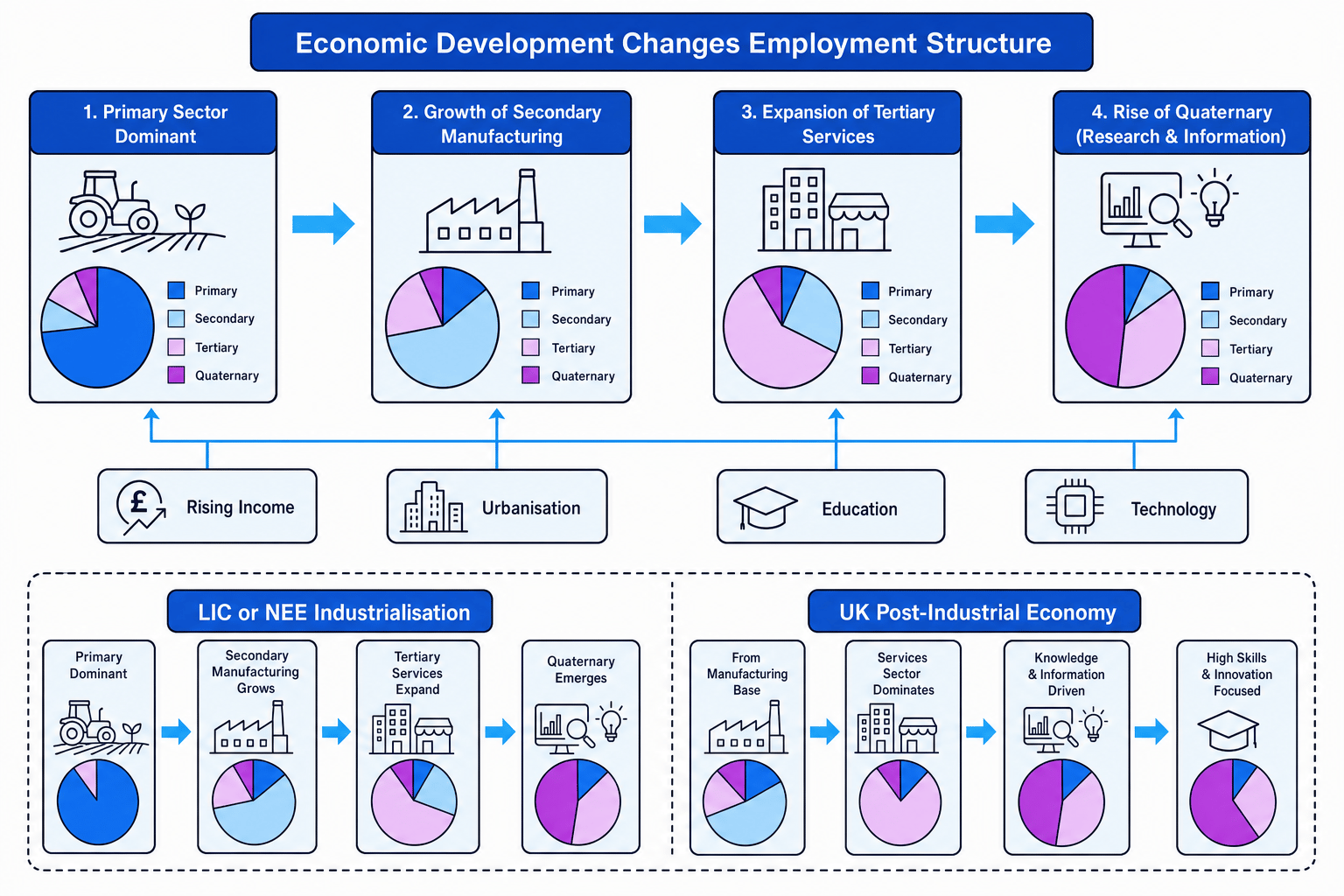
Nigeria has shifted away from mainly agriculture towards oil, manufacturing and services. Manufacturing can stimulate development because it creates jobs, adds value to raw materials, increases exports, raises tax revenue and encourages better roads, power supplies and training.
Industrial structure
Industrial structure means the share of jobs or output in the primary, secondary, tertiary and quaternary sectors of the economy.
TNCs in Nigeria
A transnational corporation, or TNC, is a company that operates in more than one country. Shell is a major example in Nigeria’s oil industry.
TNCs can bring investment, jobs, technology, skills and export earnings. However, profits may be sent abroad, workers may be low paid, and environmental damage can be severe. In the Niger Delta, oil spills and gas flaring have polluted water, farmland and fishing areas.
Trade, aid and quality of life
Nigeria’s trading relationships have changed. It still trades with the UK and EU, but it also has growing links with China, India and the USA. It is a member of OPEC and ECOWAS.
Aid to Nigeria includes health programmes, education projects, clean water schemes and emergency support. It can improve quality of life, but impacts vary depending on corruption, security and whether projects match local needs.
Economic development has improved incomes, education and access to services for many people, especially in cities such as Lagos and Abuja. But inequality remains high, and some rural areas and informal settlements still lack reliable electricity, clean water and healthcare.
7. Economic change in the UK
The UK has moved from an industrial economy towards a post-industrial economy, where services, finance, research and information technology dominate.
De-industrialisation
De-industrialisation is the decline in manufacturing employment and traditional heavy industries such as coal, steel and shipbuilding.
Causes include:
- Globalisation — companies can produce goods more cheaply abroad.
- Automation — machines reduce the number of factory workers needed.
- Government policies — privatisation, reduced subsidies and encouragement of new service industries.
- Resource decline — some coalfields and older industrial areas became less competitive.
Thinking the UK makes nothing
De-industrialisation does not mean manufacturing disappeared. It means manufacturing employs fewer people and is often more automated, specialised and high-tech.
The post-industrial economy
The UK has grown in:
- Information technology, including software, data and digital services.
- Service industries, such as retail, healthcare, education and tourism.
- Finance, especially in London.
- Research and science, including universities and science parks such as Cambridge Science Park.
- Business parks, often near motorways and airports.
Industry and the physical environment
Industry can cause air and water pollution, waste, noise, visual impact, traffic and habitat loss.
A useful example of more sustainable modern industrial development is Torr Quarry in Somerset. It reduces environmental impact through rail transport for stone, landscaping, dust control, water management and habitat restoration. It still affects the landscape, but planning and restoration reduce long-term damage.
8. Rural change in the UK
Rural areas are not all changing in the same way.
In an area of population growth, such as South Cambridgeshire, commuting and counter-urbanisation have increased demand for housing. This can bring new shops, schools and services, but also higher house prices, traffic congestion and pressure on greenfield land.
In an area of population decline, such as parts of the Outer Hebrides, young people may leave for education or work. This can lead to an ageing population, school closures, fewer services and labour shortages, although tourism and remote working can create opportunities.
9. Infrastructure, regional inequality and the wider world
The UK has invested in transport infrastructure to improve economic links. Examples include the Elizabeth line in London, upgrades to major roads such as the A14, container port expansion at London Gateway and Liverpool2, and airport capacity debates such as Heathrow expansion. Rail plans such as HS2 and Northern Powerhouse Rail show how infrastructure policy can change over time.
The north–south divide describes economic differences between the wealthier South East and London, and many former industrial regions in northern England, Wales and parts of the Midlands.
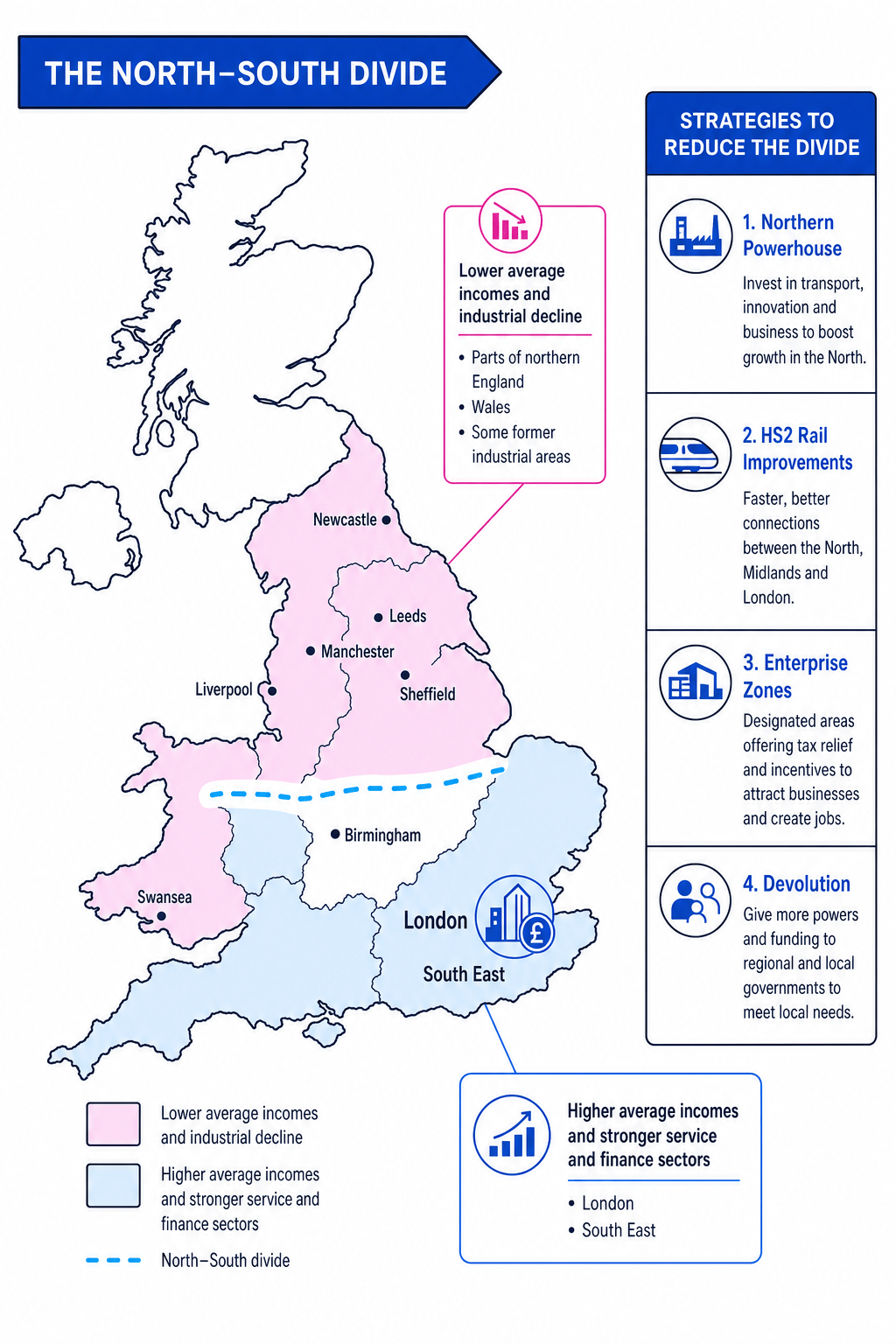
Strategies to reduce regional differences include the Northern Powerhouse, enterprise zones, devolution, transport investment and support for research and innovation outside London.
The UK also has global links through trade, culture, transport and electronic communication. It trades goods and services worldwide, exports culture through media, sport and education, and is connected by airports, ports, the Channel Tunnel and digital networks. The UK left the EU in 2020, but the EU remains a major trading partner. The Commonwealth also links the UK with countries through diplomacy, education, sport and development cooperation.
In the exam
- Use named places: for example Nigeria for an LIC or NEE case study, Jamaica for tourism, Torr Quarry for sustainable industry, and named UK rural areas.
- Explain chains of reasoning: “investment creates jobs, which raises incomes, which increases tax revenue, which can improve services.”
- Evaluate when asked: balance benefits against limitations, such as tourism jobs versus leakage, or TNC investment versus pollution.
Check yourself
- Can you explain why GNI per head alone is a limited measure of development?
- Can you link one DTM stage to a country’s level of development?
- Can you describe two strategies used to reduce the north–south divide in the UK?
