

What you'll learn
- Why food, water and energy are essential for human development.
- How resource supply and consumption vary around the world.
- The main opportunities and challenges linked to food, water and energy in the UK.
- How to build clear GCSE explanations using place, scale and cause-and-effect chains.
The starting point: what is resource management?
A resource is something people use to meet needs or wants. In this topic, the focus is on three resources that are fundamental to everyday life: food, water and energy.
Resource management
Resource management means controlling how resources are supplied, used, conserved and distributed so that people’s needs can be met now and in the future.
Human development means improvements in people’s quality of life, such as better health, education, income and life expectancy. Resources matter because they affect both social well-being — health, safety, education and living standards — and economic well-being — jobs, income, trade and productivity.
The big idea
Food, water and energy are not just “things people need”. They are the basic systems that allow people to be healthy, educated, employed and economically productive.
Why food, water and energy matter
Food provides nutrition. Without enough safe, affordable food, people may suffer from malnutrition, which means poor health caused by too little food, too much unhealthy food, or a lack of key nutrients.
Water is needed for drinking, washing, sanitation, farming and industry. Safe water reduces disease and supports schools, hospitals and businesses.
Energy powers homes, transport, factories, communications, heating, cooling and healthcare. A reliable electricity supply can allow businesses to grow and students to study after dark.
Linking a resource to development
Imagine a town has unreliable electricity for several hours each day.
- Start with the direct effect: homes, schools, clinics and businesses cannot use lights, refrigeration, computers or machinery reliably.
- Link this to social well-being: vaccines and medicines may be harder to store safely, and students have less time to study in the evening.
- Link this to economic well-being: factories and shops lose working time, so output, wages and investment may fall.
- Make the overall judgement: unreliable energy can slow development because it affects health, education and income at the same time.
Global inequalities in resources
Supply means how much of a resource is available in a place. Consumption means how much of that resource is used. These are not always the same.
Some places have a good physical supply of resources, such as high rainfall or fossil fuel reserves, but people may still lack access because of poverty, conflict, weak infrastructure or political instability. Infrastructure means the built systems that help a country function, such as pipes, roads, electricity grids, ports and treatment works.
The broad global pattern
In general:
- High income countries use large amounts of energy, water and imported food because incomes, industry and living standards are high.
- Newly emerging economies, such as China and India, have rapidly rising resource demand because of industrialisation, urbanisation and a growing middle class.
- Low income countries often use fewer resources per person, but may have the greatest unmet need, especially for safe water, reliable electricity and food security.
This inequality can happen at several scales: global between countries, national between regions of one country, and local between richer and poorer households.
Comparing consumption per person
An exam table says Country A uses 600 billion kWh of electricity and has 60 million people. Country B uses 300 billion kWh and has 300 million people.
-
Use consumption per person, because total consumption alone is unfair when countries have different population sizes.
consumption per person=total consumptionpopulation\text{consumption per person} = \frac{\text{total consumption}}{\text{population}}consumption per person=populationtotal consumption -
Calculate Country A’s value.
600 billion kWh60 million people=10,000 kWh per person\frac{600\ \text{billion kWh}}{60\ \text{million people}} = 10{,}000\ \text{kWh per person}60 million people600 billion kWh=10,000 kWh per person -
Calculate Country B’s value.
300 billion kWh300 million people=1,000 kWh per person\frac{300\ \text{billion kWh}}{300\ \text{million people}} = 1{,}000\ \text{kWh per person}300 million people300 billion kWh=1,000 kWh per person -
Compare the results: Country A uses less electricity in total than it might seem from the raw figure, but its per-person consumption is ten times higher than Country B’s.
The big-country trap
Do not assume the country with the largest total resource use is always the most resource-intensive. For fair comparisons, look at use per person as well as total use.
Resource management in the UK
The UK is a high income country, so most people have reliable access to food, clean water and energy. However, the UK still faces resource challenges because demand is changing, domestic supplies are limited, and environmental impacts are becoming more important.
This overview of all three resources is compulsory. Later in the Resource management topic, your school studies one of Food, Water or Energy in more depth.
Food in the UK
Changing food demand
UK consumers increasingly expect:
- High-value foods, such as fresh fruit, vegetables, flowers, coffee and seafood, often imported from low income countries.
- Seasonal food all year, such as strawberries in winter or green beans outside the UK growing season.
- Organic produce, meaning food produced under rules that limit artificial fertilisers, pesticides and some intensive farming methods.
This creates opportunities and challenges. For example, Kenyan green beans or cut flowers sold in UK supermarkets can create jobs and export income in Kenya, but may also use scarce water and depend on air transport.
Food miles and carbon footprints
Food miles are the distance food travels from where it is produced to where it is eaten. Longer food miles can increase transport emissions, especially if food is flown.
A carbon footprint is the total greenhouse gas emissions linked to a product, person or activity. For food, this includes farming, processing, packaging, transport, refrigeration and waste.
Food miles are not the whole story
Local food often reduces transport distance, but the total carbon footprint also depends on production methods. For example, heated greenhouses can use lots of energy, while some imported food may be grown outdoors with less heating.
Local sourcing and agribusiness
Local sourcing means buying food produced close to where it is sold. It can support local farmers, reduce transport distances and make supply chains easier to trace.
Agribusiness means large-scale, commercial farming often linked to big companies, machinery, chemicals, contracts and supermarket supply chains. It can produce large quantities of affordable food efficiently, but may reduce rural employment, increase pressure on small farms, and harm biodiversity if farming becomes very intensive.
Assessing a UK food choice
A supermarket sells green beans imported from Kenya and beans grown locally in season.
- Consider the social and economic benefits of imports: Kenyan producers may gain jobs, wages and export income.
- Consider the environmental costs: air freight, packaging and refrigeration may increase emissions, and irrigation may add pressure in dry areas.
- Compare this with local seasonal food: it may reduce transport emissions and support local farmers, but it may not be available all year.
- Reach a balanced view: local seasonal food is often environmentally attractive, but the best answer weighs carbon footprint, development benefits and reliability of supply.
Water in the UK
Changing demand for water
UK water demand is affected by population growth, smaller households, more appliances, gardens, industry and rising expectations of comfort. Climate change may make the issue harder by increasing the risk of hotter, drier summers in parts of the UK.
Water quality and pollution management
Water quality can be reduced by:
- Sewage pollution from overloaded drains or treatment works.
- Agricultural runoff, where fertilisers and manure wash into rivers.
- Industrial pollution from chemicals or waste.
Pollution is managed through sewage treatment, water quality monitoring, regulation, fines, farm buffer strips beside rivers, and investment in better pipes and treatment works.
Matching supply and demand
A water surplus happens where supply is greater than demand. A water deficit happens where demand is greater than supply. In the UK, the general pattern is:
- Western and northern areas, such as Wales, Scotland and North West England, tend to have higher rainfall and lower population density.
- South East England and East Anglia tend to have lower rainfall, high population density and high demand.
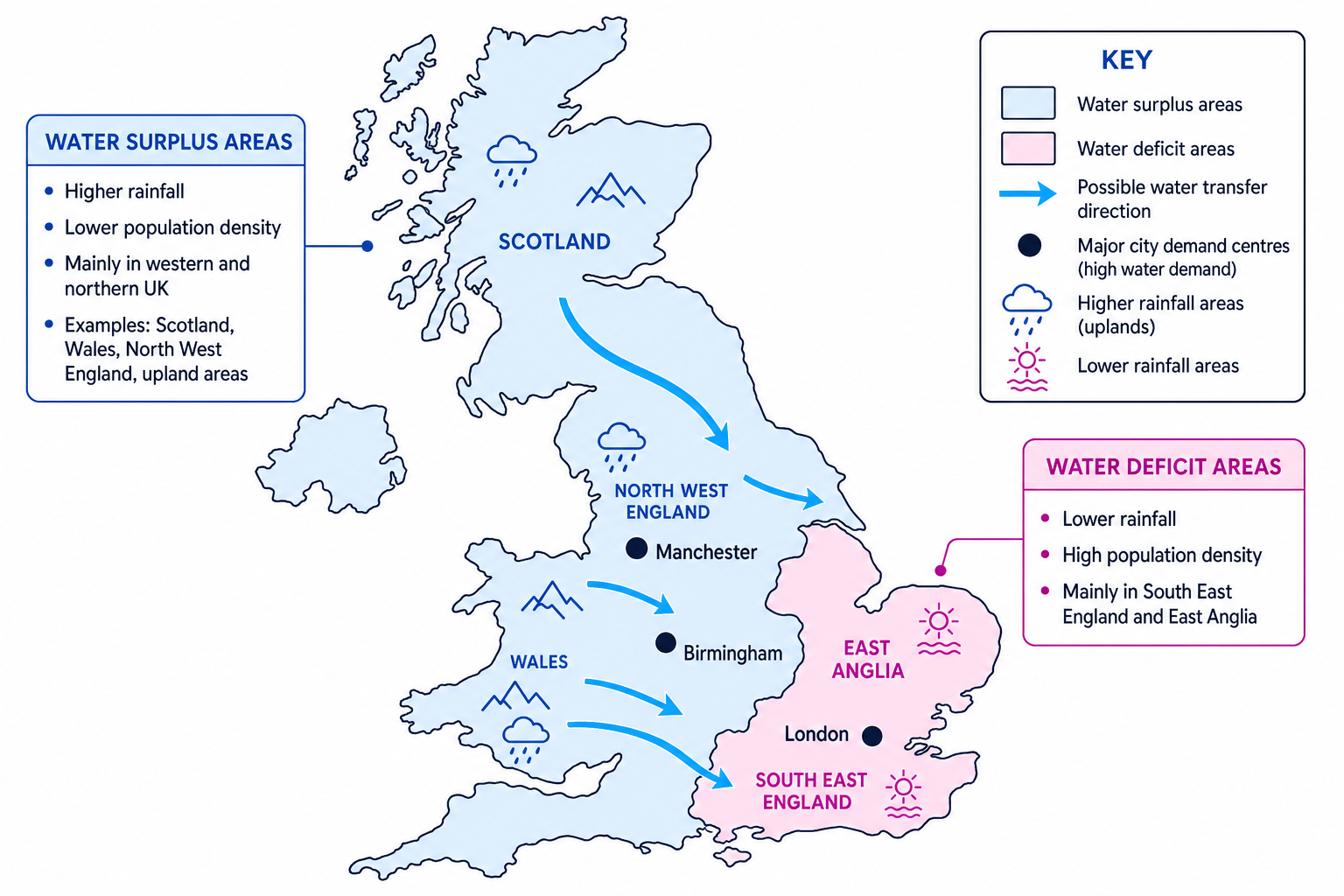
Water transfer means moving water from an area of surplus to an area of deficit, often through rivers, pipes, canals or reservoirs. It can help maintain supplies, but it can be expensive, use energy and affect ecosystems.
Explaining a water transfer decision
A proposed scheme would move water from a wetter upland area to a growing city in the south east.
- Identify the mismatch: the upland area has high rainfall and lower demand, while the city has lower rainfall and a larger population.
- Explain why transfer may be needed: the city needs reliable water for homes, businesses and public services, especially during dry periods.
- Add the challenge: building and pumping water can be costly and may damage landscapes or river habitats.
- Make a judgement: transfer can improve water security, but it should be combined with reducing leaks, saving water and managing demand.
Energy in the UK
The changing energy mix
The energy mix is the range of energy sources a country uses. The UK has moved away from heavy reliance on coal and towards a mix including natural gas, nuclear power and renewables.
Fossil fuels are coal, oil and natural gas. They formed from ancient organic material over millions of years and release carbon dioxide when burned. Renewable energy comes from sources that are naturally replenished, such as wind, solar, hydroelectric power and biomass.
In recent years, coal has become a very small part of UK electricity generation, while renewables — especially offshore wind — have grown strongly. However, transport and heating still rely heavily on oil and gas, so the whole UK energy system is not yet fully renewable.
Reduced domestic supplies
The UK’s own supplies of coal, oil and gas have declined. Deep coal mining has largely ended, and North Sea oil and gas production has fallen from its peak. This can increase dependence on imports, which may affect energy security and prices.
Energy security means having a reliable, affordable and sufficient energy supply.
Economic and environmental issues
Different energy sources create different opportunities and problems:
- North Sea oil and gas support jobs, tax revenue and energy security, but add greenhouse gas emissions and risk marine pollution.
- Offshore wind creates low-carbon electricity and skilled jobs, but needs grid connections and can face concerns about cost, sea views and wildlife.
- Nuclear power produces low-carbon electricity, but has high construction costs and creates radioactive waste.
- Shale gas has been debated in the UK, but it is not currently a major source because of concerns about earthquakes, groundwater and public opposition.
Evaluating an energy source
Consider whether offshore wind is a good choice for the UK.
- Use the UK’s physical advantages: the UK has long coastlines, shallow seas in some areas, and strong winds, especially in the North Sea.
- Add the economic benefits: offshore wind can create construction, maintenance and engineering jobs while reducing reliance on imported fuels.
- Add the environmental benefits and limits: it produces low-carbon electricity, but turbines, cables and maintenance may affect marine ecosystems.
- Make a balanced judgement: offshore wind is a strong option for the UK, but it needs investment in storage, grid connections and backup supply for calmer periods.
Bringing it together
Strong answers in this topic usually follow a chain:
resource issue → effect on people → effect on the economy → environmental impact → judgement
For example, don’t just write “water transfer is good”. Explain where the surplus and deficit are, why the transfer is needed, who benefits, and what problems it may create.
Use named places
Even when a question does not ask for a full case study, named examples make answers stronger: South East England for water deficit, Kenya for high-value food exports, the North Sea for oil and gas, and offshore wind farms such as Dogger Bank or Hornsea.
In the exam
- Define the resource issue clearly before explaining it: supply, demand, consumption, deficit, surplus or energy mix.
- Use a chain of reasoning: show how the resource affects health, jobs, income, education or the environment.
- Include scale and place: global inequality, UK national patterns, and named regional or local examples.
- For evaluate questions, give both benefits and challenges, then make a supported judgement.
Check yourself
- Why are food, water and energy described as fundamental to human development?
- How can a country have enough physical water supply but still have poor access to safe water?
- What are two opportunities and two challenges created by the UK’s changing demand for food, water or energy?
