

Tectonic hazards are some of the most powerful and destructive natural events on Earth. By understanding the processes deep beneath our feet, we can explain why earthquakes and volcanoes happen where they do, how they affect different societies, and how we can manage them to save lives.
What you'll learn
- How the Earth’s crust is structured and why tectonic plates move.
- The physical processes that occur at constructive, destructive, and conservative plate margins.
- Why the effects of, and responses to, tectonic hazards differ significantly between High-Income Countries (HICs) and Low-Income Countries (LICs).
- How monitoring, prediction, protection, and planning can reduce the overall risk.
1. Plate tectonics theory
To understand tectonic hazards, we must first look at the structure of the Earth. The Earth is made up of distinct layers: the inner core, outer core, mantle, and crust.
Tectonic plate
A tectonic plate is a massive, irregularly shaped slab of solid rock, made up of the Earth's lithosphere (the crust and the rigid upper mantle).
The Earth's crust is not a continuous shell; it is cracked into several large and small pieces called tectonic plates. These plates float on a semi-molten layer of the mantle called the asthenosphere.
Tectonic plates move incredibly slowly—usually only a few centimetres per year (about the same speed that your fingernails grow!). There are two main types of crust:
- Oceanic crust: Thinner (usually 5–10 km thick), younger, and denser. It is constantly being created and destroyed.
- Continental crust: Thicker (typically 30–50 km thick), older, and less dense. It is permanent and cannot sink (subduct).
Why do the plates move?
Historically, geographers believed that convection currents in the mantle were the sole driver of plate movement. Intense heat from the Earth's core warms the lower mantle, causing magma to rise. As it reaches the crust, it cools, spreads sideways, and sinks back down, dragging the plates above it.
Today, scientists recognize two additional, powerful forces:
- Slab pull: At destructive margins, the heavier, cooler edge of an oceanic plate sinks into the mantle under gravity, pulling the rest of the plate down behind it.
- Ridge push: At constructive margins, rising magma heats the rocks, causing them to expand and form a ridge. Gravity then pushes the older, colder plate material away from the ridge crest.
2. Global distribution of tectonic hazards
Earthquakes and volcanoes do not occur at random across the globe. Instead, they follow a highly clear spatial pattern.
The margin connection
The vast majority of earthquakes and volcanic eruptions occur along or very close to plate margins (the boundaries where two plates meet).
Distribution of volcanoes
Volcanoes are found in long, narrow belts along plate margins. A prime example is the Pacific Ring of Fire, a horse-shoe-shaped belt looping around the edge of the Pacific Ocean. Volcanoes occur at:
- Constructive margins (e.g., the Mid-Atlantic Ridge), where plates move apart and magma rises to fill the gap.
- Destructive margins (e.g., the West Coast of South America), where one plate sinks beneath another and melts.
Note: Some volcanoes occur in the middle of plates over hotspots—plumes of extremely hot magma rising from deep within the mantle (such as the Hawaiian Islands).
Distribution of earthquakes
Earthquakes occur in the same belts as volcanoes, but they are also found along conservative margins (where plates slide past each other). Unlike volcanoes, which require magma to reach the surface, earthquakes can happen anywhere plates grind together and get stuck.
3. Physical processes at plate margins
The tectonic processes and hazards you experience depend entirely on the direction the plates are moving.
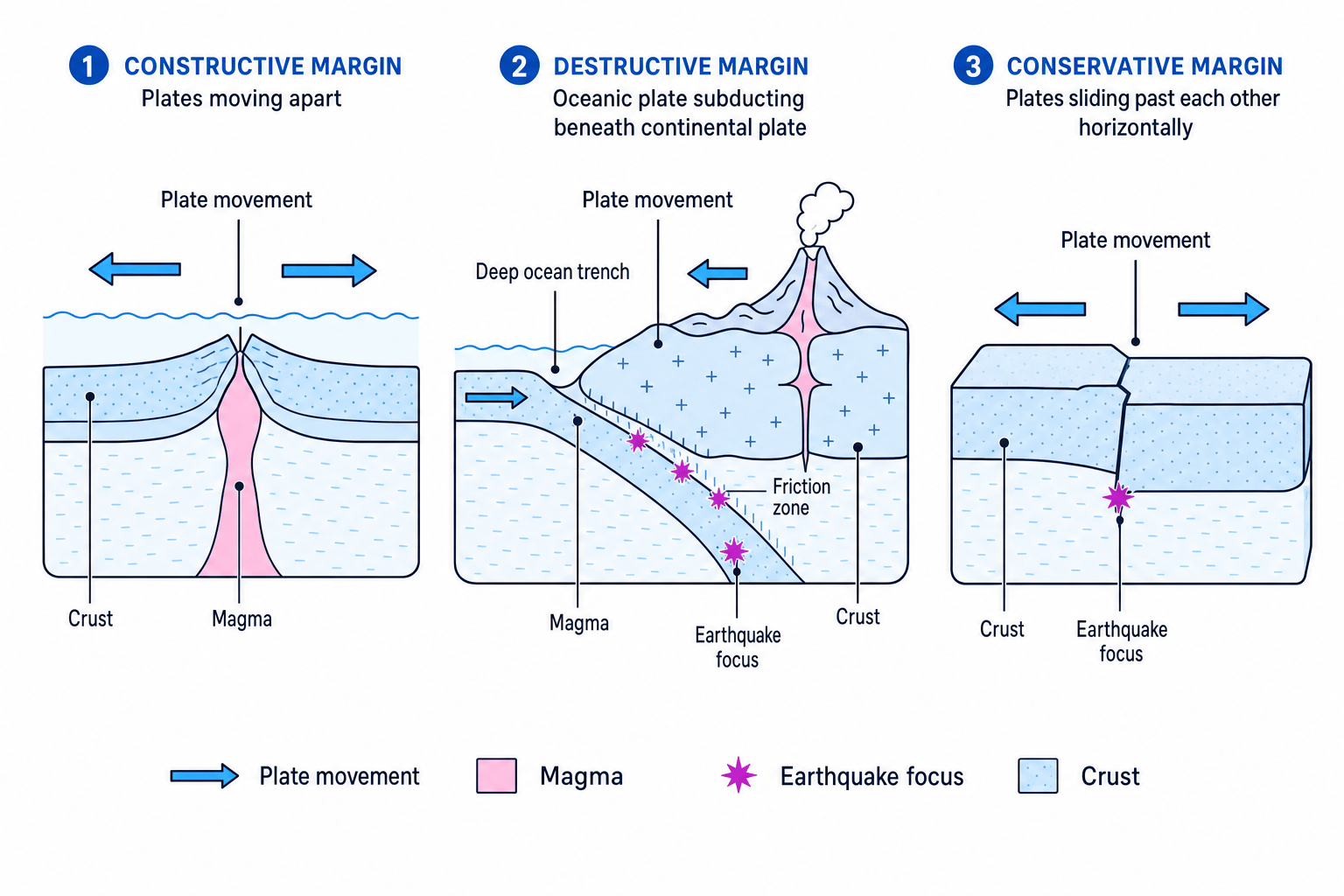
Constructive (divergent) margins
At a constructive margin, plates are moving away from each other.
- The Process: As the plates part, a gap is created. Magma rises from the mantle to fill this shield-like gap, cooling to form new oceanic crust.
- Hazards: The rising magma is runny (low viscosity), allowing gas to escape easily. This leads to gentle, non-explosive volcanic eruptions that form flat, wide shield volcanoes. The movement of plates also causes light, shallow-focus earthquakes.
Destructive (convergent) margins
At a destructive margin, plates are moving towards each other. What happens next depends on the crust types involved:
Oceanic meets Continental
- The Process: The denser oceanic plate is forced underneath the lighter continental plate into the mantle. This process is called subduction, and the zone where it happens is the subduction zone.
- Hazards: Deep oceanic trenches form where the plate bends. As the oceanic plate sinks, immense friction and pressure build up. When the plates suddenly slip, they release massive energy, causing violent, deep-focus earthquakes.
- Meanwhile, the subducting plate melts in the mantle. This magma is thick and silica-rich, trapping gas bubbles. It forces its way to the surface through cracks, resulting in highly explosive eruptions that build steep-sided composite volcanoes.
Continental meets Continental (Collision)
- The Process: When two continental plates collide, neither can subduct because they are both low-density.
- Hazards: Instead, the crust crumples upwards to form fold mountains (like the Himalayas). This causes severe, shallow earthquakes but no volcanoes, because there is no subduction to melt rock into magma.
Conservative (transform) margins
At a conservative margin, plates are sliding past each other—either in opposite directions or in the same direction but at different speeds.
- The Process: The plates do not slide smoothly. Their jagged edges catch on one another, locking the plates in place. Stress builds up over years or decades.
- Hazards: Eventually, the rock reaches its limit and breaks. The plates suddenly jerk forward, releasing vast shockwaves (seismic waves). This causes highly destructive, shallow-focus earthquakes. Because no crust is being created or destroyed, there is no magma, meaning there are no volcanoes at conservative margins.
Confusing plate margin hazards
Many students write that volcanoes occur at conservative margins. Remember: conservative margins do not have volcanoes because there is no gap for magma to rise through, and no subduction melting crust into magma.
4. Effects and responses: HICs vs LICs
When a tectonic event strikes, the immediate and long-term consequences depend heavily on how wealthy a country is.
Primary vs Secondary Effects
- Primary effects: Direct consequences of the physical event itself (e.g., buildings collapsing, ground shaking, people injured by falling debris, lava flows destroying crops).
- Secondary effects: Subsequent consequences triggered by the primary effects (e.g., fires from broken gas pipes, disease spreading due to dirty water, tsunamis, landslides blocking roads, economic decline).
Immediate vs Long-term Responses
- Immediate responses: Actions taken in the hours and days directly after the hazard to save lives and prevent further harm (e.g., search and rescue, evacuation, setting up emergency shelters, medical aid).
- Long-term responses: Actions taken in the months and years after the event to rebuild lives and make the area more resilient (e.g., rebuilding infrastructure, improving hazard-proof building laws, boosting the local economy).
Contrasting wealth: Named examples
To get top marks in your exam, you must compare a tectonic event in a High-Income Country (HIC) with one in a Low-Income Country (LIC) or Newly Emerging Economy (NEE).
Choose your case studies early
Your school will have taught you two specific tectonic case studies. Common pairings include:
- HIC: Chile earthquake (2010) or Tohoku, Japan earthquake (2011).
- LIC/NEE: Nepal earthquake (2015) or Haiti earthquake (2010). Ensure you learn the specific facts, figures, and dates for your chosen examples!
Here is how the impacts and responses typically contrast:
| Feature | High-Income Country (HIC) | Low-Income Country (LIC) |
|---|---|---|
| Primary Effects | Fewer deaths due to earthquake-proof building regulations. High economic cost due to expensive infrastructure being damaged. | High death toll as poorly constructed buildings collapse easily. Lower absolute economic cost, but highly significant to their economy. |
| Secondary Effects | Well-managed. Emergency services quickly isolate gas leaks and restore clean water to prevent disease. | Severe. Lack of clean water leads to outbreaks of water-borne cholera. Landslides can completely isolate remote villages for weeks. |
| Immediate Responses | Rapid, well-funded national response. Helicopters, search-and-rescue teams, and emergency shelters deployed immediately. | Heavily reliant on international aid. Search-and-rescue is slow due to a lack of heavy machinery and poor communication. |
| Long-term Responses | Swift rebuilding of infrastructure. The government provides grants to businesses, and lessons are learned to upgrade building codes. | Rebuilding takes years or even decades. The economy suffers long-term damage, and the country may fall deeper into international debt. |
Calculating relative economic impact
A common GCSE skill is comparing the relative economic damage of two disasters. Let's look at how we calculate economic damage as a percentage of a nation's wealth (Gross Domestic Product - GDP).
Suppose:
- HIC (Country A): Suffered 30billionindamagefromanearthquake.ItsannualGDPis30 billion in damage from an earthquake. Its annual GDP is 30billionindamagefromanearthquake.ItsannualGDPis1.5 trillion ($1,500 billion).
- LIC (Country B): Suffered 4billionindamage.ItsannualGDPis4 billion in damage. Its annual GDP is 4billionindamage.ItsannualGDPis20 billion.
Which country suffered the greater relative economic impact?
- Calculate Country A's relative damage: Use the percentage formula:
Substitute the values for Country A:
Percentage of GDP lost=(30 billion1500 billion)×100=0.02×100=2% \text{Percentage of GDP lost} = \left( \frac{30\text{ billion}}{1500\text{ billion}} \right) \times 100 = 0.02 \times 100 = 2\% Percentage of GDP lost=(1500 billion30 billion)×100=0.02×100=2%- Calculate Country B's relative damage: Substitute the values for Country B:
- Compare and conclude: Compare the two values (2%2\%2% vs 20%20\%20%). Even though Country A lost more money in absolute terms (30billionvs30 billion vs 30billionvs4 billion), the earthquake was vastly more devastating to Country B's national economy, stripping away 20%20\%20% of its annual wealth generation.
5. Why do people continue to live in hazard zones?
It might seem strange that millions of people live near active plate margins. However, there are several compelling reasons why people choose to, or have to, stay:
- Geothermal energy: Areas near active volcanoes (like Iceland) can harness cheap, renewable volcanic heat to generate electricity and warm homes.
- Fertile soils: Volcanic ash is rich in minerals. Once weathered, it creates incredibly fertile soils ideal for farming high-value crops (e.g., grapes on the slopes of Mount Etna, Italy).
- Tourism: Volcanoes are dramatic landscapes that attract millions of tourists every year, providing jobs in hotels, restaurants, and guiding (e.g., Mount Fuji, Japan).
- Mining: Volcanic areas often contain valuable mineral deposits, such as sulphur, gold, and copper.
- Poverty: Many people in LICs simply cannot afford to move away, or lack the options to find work and housing elsewhere.
- Effective management: In HICs, citizens feel safe because they trust their government's prediction systems and earthquake-resistant buildings.
6. Managing tectonic hazards
We cannot stop tectonic plates from moving, but we can drastically reduce the risk to human life through four key strategies: Monitoring, Prediction, Protection, and Planning.
                   ┌───────────────────────────────────┐
                   │     MANAGING TECTONIC HAZARDS     │
                   └─────────────────┬─────────────────┘
         ┌───────────────────┬───────┴───────┬───────────────────┐
         ▼                   ▼               ▼                   ▼
   [ MONITORING ]      [ PREDICTION ]  [ PROTECTION ]      [ PLANNING ]
Using technology to    Using patterns   Designing safe      Preparing the
 detect early signs    to estimate the   structures &      population with
   of tectonic activity.  time & place.    retrofitting.     drills & kits.
Monitoring
Using scientific equipment to detect physical changes in the Earth:
- Volcanoes: Scientists use tiltmeters to check if a volcano is swelling as magma rises, seismometers to record mini-earthquakes, and thermal sensors to measure rising ground temperatures. Gas kits measure rising levels of carbon dioxide and sulphur dioxide.
- Earthquakes: These are incredibly difficult to monitor, but scientists measure micro-tremors and look for unusual radon gas releases.
Prediction
- Volcanoes: Thanks to close monitoring, volcanic eruptions can often be predicted with high accuracy, giving authorities time to evacuate nearby populations.
- Earthquakes: Currently, it is impossible to predict the exact time and location of an earthquake. Scientists can only identify zones of high risk using historical patterns and tectonic movement rates.
Protection
- Volcanoes: Earth walls and explosives have occasionally been used to divert lava flows away from buildings, though this has limited success.
- Earthquakes: This is the most effective strategy. HICs design buildings with:
- Shock absorbers (base isolators) in the foundations to absorb seismic waves.
- Rolling weights (tuned mass dampers) on roofs to counteract swaying.
- Reinforced concrete and steel frames that flex rather than collapse.
- Automatic shutters on windows to prevent shattering glass.
Planning
Educating the public so they know what to do when a disaster strikes:
- Drills: Holding regular practices (such as Japan’s annual Disaster Prevention Day on September 1st) so school children and workers know to "Drop, Cover, and Hold on".
- Evacuation routes: Clearly signposting safe zones and evacuation paths, especially in coastal areas at risk of a tsunami.
- Emergency kits: Encouraging households to keep "go-bags" stocked with fresh water, tinned food, a wind-up radio, and a first-aid kit.
In the exam
- Command words matter: If a question asks you to "Compare" or "Contrast" the effects or responses of your two case studies, do not write two separate essays. Use comparative language like "In contrast to Nepal, where most buildings collapsed due to lack of regulation, Chile suffered less structural damage because..."
- Be specific with numbers: Don't just say "lots of people died." Give a precise figure from your case studies (e.g., "In the 2015 Nepal earthquake, over 8,800 people died, whereas in Chile's 2010 earthquake, only 500 lost their lives").
- Structure long answers logically: For 6-mark or 9-mark questions, use a clear structure. Dedicate one paragraph to physical processes/primary effects and another to human factors/responses. Always conclude by directly addressing the question's prompt (e.g., evaluating which factor is most important).
Check yourself
- Can you explain the difference between a constructive and a destructive plate margin, including the direction of plate movement at each?
- Why do conservative margins experience severe earthquakes but absolutely no volcanic eruptions?
- What is the difference between an immediate response and a long-term response? Give two examples of each.
- How do monitoring and prediction differ when managing a volcano compared to managing an earthquake?
