Natural hazards
What you'll learn
- What a natural hazard is, and how it is different from a natural event.
- The main types of natural hazard you need to recognise for GCSE Geography.
- Why hazard risk is higher in some places than others.
- How factors like poverty, urbanisation, farming and climate change can increase risk.
The big idea: nature is not always a hazard
A natural process only becomes a serious problem for people when it threatens lives, homes, jobs, services or infrastructure.
For example, an earthquake in an empty desert may be a natural event, but it is not a major hazard for people. The same size earthquake under a crowded city could be disastrous.
Natural hazard
A natural hazard is a natural event or process that threatens people and has the potential to cause death, injury, damage to property, economic disruption or environmental damage.
A natural hazard has two key parts:
- It is caused by natural processes, such as plate movement, weather systems or disease spread.
- It creates a threat to people, property or the environment.
Hazards need people
A natural event becomes a natural hazard when people, buildings, farmland, transport links or services could be affected by it.
Natural event, hazard and disaster
These three terms are linked, but they do not mean exactly the same thing.
Natural event
A natural event is something that happens due to natural processes, such as a volcanic eruption, storm or flood. It may or may not affect people.
Natural disaster
A natural disaster happens when a natural hazard causes serious damage, such as many deaths, major economic losses, homelessness or disruption to essential services.
So the chain often looks like this:
natural process → natural event → natural hazard → natural disaster
But it only becomes a disaster if the impacts are severe enough.
Deciding whether an event is a natural hazard
A magnitude 7 earthquake occurs beneath an uninhabited area of ocean. No tsunami forms, and no people or property are affected. Is it a natural hazard?
- Check whether the event is natural: an earthquake is caused by natural tectonic processes, so it is a natural event.
- Check whether people or property are threatened: no people, buildings or infrastructure are affected, and no tsunami forms.
- Apply the definition: because there is no threat to people or property, this is best described as a natural event, not a significant natural hazard.
Types of natural hazard
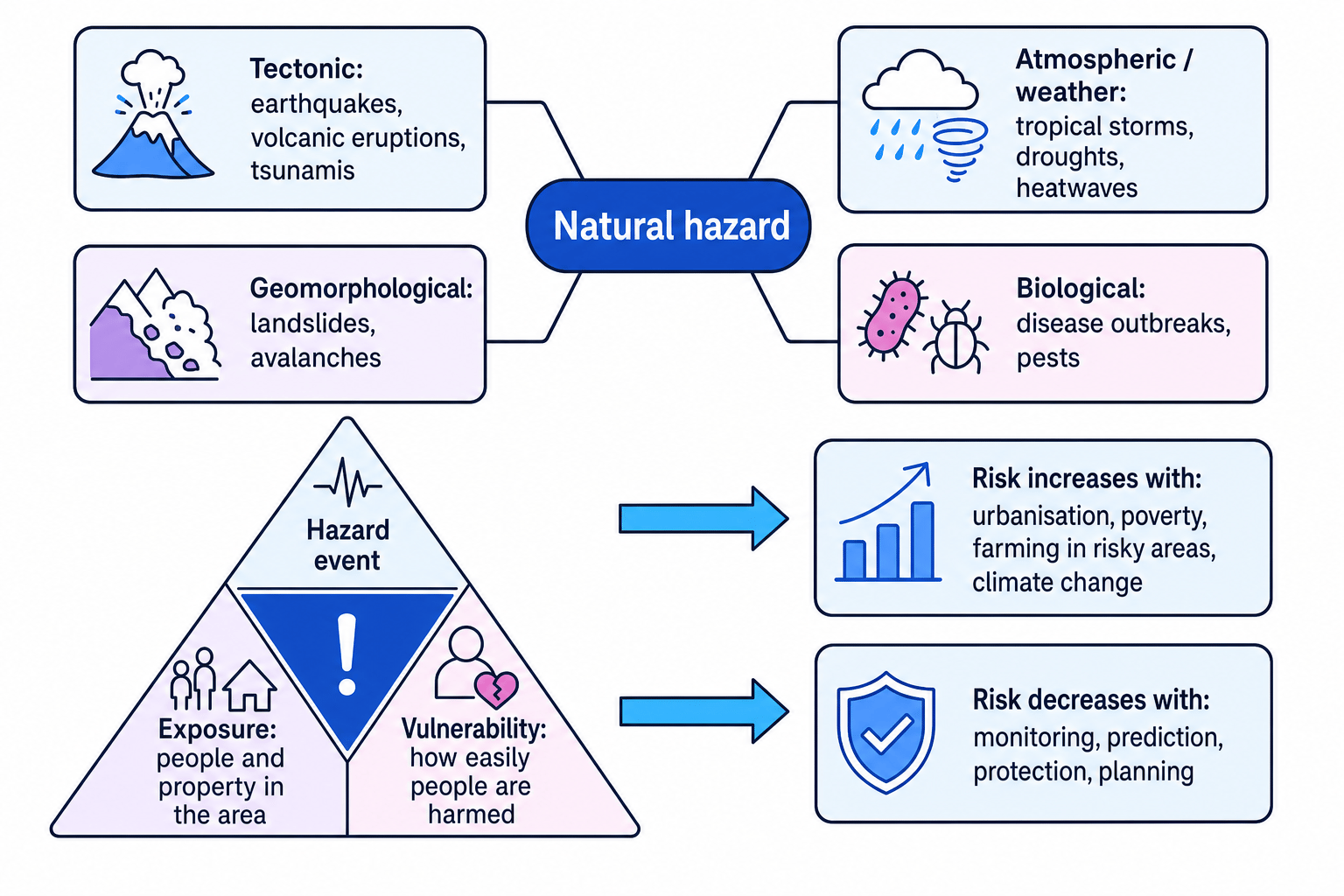
Natural hazards can be grouped into categories. Grouping them helps you compare causes, impacts and responses.
Tectonic hazards
Tectonic hazard
A tectonic hazard is caused by movement of the Earth’s plates or activity within the Earth’s crust.
Common tectonic hazards include:
- Earthquakes — sudden shaking of the ground caused by movement along faults.
- Volcanic eruptions — lava, ash and gases are released from a volcano.
- Tsunamis — large sea waves, often triggered by underwater earthquakes or volcanic activity.
You will study tectonic hazards in more detail later, including how plate margins influence earthquakes and volcanoes.
Atmospheric or weather hazards
Atmospheric hazard
An atmospheric hazard is caused by processes in the atmosphere, such as air pressure, wind, rainfall and temperature.
Examples include:
- Tropical storms, such as hurricanes, cyclones and typhoons.
- Droughts, when rainfall is much lower than usual for a long period.
- Heatwaves, when temperatures remain unusually high.
- Extreme rainfall, which can lead to flooding.
In the AQA Natural hazards topic, you will later look closely at tropical storms and extreme weather in the UK.
Geomorphological hazards
Geomorphological hazard
A geomorphological hazard is linked to the movement or shape of landforms on the Earth’s surface.
Examples include:
- Landslides, where rock, soil or mud moves downslope.
- Avalanches, where snow and ice move rapidly downhill.
These hazards are often triggered by other events, such as heavy rainfall, earthquakes or rapid snowmelt.
Biological hazards
Biological hazard
A biological hazard is caused by living organisms or the spread of disease.
Examples include:
- Disease outbreaks.
- Pest infestations that damage crops.
- Waterborne diseases after flooding.
Biological hazards are not the main focus of this AQA section, but they are useful to recognise as part of the wider hazards picture.
Mixing up hazard type and hazard cause
Do not just say “it is dangerous” when classifying a hazard. Classify it by its main natural process: plate movement is tectonic, weather and climate processes are atmospheric, slope movement is often geomorphological, and disease spread is biological.
Classifying natural hazards
A village is affected by heavy rain, which saturates a steep hillside. The slope collapses and mud flows through several homes. What type of hazard is this?
- Identify the damaging event: the direct damage is caused by mud and soil moving downslope.
- Link the event to a natural process: downslope movement of material is connected to landforms and slope processes.
- Classify the hazard: this is mainly a geomorphological hazard, although heavy rainfall acted as a trigger.
Hazard risk: why some places are more at risk
Hazard risk
Hazard risk is the chance that people or places will be harmed by a natural hazard.
Risk is not only about the size of the event. A powerful earthquake in a well-prepared country may cause fewer deaths than a smaller earthquake in a poorer, crowded area.
A simple way to think about hazard risk is:
hazard risk≈hazard event+exposure+vulnerability\text{hazard risk} \approx \text{hazard event} + \text{exposure} + \text{vulnerability}hazard risk≈hazard event+exposure+vulnerabilityThis is not a formula you need to calculate with exact numbers. It is a thinking tool.
Exposure
Exposure
Exposure means the number of people, buildings, services and economic activities located in an area where a hazard may occur.
A coastal city exposed to tropical storms has more at risk than an empty coastline, because there are more people, homes, roads, hospitals and businesses that could be damaged.
Vulnerability
Vulnerability
Vulnerability means how easily people, buildings and services can be harmed by a hazard.
Vulnerability is affected by things like:
- Building quality.
- Access to healthcare.
- Education and warning systems.
- Income and savings.
- Government planning.
- Emergency services.
Japan and Haiti have both experienced severe earthquakes, but Japan generally has stricter building regulations, better monitoring and more emergency planning. This usually reduces vulnerability, although very large events can still cause serious damage.
Capacity to cope
Capacity to cope
Capacity to cope means the ability of people, communities and governments to prepare for, respond to and recover from a hazard.
Places with strong transport networks, emergency services, warning systems and funding usually recover more quickly.
Risk is uneven
Hazard risk is highest where dangerous natural events overlap with high exposure and high vulnerability.
Comparing hazard risk in two places
Two areas are near an active plate margin. Area A is a wealthy city with earthquake-resistant buildings and emergency drills. Area B is a rapidly growing city with informal housing on steep slopes. Which has the higher hazard risk?
- Compare the hazard event: both areas are near an active plate margin, so both may experience earthquakes.
- Compare exposure: both are cities, so many people and buildings may be exposed.
- Compare vulnerability: Area B has informal housing and steep slopes, so buildings may collapse more easily and landslides may occur.
- Make a judgement: Area B has the higher hazard risk because its vulnerability is greater, even if the tectonic threat is similar.
Factors affecting hazard risk
The AQA specification highlights several important factors that can increase hazard risk: urbanisation, poverty, farming and climate change.
Urbanisation
Urbanisation
Urbanisation is the increase in the proportion of people living in towns and cities.
Urbanisation can increase hazard risk because more people and property become concentrated in one place. This increases exposure.
In rapidly growing cities, some people may live in unsafe locations, such as:
- Steep slopes at risk of landslides.
- Floodplains near rivers.
- Low-lying coastal areas.
- Informal settlements with weaker buildings.
For example, many large cities are located on coasts because of trade, jobs and transport links. This can increase exposure to storm surges, sea-level rise and tropical storms.
Use the word exposure
When explaining urbanisation, try to include the word exposure. More people and buildings in a hazard-prone area means more things can be harmed.
Poverty
Poverty
Poverty means lacking enough income, resources or services to meet basic needs such as safe housing, food, clean water, healthcare and education.
Poverty often increases vulnerability. People with fewer resources may be more likely to live in weaker buildings or unsafe locations because safer land is too expensive.
Poverty can also reduce preparation and recovery. For example:
- Homes may not be built to withstand earthquakes or storms.
- People may not have insurance or savings.
- Emergency services may be limited.
- Healthcare may be harder to access.
- Rebuilding may take much longer.
This is why low-income countries often suffer higher death rates from hazards, even when the hazard event itself is not the most powerful.
Assuming poorer countries always have more hazards
Poorer countries do not necessarily have more natural events. The key point is that poverty often increases vulnerability, so the impacts may be worse.
Farming
Farming can affect hazard risk in two main ways.
First, people may farm in risky places because the land is fertile. Volcanic areas, for example, often have fertile soils, so people may choose to live and farm near volcanoes despite the eruption risk.
Second, some farming practices can increase risk. Removing trees for farmland can reduce interception and root binding, making slopes less stable and increasing the chance of landslides or flooding.
Interception
Interception is when vegetation catches rainfall before it reaches the ground.
Root binding
Root binding is when plant roots help hold soil together, making slopes more stable.
For example, deforestation on steep slopes can increase runoff after heavy rainfall. More runoff can raise flood risk downstream and increase the chance of mudflows.
Climate change
Climate change
Climate change is a long-term change in average weather conditions, including temperature, rainfall patterns and the frequency of some extreme weather events.
Climate change can increase hazard risk by changing the frequency or intensity of some weather-related hazards.
It may increase risks linked to:
- Heatwaves, as average temperatures rise.
- Drought, where rainfall becomes less reliable.
- Flooding, where rainfall becomes more intense in some regions.
- Tropical storms, because warmer oceans can provide more energy, although exact patterns vary by region.
- Coastal flooding, because sea-level rise makes storm surges more damaging.
Climate change does not cause every hazard
Be careful: climate change does not cause tectonic hazards such as earthquakes and volcanic eruptions. It mainly affects weather, climate and coastal hazards.
Explaining why hazard risk has increased
A coastal city has grown from 1 million to 4 million people in recent decades. Many new homes are built on low-lying land. Sea level is also rising. Explain why hazard risk has increased.
- Identify the change in exposure: the population has increased, so more people, homes and services are located in the hazard-prone area.
- Identify the change in vulnerability: low-lying land is more easily affected by coastal flooding and storm surges.
- Link to climate change: sea-level rise means floodwater can reach further inland and cause more damage.
- Combine the factors: risk has increased because urbanisation, vulnerable land use and climate change now overlap in the same place.
How to write strong hazard explanations
In GCSE Geography, strong answers usually link cause → effect → impact.
A basic answer might say:
“Poverty increases hazard risk because people have weak houses.”
A stronger answer says:
“Poverty increases vulnerability because people may be unable to afford earthquake-resistant housing. This means buildings are more likely to collapse during an earthquake, increasing deaths, injuries and homelessness.”
Notice how the stronger answer uses a key term and explains the chain of reasoning.
Use a three-link chain
For hazard risk questions, try: factor → vulnerability or exposure → impact. For example: “Urbanisation increases exposure because more people live on floodplains, so a flood could affect more homes and services.”
Mini summary
Natural hazards are not just about powerful natural events. Risk depends on where people live, how prepared they are, and how vulnerable their homes and services are.
The most important points are:
- A natural hazard threatens people or property.
- Hazards can be tectonic, atmospheric, geomorphological or biological.
- Risk is affected by exposure, vulnerability and capacity to cope.
- Urbanisation, poverty, farming and climate change can all increase hazard risk.
- Human choices can make natural hazards more or less dangerous.
In the exam
- Define key terms precisely: a natural hazard must threaten people, property or the environment.
- When explaining risk, use the language of exposure, vulnerability and capacity to cope.
- Develop your points with clear chains: factor → why it changes risk → likely impact on people or property.
Check yourself
- What is the difference between a natural event and a natural hazard?
- Why might two places experience similar earthquakes but have very different impacts?
- How can urbanisation and poverty increase hazard risk in different ways?