

What you'll learn
- How we know Earth’s climate has changed from the Quaternary period to today.
- The natural and human causes of climate change.
- The main effects of climate change on people and the environment.
- How climate change can be managed through mitigation and adaptation.
1. Start point: weather, climate and climate change
Weather means the day-to-day conditions of the atmosphere, such as temperature, rainfall, wind and cloud cover.
Climate means the average weather conditions of a place over a long period, usually around 30 years.
Climate change
Climate change is a long-term shift in average climate conditions, such as temperature, rainfall patterns and the frequency of extreme weather events.
A single hot day is not climate change. A long-term trend, such as average global temperatures rising over many decades, is climate change.
Weather is not the same as climate
A cold winter or a rainy week does not disprove climate change. You need to look at long-term patterns, usually over decades or longer.
2. Evidence for climate change
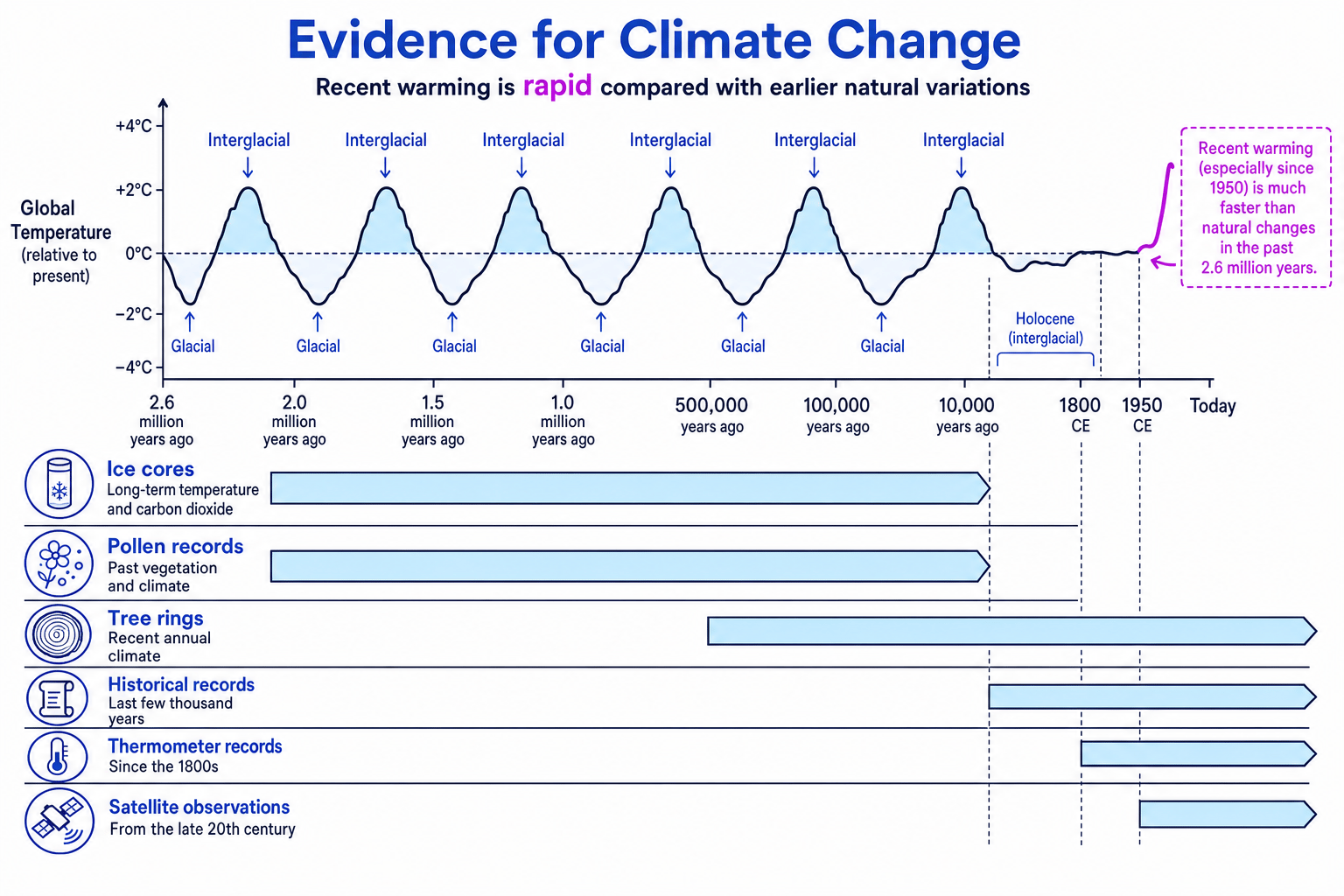
The Quaternary period is the most recent geological period. It began about 2.6 million years ago and continues today.
During the Quaternary, Earth’s climate has moved between colder glacial periods, when ice sheets expanded, and warmer interglacial periods, when ice sheets retreated. We are currently in an interglacial period called the Holocene, which began about 11,700 years ago.
Much evidence for older climate comes from proxy evidence. A proxy is an indirect clue used to work out past conditions, such as ice cores or tree rings.
The timeline below shows how different types of evidence help geographers understand climate change across different timescales.
Key evidence
- Ice cores: cylinders of ice drilled from ice sheets. Trapped air bubbles show past carbon dioxide levels, and the ice chemistry gives clues about past temperature.
- Pollen records: pollen preserved in lake sediments shows what plants grew in the past, which suggests what the climate was like.
- Tree rings: wider rings usually show warmer or wetter growing seasons; narrower rings suggest colder or drier years.
- Historical records: written accounts, harvest dates and paintings can give clues about past climate.
- Thermometer records: direct temperature measurements, especially since the 1800s.
- Satellite observations: modern measurements of temperature, sea ice, glaciers and sea level from space.
The big pattern
Climate has changed naturally many times, but recent warming since industrialisation has been unusually rapid and closely linked to human greenhouse gas emissions.
3. Natural causes of climate change
Natural factors can change Earth’s climate without human involvement.
Orbital changes
Orbital changes are slow changes in Earth’s movement around the Sun. These include changes in:
- the shape of Earth’s orbit;
- the tilt of Earth’s axis;
- the wobble of Earth’s axis.
These changes affect how much solar energy reaches different parts of Earth. Over thousands of years, they help explain glacial and interglacial cycles.
Volcanic activity
Large volcanic eruptions can blast ash and sulfur dioxide high into the atmosphere. These particles reflect some sunlight back into space, which can cause short-term global cooling.
Volcanoes also release carbon dioxide, but modern human emissions are much larger and better explain recent warming.
Solar output
Solar output means the amount of energy released by the Sun. If solar output increases, Earth can warm slightly; if it decreases, Earth can cool slightly. However, recent global warming cannot be explained by solar changes alone.
4. Human causes of climate change
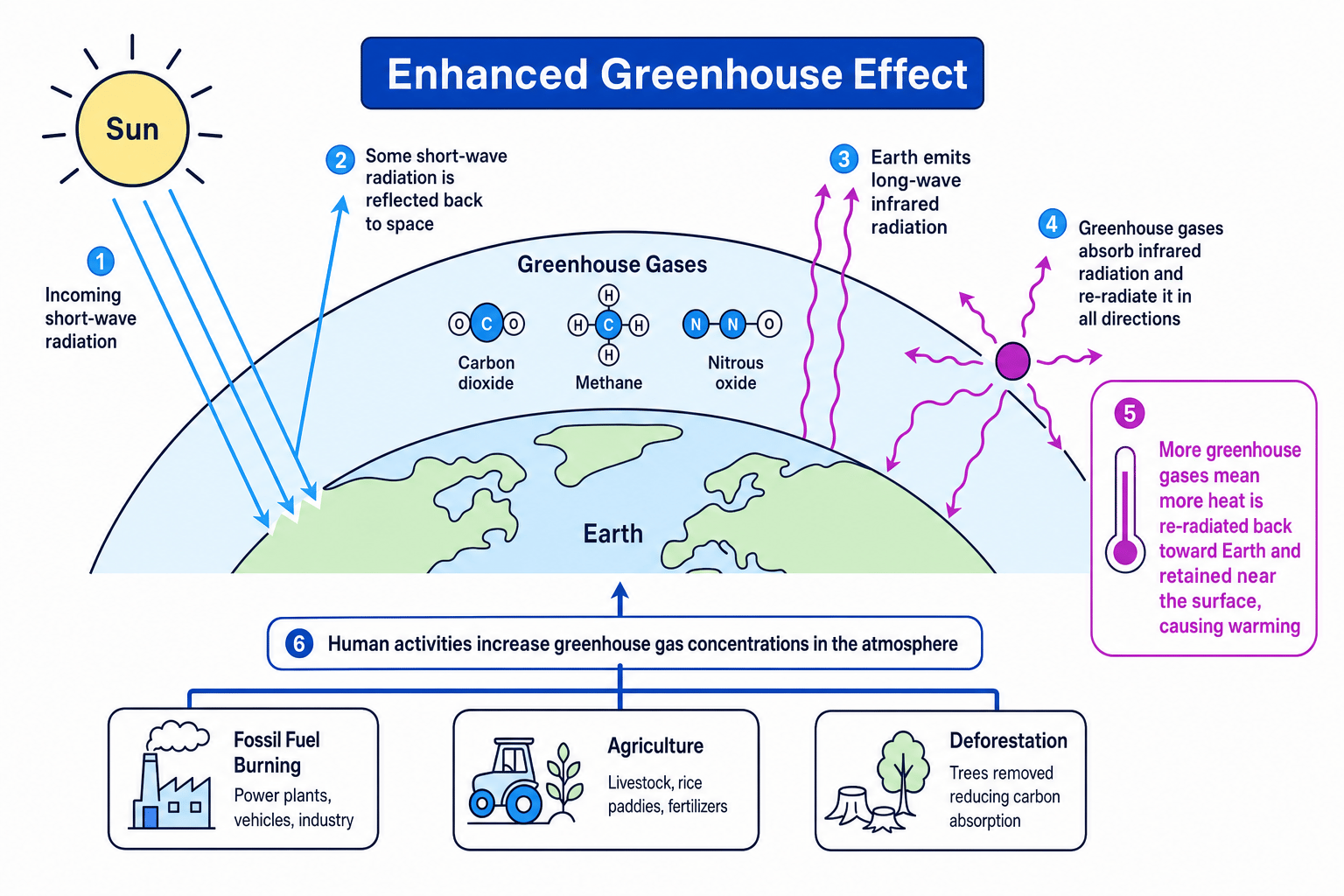
The main human cause is the enhanced greenhouse effect.
Greenhouse gases
Greenhouse gases are gases in the atmosphere, such as carbon dioxide, methane and nitrous oxide, that trap some heat and keep Earth warm.
The natural greenhouse effect is essential for life. Without it, Earth would be much colder. The problem is that humans have increased greenhouse gas concentrations, trapping extra heat.
Fossil fuels
Fossil fuels are coal, oil and natural gas. Burning them for electricity, transport and industry releases carbon dioxide.
Agriculture
Agriculture means farming. Cattle and rice paddies release methane. Fertilisers can release nitrous oxide. Both are powerful greenhouse gases.
Deforestation
Deforestation means cutting down or clearing forests. Trees remove carbon dioxide from the atmosphere through photosynthesis, the process plants use to make food. When trees are burned or decay, stored carbon is released back into the atmosphere.
Calculating percentage increase in carbon dioxide
- Use approximate values: pre-industrial carbon dioxide was about 280 parts per million, while recent values are about 420 parts per million. Exact figures vary slightly depending on the year and dataset.
- Find the increase: 420 - 280 = 140 parts per million.
- Divide the increase by the original value and multiply by 100: 140280×100=50%\frac{140}{280} \times 100 = 50\%280140×100=50%.
- Interpret the result: atmospheric carbon dioxide is about 50% higher than the pre-industrial level, strengthening the enhanced greenhouse effect.
5. Effects of climate change
Climate change affects both people and the environment. The impacts are uneven: some places are more exposed, and poorer communities often have less money to adapt.
Effects on people
Rising temperatures can increase heatwaves, which can cause illness and death, especially among elderly people and outdoor workers.
Changing rainfall patterns can increase drought in some regions and flooding in others. This affects water supply, crop yields and food prices.
Rising sea levels threaten low-lying coastal areas such as Bangladesh, the Maldives and parts of eastern England. Impacts include coastal flooding, erosion and saltwater entering farmland or drinking water supplies.
Climate change can also increase economic costs by damaging homes, roads, railways and power supplies. In some places, people may be forced to migrate.
Effects on the environment
Melting glaciers and ice sheets add water to the oceans, raising sea level. Melting sea ice also reduces albedo, which means reflectivity. Dark ocean water absorbs more heat than bright ice, causing further warming.
Habitats may shift towards the poles or to higher altitudes. Species that cannot move or adapt quickly may decline.
Warmer oceans can cause coral bleaching, where corals lose the algae they depend on. The Great Barrier Reef in Australia is a well-known example.
Build impact chains
For longer answers, link cause to effect: higher temperature → more evaporation → drought risk → lower crop yields → food insecurity.
6. Managing climate change
Managing climate change involves two linked approaches: mitigation and adaptation.
Mitigation and adaptation
Mitigation means reducing the causes of climate change. Adaptation means responding to the effects of climate change to reduce risk.
Mitigation: reducing the causes
Alternative energy production means using lower-carbon energy sources instead of fossil fuels. Examples include wind, solar, tidal, hydroelectric power, geothermal energy and nuclear power. These reduce carbon dioxide emissions, although cost, reliability and suitable locations can be challenges.
Carbon capture means capturing carbon dioxide from power stations or industry and storing it underground, often in old oil and gas fields. This can reduce emissions, but it is expensive and does not remove the need to cut fossil fuel use.
Planting trees through afforestation or reforestation increases carbon storage. Trees absorb carbon dioxide as they grow. However, forests take time to mature and must be protected from fire, disease and future clearance.
International agreements are deals between countries to reduce emissions. The Paris Agreement, signed in 2015, aims to limit global warming to well below 2°C and pursue efforts to limit it to 1.5°C. Its success depends on countries setting and meeting strong national targets.
Adaptation: responding to the changes
Changing agricultural systems can help farmers cope. This might include drought-resistant crops, different planting dates, improved irrigation, shade for livestock or switching to crops better suited to warmer conditions.
Managing water supply includes building reservoirs, reducing leaks, recycling water, rainwater harvesting, water transfer schemes and desalination in some coastal areas.
Reducing risk from rising sea levels can involve sea walls, flood barriers, raised buildings, early warning systems, coastal zoning and managed retreat. The Thames Barrier in London is an example of a flood defence designed to reduce tidal flood risk.
Classifying management strategies
- Decide whether the strategy tackles the cause of climate change or the impact of climate change.
- Offshore wind farms reduce fossil fuel use, so they are mitigation.
- Sea walls protect people from coastal flooding, so they are adaptation.
- Drought-resistant crops help farmers cope with drier conditions, so they are adaptation.
- Planting trees removes carbon dioxide from the atmosphere, so it is mitigation.
Mixing up mitigation and adaptation
If it cuts greenhouse gas emissions or increases carbon storage, it is mitigation. If it helps people live with the impacts, it is adaptation.
Both approaches are needed
Mitigation reduces future warming, but adaptation is still needed because some climate change is already happening and will continue for decades.
In the exam
- Use precise cause-and-effect links, such as “burning fossil fuels releases carbon dioxide, which strengthens the enhanced greenhouse effect”.
- Separate natural causes, human causes, effects, mitigation and adaptation clearly in your answer.
- Add named places where useful, such as Bangladesh for sea-level risk, the Great Barrier Reef for coral bleaching, or the Paris Agreement for international action.
Check yourself
- What evidence shows climate has changed since the start of the Quaternary period?
- How do fossil fuels, agriculture and deforestation increase greenhouse gas concentrations?
- What is the difference between mitigation and adaptation?
