What you'll learn
- Where polar and tundra environments are found, and what makes them distinctive.
- How climate, permafrost, soils, plants, animals and people are linked.
- How plants and animals survive harsh physical conditions.
- Why cold environments offer development opportunities but also need careful protection.
Cold environments in the Living World
In AQA GCSE Geography, cold environments are one optional Living World route. Your class studies ecosystems and tropical rainforests, then either hot deserts or cold environments. If your teacher has chosen cold environments, you need a named case study of one cold environment.
Cold environment
A cold environment is a large-scale ecosystem where low temperatures strongly limit plant growth, animal life, soil development and human activity. GCSE cold environments mainly include polar and tundra areas.
An ecosystem is a community of living things, such as plants and animals, interacting with the non-living environment, such as climate, soils and water. A biome is a very large ecosystem found at a global scale.
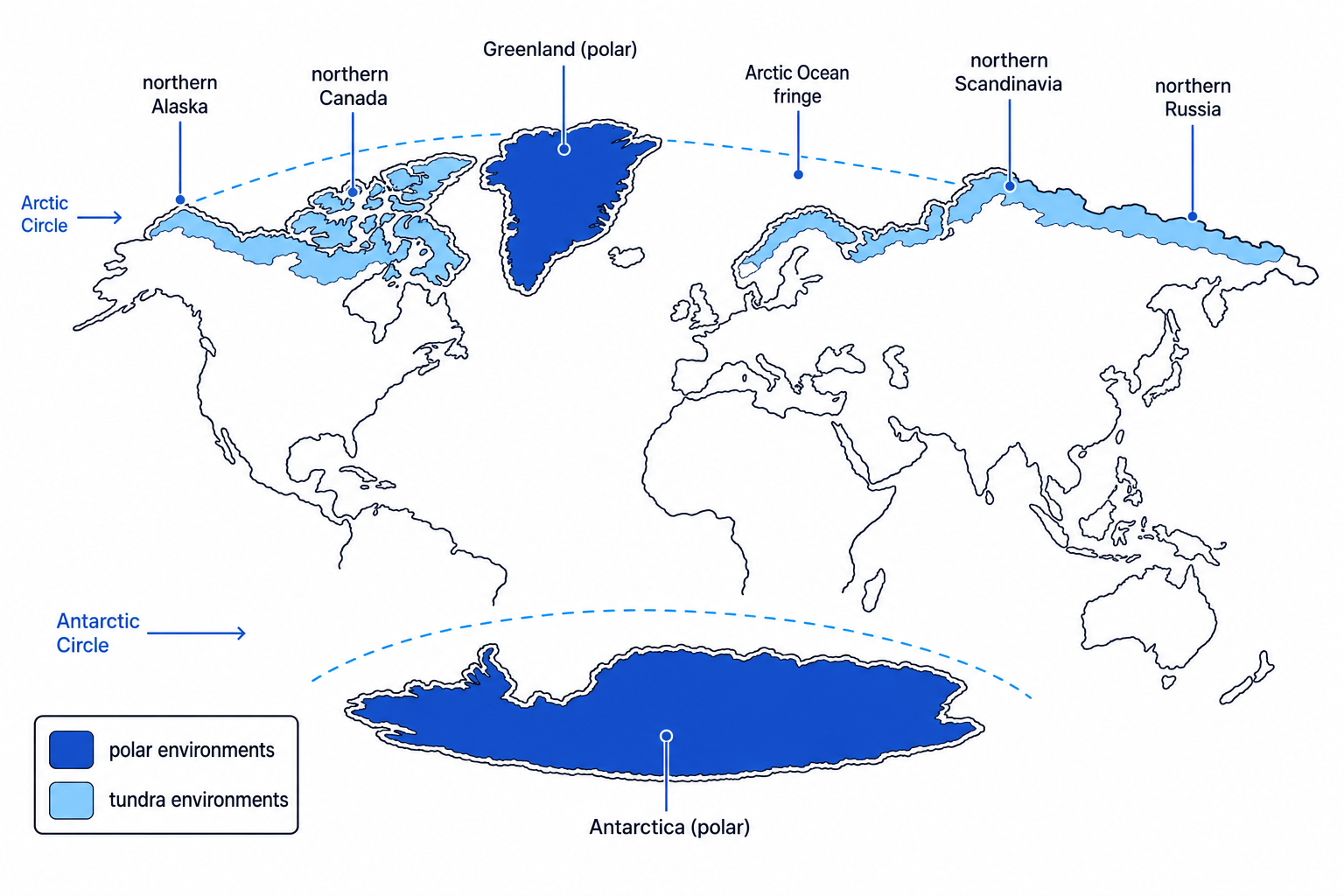
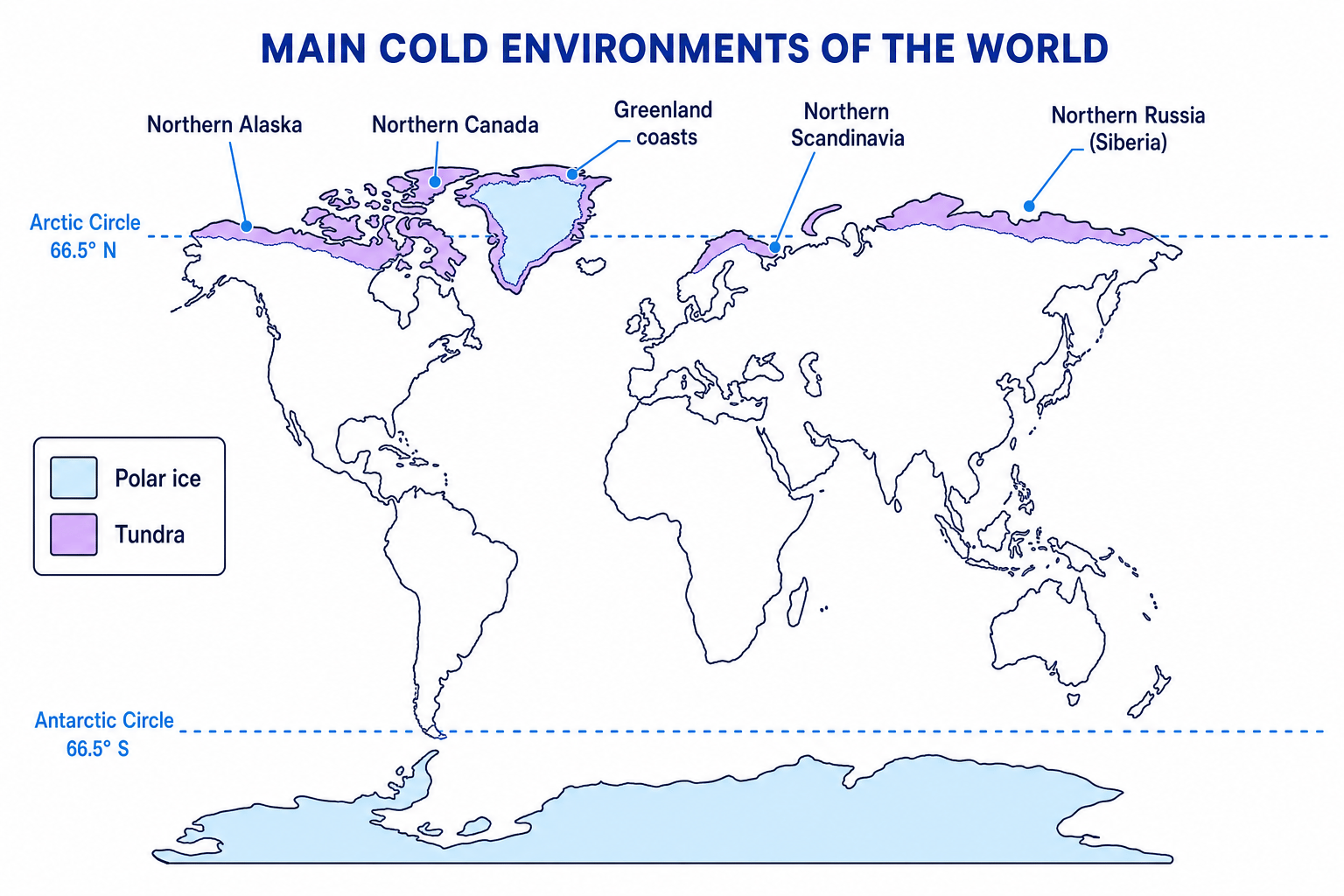
Cold environments are mostly found at high latitudes near the North and South Poles. Tundra is mainly around the Arctic, while Antarctica and much of Greenland are polar ice environments.
Polar and tundra: the two main types
Polar environments
Polar environments are the coldest. They are found in Antarctica, Greenland and parts of the Arctic. Temperatures are below freezing for most or all of the year, precipitation is low and mostly falls as snow. Much of the ground is covered by ice sheets or sea ice, so there is very little plant life.
Tundra environments
Tundra is a cold, treeless environment found mainly around the Arctic Circle, including northern Alaska, northern Canada and northern Russia. Tundra has a short summer when the surface layer of ground thaws, allowing low-growing plants to grow.
Permafrost and active layer
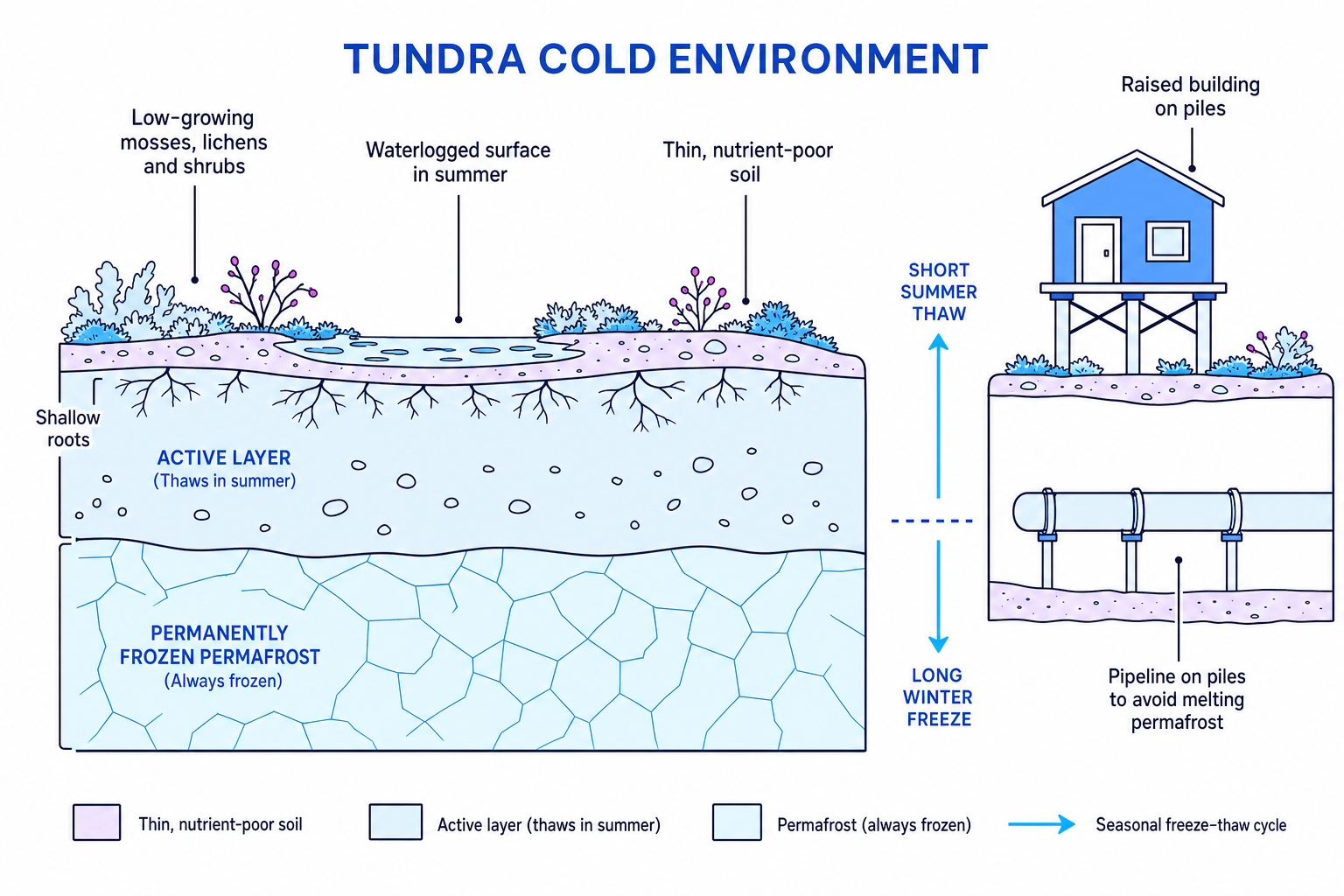
Permafrost is ground that has remained frozen for at least two years. The active layer is the surface layer above the permafrost that thaws in summer and freezes again in winter.
The active layer is important because it controls drainage, plant roots, building foundations and transport routes.
Classifying a cold environment from climate data
A place has a coldest monthly average of -24°C, a warmest monthly average of 6°C, and annual precipitation of about 250 mm.
- Compare the warmest month with the tundra threshold: tundra has a short summer above 0°C but usually below about 10°C, so 6°C suggests tundra rather than a warm forest biome.
- Check the winter severity: -24°C shows a long, very cold winter, which supports a cold-environment classification.
- Use precipitation as supporting evidence: 250 mm a year is low, so the place is likely to have slow plant growth and limited soil development.
- Conclude that this is most likely tundra, because there is a brief thaw season but conditions are still too cold for trees.
Physical characteristics of cold environments
Cold environments share several physical features:
- Very low temperatures for much of the year.
- Short growing season, often only a few weeks or months.
- Low precipitation, because cold air holds little moisture.
- Strong winds, especially in open polar and tundra landscapes.
- Thin, nutrient-poor soils, because decomposition is slow.
- Limited vegetation, especially where permafrost or ice prevents deep roots.
- Fragile surfaces, where tracks, pipelines or buildings can damage vegetation and soils for decades.
Cold limits everything
The main control in cold environments is temperature. It limits soil formation, plant growth, animal numbers, transport, construction and economic development.
Interdependence in cold environments
Interdependence means that parts of an ecosystem rely on each other. In cold environments, climate, permafrost, soils, plants, animals and people are tightly connected.
Cold temperatures create permafrost. Permafrost prevents water draining downwards, so the surface can become waterlogged in summer. Waterlogged, cold soils slow decomposition, so nutrients are released very slowly. This limits plant growth to mosses, lichens, grasses and small shrubs. Fewer plants mean fewer herbivores, which then limits predators.
People are also part of this system. Indigenous communities, such as Inuit groups in Arctic Canada and Alaska, have traditionally depended on fishing, hunting, reindeer or caribou herding, and seasonal movement. Modern development can disturb these links by changing migration routes, damaging vegetation or polluting water.
Tracing the knock-on effects of permafrost thaw
If a road warms the ground beneath it, the impacts can spread through the ecosystem.
- Heat from the road can thaw the active layer more deeply, weakening the frozen ground that previously supported the surface.
- The surface may subside, creating uneven ground and poor drainage, so pools of water form.
- Waterlogged soil can damage tundra vegetation because roots are shallow and oxygen is limited.
- If vegetation is lost, the soil is more exposed to erosion and habitats for insects, birds and grazing animals are reduced.
- The human impact also increases, because the road may need more repairs, bringing more vehicles and disturbance.
Seeing cold environments as empty
Cold environments may look bare, but they are not “empty” or “useless”. They contain specialised species, store carbon, support Indigenous cultures and help regulate the global climate.
Plant adaptations
An adaptation is a feature or behaviour that helps an organism survive in its environment.
Plants in tundra environments must cope with cold, wind, shallow soils and a short growing season. Common adaptations include:
- Low growth close to the ground, reducing exposure to wind.
- Shallow roots, because roots cannot grow deeply into permafrost.
- Small leaves, which reduce water loss and frost damage.
- Dark-coloured leaves or stems, helping absorb more heat.
- Rapid flowering, so plants reproduce during the short summer.
- Growing in clumps or cushions, which traps warmth and protects against wind.
Examples include mosses, lichens, sedges, cotton grass and dwarf willow.
Animal adaptations
Animals also need adaptations to survive cold, seasonal food shortages and snow or ice.
Common animal adaptations include:
- Thick fur or feathers for insulation.
- Fat layers to reduce heat loss and store energy.
- Small ears and tails, reducing surface area and heat loss.
- White winter camouflage, helping animals avoid predators or hunt prey.
- Migration, where animals move seasonally to find food.
- Hibernation, where some animals reduce activity during the coldest months.
Examples include polar bears, Arctic foxes, musk oxen, caribou, snowy owls and seals.
Link adaptation to condition
In longer answers, do not just name an adaptation. Link it to the physical challenge: “shallow roots help tundra plants survive because permafrost prevents deep root growth.”
Biodiversity issues
Biodiversity means the variety of living things in an area, including plants, animals and microorganisms.
Cold environments usually have low biodiversity compared with tropical rainforests because conditions are harsh and the growing season is short. However, the species that do live there are highly specialised. This makes the ecosystem fragile: if one species declines, there may be few alternatives in the food web.
Key biodiversity issues include:
- Simple food webs, so changes to one species can affect many others.
- Slow recovery, because plants grow slowly and decomposition is limited.
- Climate change, which can thaw permafrost, reduce sea ice and shift habitats northwards.
- Development pressure, including mining, oil extraction, roads and tourism.
- Pollution, which breaks down slowly in cold conditions.
Low biodiversity does not mean low value
Cold environments often have fewer species than warmer biomes, but those species are specially adapted and can be highly vulnerable to disturbance.
Case study: Alaska, USA
For the exam, you need one cold environment case study. A common choice is Alaska, a US state in the Arctic and sub-Arctic. Exact figures vary by source, but Alaska is very large, sparsely populated and contains tundra, mountains, forests, glaciers and coastal ecosystems.
Development opportunities in Alaska
Mineral extraction
Alaska has valuable minerals including zinc, lead, gold and copper. The Red Dog Mine in north-west Alaska is one of the world’s major zinc mines. Mining creates jobs, export income and infrastructure, but it can also damage habitats and create waste.
Energy
Alaska has major oil and gas reserves, especially around Prudhoe Bay on the North Slope. The Trans-Alaska Pipeline carries oil south to Valdez. Energy development brings government revenue, employment and energy security.
Fishing
Fishing is very important, especially salmon, cod, crab and pollock in Alaskan waters. It supports jobs in ports, processing and exports. However, fish stocks need careful management through quotas and monitoring.
Tourism
Tourism includes cruises, wildlife watching, wilderness hiking, northern lights trips and visits to national parks such as Denali. Tourism creates income but can also increase waste, disturbance and pressure on fragile landscapes.
Challenges of developing cold environments
Extreme temperature
Very low temperatures make outdoor work dangerous and expensive. Machinery can fail, fuel can thicken, workers need specialist clothing, and construction seasons are short.
Inaccessibility
Inaccessibility means being difficult to reach. Alaska has long distances, few roads in many northern areas, seasonal sea ice and remote settlements. Transporting workers, food, fuel and building materials is expensive.
Buildings and infrastructure
Infrastructure means the basic systems needed for development, such as roads, pipelines, ports, airports, power supplies and water systems.
Permafrost creates a major challenge. If heated buildings or roads thaw the ground, the surface can sink or crack. This is why buildings and pipelines may be raised on piles, insulated or designed to allow cold air to circulate underneath.
Judging whether an oil project is sustainable
Imagine a proposal for a new oil development in northern Alaska.
- Identify the economic benefits: oil could provide jobs, tax revenue, energy supplies and investment in roads or ports.
- Identify the environmental risks: drilling pads, roads and pipelines could disturb tundra vegetation, affect caribou migration and increase the risk of spills.
- Consider the physical challenge: permafrost makes construction difficult, so raised pipelines, insulation and careful route planning would be needed.
- Weigh the balance: the project is more sustainable if it uses fewer roads, strict pollution controls, Indigenous consultation and protected no-development zones.
- Reach a judgement: development may be possible, but only if environmental limits are strong enough to protect a fragile ecosystem.
Why cold environments should be protected
A wilderness area is a large area where natural processes dominate and human impact is limited. This does not mean nobody lives there; many cold environments are also homelands for Indigenous peoples.
Cold environments are valuable because they:
- provide habitats for specialised species;
- store carbon in frozen soils and vegetation;
- help regulate global climate through ice and snow reflecting sunlight;
- support Indigenous cultures and traditional livelihoods;
- provide scientific evidence about climate change;
- offer recreation, education and a sense of wildness.
Fragile means slow to recover
Cold environments can take decades to recover from tyre tracks, oil spills or vegetation damage because low temperatures slow plant growth and decomposition.
Balancing development and conservation
Conservation means protecting and managing environments so they are not permanently damaged. The aim is not always to stop all development, but to make sure development stays within environmental limits.
Technology
Technology can reduce damage. Examples include raised pipelines, insulated foundations, winter roads built on snow and ice, satellite monitoring, directional drilling from fewer sites, and double-hulled ships to reduce spill risk.
Governments
Governments can create national parks, issue licences, set pollution rules, require environmental impact assessments and control fishing quotas. In Alaska, protected areas such as national parks and wildlife refuges help conserve large areas, while other areas are used for resource extraction.
International agreements
Some cold environments need international cooperation. The Antarctic Treaty System protects Antarctica for peace and science, and the Environmental Protocol restricts mineral exploitation. In the Arctic, cooperation includes the Arctic Council and agreements on wildlife, pollution and search and rescue.
Conservation groups
Conservation groups such as WWF, Greenpeace and local Indigenous organisations can campaign, monitor wildlife, provide scientific evidence and pressure governments or companies to improve environmental standards.
Writing one-sided answers
For development questions, avoid saying “development is good” or “development is bad”. The strongest answers explain both benefits and costs, then judge how far management reduces the risks.
In the exam
- Use a named case study, such as Alaska, and connect each point to the place rather than writing generally about “cold areas”.
- For 6- or 9-mark questions, build chains of reasoning: physical condition → human challenge or ecosystem impact → consequence.
- Include balance in evaluation questions: explain economic benefits, environmental risks and how management strategies reduce, but may not remove, damage.
Check yourself
- How does permafrost affect soils, vegetation and building design in tundra environments?
- Why can a cold environment have low biodiversity but still be very valuable?
- For your chosen case study, what are two development opportunities and two development challenges?