In Paper 2, Section B of your GCSE English Literature exam, you are asked to write a comparative essay. The exam paper will print one poem from your Worlds and Lives anthology cluster in full, and you must compare it to another poem of your choice from the same cluster.
This guide will show you how to structure a high-scoring comparative essay, weave your analysis of two poems together seamlessly, and address the assessment objectives (AOs) directly.
What you'll learn
- How to unpack a comparative essay question specifically for the Worlds and Lives cluster
- The "Integrated Weave" method of structural comparison to secure top marks
- How to construct a sharp, comparative thesis statement using "London" and "Thirteen"
- Strategies for linking language analysis with contextual insights across two different eras
Understanding the Poetry Comparison Task
The poetry comparison task assesses three core areas: your ability to construct a cohesive argument supported by textual evidence (AO1), your analysis of the writers' choices of language, structure, and form (AO2), and your understanding of the relationship between the poems and the contexts in which they were written (AO3).
You are not analyzing these poems in isolation. The examiner is looking for a dynamic, running dialogue between the two texts. Every time you make a point about the printed poem, you must immediately ask: How does my chosen poem mirror, adapt, or challenge this idea?
Integrated Comparison
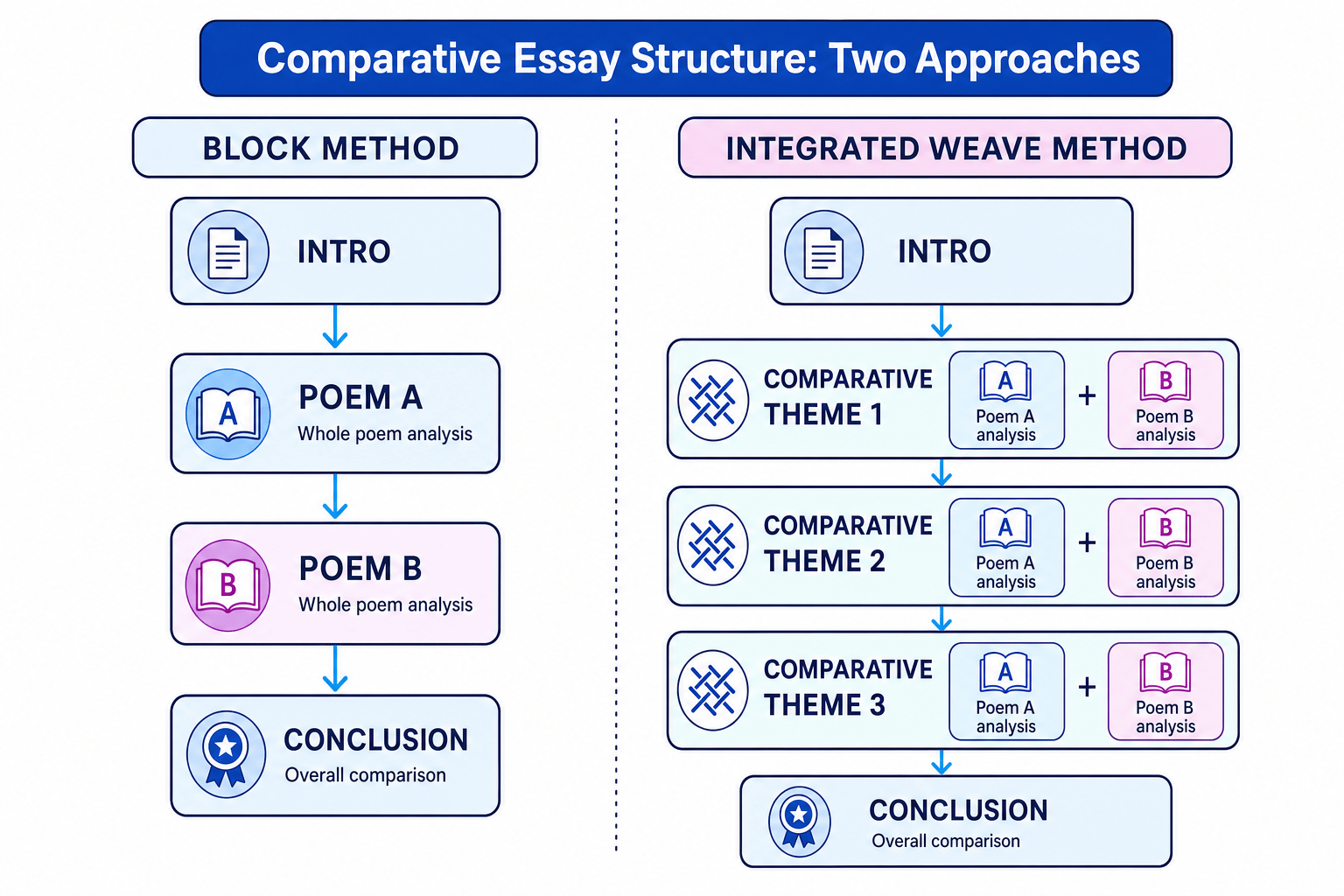
Integrated Comparison (often called the "weave" method) is the technique of analyzing two texts simultaneously within the same paragraph, using comparative transition words to highlight their similarities and differences.
The graphic below illustrates why the Integrated Weave Method is far superior to the Block Method (where you write everything about Poem A, then everything about Poem B). The Block Method makes it incredibly difficult to achieve high marks for comparison because it delays the actual comparative work until the very end of your essay.
Unpacking "Worlds and Lives"
To write a great comparative essay for this specific cluster, you need to understand what "Worlds and Lives" means as a unifying theme.
- "Worlds" refers to the environments, physical settings, societies, time periods, or power structures that surround the speakers. This could be the oppressive urban landscapes of Blake's Industrial London, or the modern, racially charged streets of Femi's Peckham.
- "Lives" refers to the individual human experience, identity, vulnerability, resilience, or loss of innocence within those worlds.
When you read the exam prompt, it will always point you toward a specific aspect of "Worlds and Lives"—such as how poets present places, vulnerability, change, or powerlessness.
The Comparative Pivot
Always base your comparison on the ideas and intentions of the poets first. Do not just compare devices (e.g., "Both poets use metaphors"). Instead, compare what the poets are trying to tell us about human lives, and why their historical or social contexts influenced them to write this way.
Mastering the "Weave": How to Structurally Compare
To achieve a top grade, your paragraphs must act as a bridge between the two poems. Rather than writing separate paragraphs for each poem, structure your main body paragraphs around a shared thematic sub-point.
Here is the ideal structure for an integrated comparative paragraph:
- Comparative Topic Sentence: State a shared idea or contrast between the two poems that answers the prompt.
- Poem A (Printed) Analysis: State a point, embed a short quote, analyze a specific method (AO2), and link to the poet’s context/message (AO3).
- Comparative Transition Pivot: Use a transition word (conversely, similarly, whereas, in a parallel fashion) to shift to the second poem.
- Poem B (Chosen) Analysis: Repeat the cycle for Poem B, directly contrasting or comparing its methods and context to Poem A.
- Synthesis Link: Conclude the paragraph by summarizing how both poets’ representations deepen our understanding of the essay prompt.
The Transition Toolkit
Keep a mental bank of comparative transition words ready for your exam:
- For Similarities: Correspondingly, parallel to this, in a similar vein, likewise, echoes.
- For Differences: Conversely, on the other hand, in stark contrast, whereas, diverges from.
Formulating a Winning Thesis
Your thesis statement is the most important sentence in your essay. It appears at the end of your introduction and outlines your entire argument. A weak thesis simply states that two poems are "similar and different." A strong thesis explains how and why they differ in their depictions of "worlds" and "lives."
Let's look at how to build a high-level thesis statement step-by-step.
Constructing a Comparative Thesis Statement
The Prompt: Compare how poets present the impact of hostile environments on individuals in "London" by William Blake and one other poem from the Worlds and Lives cluster.
Chosen Poem: "Thirteen" by Caleb Femi.
-
Identify the shared core theme and the key divergence: Both poems explore how hostile, restrictive urban environments harm vulnerable citizens. However, Blake focuses on universal, institutionalized oppression in 18th-century industrial London, while Femi focuses on the specific racial profiling and loss of childhood innocence experienced by a Black boy in 21st-century modern London.
-
Formulate the contextual contrast (AO3): Blake's hostility stems from the institutional corruption of the Church and Palace during the Industrial Revolution, whereas Femi's hostility stems from systemic police bias and the societal perception of young Black boys as inherently threatening.
-
Synthesize into a single, cohesive thesis statement: Combine these elements using a subordinating conjunction (like "while" or "although") to establish a sophisticated, dual-focus argument:
"While both Blake and Femi depict the streets of London as hostile terrains that restrict the freedom of vulnerable individuals, Blake presents this as a universal tragedy of institutionalized, class-based oppression in the industrial era, whereas Femi exposes a deeply personal, racialized loss of innocence enforced by modern systemic profiling."
The 'Two Separate Essays' Trap
Many students write excellent analysis of Poem A, followed by excellent analysis of Poem B, but only compare them in the introduction and conclusion. This is treated as two separate essays and limits your mark. To avoid this, ensure every single body paragraph contains at least one comparative transition word that actively links the two texts.
Integrating Language, Structure, and Context
To secure a Grade 7, 8, or 9, you must demonstrate how the methods used by the poets are shaped by their contexts. Let's look at how we can weave these elements together.
- In "London", Blake uses a highly regular ABAB rhyme scheme and repetitive, driving iambic tetrameter. This rigid structure mirrors the physical and mental confinement of the citizens—the "mind-forg'd manacles" that trap them. This reflects his anger at the Industrial Revolution and the state's total control over human lives.
- In "Thirteen", Femi uses free verse and erratic, conversational line lengths. This lack of a formal structure mirrors the unpredictability and sudden, jarring nature of being stopped and searched by police. It reflects the modern, hostile reality where a child's freedom of movement can be instantly restricted based on his age and race.
By contrasting Blake’s rigid, repetitive structure with Femi’s unstable free verse, you are comparing AO2 (structure) and directly tying it to AO3 (the social contexts of the Industrial Revolution versus modern systemic policing).
The Context Dump
Never write a paragraph of pure history. If you write about the Industrial Revolution or modern policing without tying it directly to a specific quote or poetic choice, you will not gain AO3 marks. Context must always explain why the poet chose a specific word or structural technique.
In the exam
- Spend 5 minutes planning: Do not start writing immediately. Write down your thesis statement and choose your three comparative points of connection first.
- Read the printed poem with a pen in hand: Underline 3-4 short, high-yield quotations that directly answer the key theme of the prompt.
- Retrieve matching quotes: Jot down 3-4 matching quotations from your memory for your chosen poem. Ensure they allow for direct comparison of language or structural methods.
- Use the "Weave" method: Aim for 3 solid body paragraphs that compare both poems side-by-side using the structure detailed above.
- Conclude on the poets' ultimate messages: In your conclusion, summarize how comparing these two poems deepens our understanding of the "Worlds and Lives" theme as a whole.
Check yourself
- Can you explain the structural difference between the "Block Method" and the "Integrated Weave Method" of comparison?
- What are three transition words you can use to signal a contrast between your two chosen poems?
- How does the context of William Blake's "London" contrast with the context of Caleb Femi's "Thirteen", and how does this affect their presentation of urban "worlds"?
