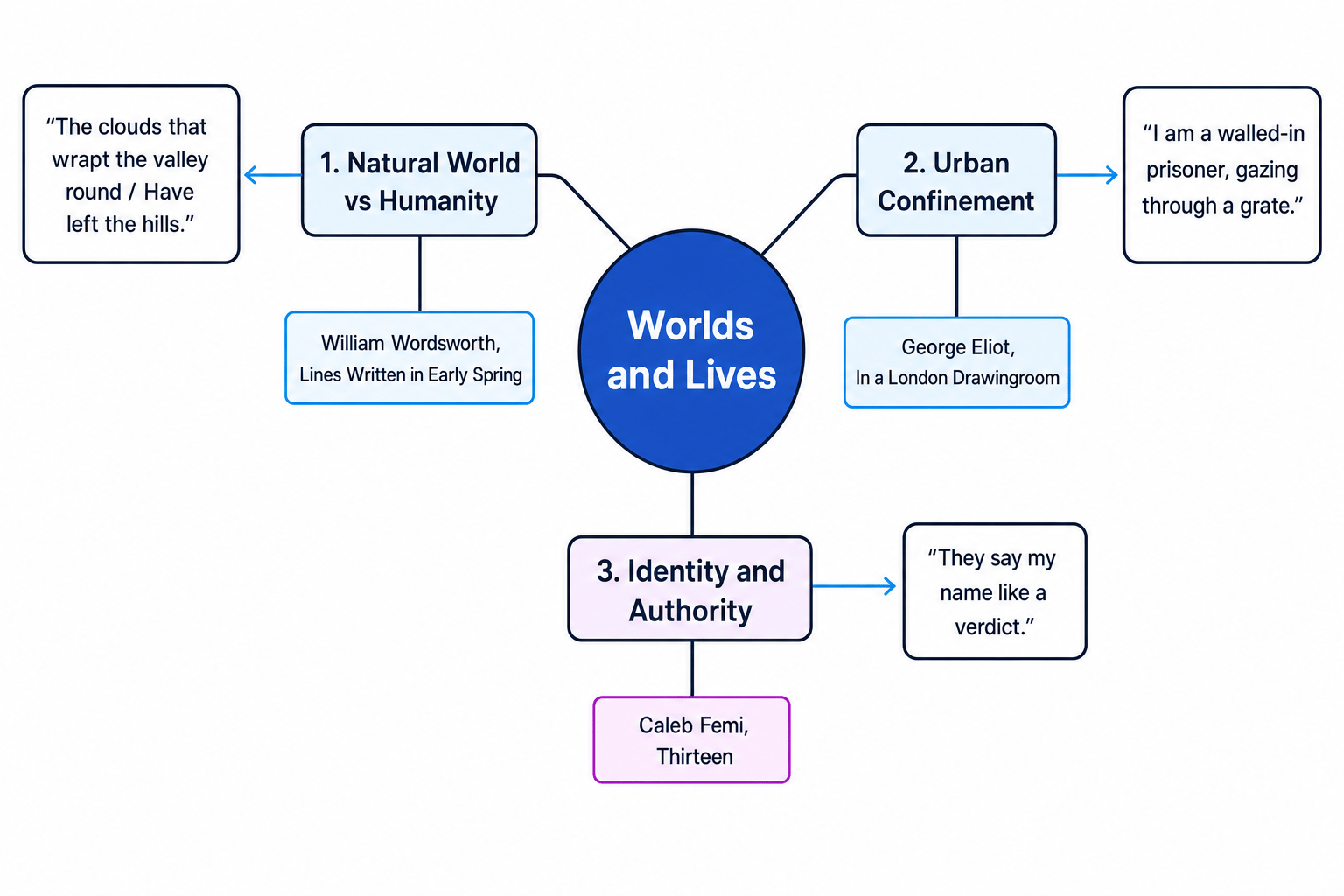
Defining Your Core Revision Vocabulary
To write high-scoring answers, you must move beyond simply identifying what a poem is about. You need to analyze the writer's craft. Let's define the key concepts we will use to analyze our quotes:
High-Yield Quote
A high-yield quote is a short, memorable, and dense line of poetry that contains multiple literary devices (methods) and can be used to address several different themes.
Exploding a Quote
Exploding a quote is the analytical practice of breaking a single line down into micro-details (individual words, punctuation, sound devices, and structural shifts) to extract multiple layers of meaning.
Romanticism
Romanticism was an artistic and literary movement of the late 18th and early 19th centuries that reacted against the scientific rationalism of the Enlightenment and the urbanization of the Industrial Revolution. It championed the beauty of the natural world, emotional intensity, and the individual spirit.
Less is More
For closed-book exams, memorizing ten 3-word to 6-word quotes per poem is far more effective than trying to memorize long stanzas. Short quotes are easier to embed seamlessly into your own sentences, which instantly improves your academic writing style.
How to "Explode" a Quotation
To get top marks for AO2, you must show the examiner how the writer constructs meaning. You cannot just state that a device is present; you must explain its specific effect on the reader.
We do this using a structured, step-by-step approach.
Deconstructing a key quotation from 'Lines Written in Early Spring'
Let's analyze this famous, pivotal line from William Wordsworth's poem:
"Have I not reason to lament / What man has made of man?"
- Identify the core method and structural choice: Note that Wordsworth structures this sentence as a rhetorical question, which directly challenges the reader to reflect on human behaviour. Identify the enjambment (the run-on line) between "lament" and "What", which mirrors the ongoing, unbroken cycle of human suffering and destruction.
- Analyze the micro-effects of specific word choices (diction): Zoom in on the verb "lament." This is a deeply sorrowful word associated with mourning the dead, suggesting that humanity's departure from nature is a tragic, fatal loss. Next, look at the repetition of "man" ("What man has made of man"). This structural repetition (diacope) emphasizes that humanity is both the perpetrator and the victim of its own suffering; we have brought misery upon ourselves.
- Connect the choices to historical context (AO3) and theme: Connect this lamentation to the context of the Industrial Revolution and the French Revolution. Wordsworth, as a Romantic poet, is grieving how the rise of factories, urban crowding, and political violence have severed human beings from the healing, peaceful influence of the natural world ("holy plan").
Feature spotting without analysis
Many students write: "Wordsworth uses a rhetorical question when he asks 'Have I not reason to lament?'" This is called "feature spotting." It earns very few marks because it fails to explain how or why the device works. Always link the method directly to the writer's deeper message.
The Key Quote Bank
Here is your targeted bank of highly versatile quotes from three key poems in the Worlds and Lives cluster. Each quote is selected because it can be used for multiple exam questions.
1. Lines Written in Early Spring by William Wordsworth
- Theme Focus: Nature's harmony vs. human discord; mental health and tranquility vs. societal misery.
| Quote | Key Methods | Analytical Effect |
|---|---|---|
| "To her fair works did Nature link / The human soul that through me ran" | Personification, Capitalisation, Metaphorical link | Wordsworth personifies Nature as a benevolent female force ("her"). The verb "link" suggests a designed, spiritual kinship between humanity and the environment. By capitalizing "Nature", he elevates her to a divine status, criticizing how modern society has severed this sacred connection. |
| "And much it grieved my heart to think / What man has made of man" | Juxtaposition, Repetition | The speaker's internal emotional landscape ("grieved my heart") is placed in stark contrast (juxtaposition) with the beautiful scene around him. The repetition of "man" reinforces a cycle of self-destruction and social inequality, reflecting Romantic anxiety over industrialization. |
| "Every flower / Enjoys the air it breathes" | Personification, Active verbs | By giving flowers the human capacity to "enjoy" and "breathe", Wordsworth portrays the natural world as sentient, joyful, and harmonious. This highlights how far humanity has strayed from this effortless, peaceful state of being. |
2. In a London Drawingroom by George Eliot
- Theme Focus: Urban confinement; industrialization; loss of individuality; the unnatural modern world.
| Quote | Key Methods | Analytical Effect |
|---|---|---|
| "All shut in by a high wall of dark houses" | Oppressive imagery, Monosyllabic words | The heavy, monosyllabic words ("All shut in by a high wall...") create an auditory sense of confinement and claustrophobia. The houses are not homes but barriers, blocking out light and nature, illustrating how urbanization traps the human spirit. |
| "the same uniform red breast" | Adjective "uniform", Monotony | The word "uniform" suggests a complete loss of individuality and variety. In the Victorian city, everything—including the buildings—has been standardized by industrial greed. Even the natural color "red" is rendered dull and mechanical. |
| "The world seems made of giant pigeon-holes" | Metaphor, Industrial imagery | Eliot uses the metaphor of "pigeon-holes" to criticize how modern city dwellers are compartmentalized, categorized, and stripped of their humanity. The word "giant" emphasizes the overwhelming, inescapable power of this oppressive urban structure. |
Perfect Poem Pairings
If your exam question is about how place influences our lives, pair In a London Drawingroom (oppressive, urban confinement) with Lines Written in Early Spring (liberating, natural harmony). They are perfect thematic opposites!
3. Thirteen by Caleb Femi
- Theme Focus: Youth and innocence vs. systemic power; authority and racial profiling; identity in the modern world.
| Quote | Key Methods | Analytical Effect |
|---|---|---|
| "You are thirteen, and you have a choice of being a boy or a target." | Direct address (second-person pronoun), Juxtaposition | The pronoun "You" immediately pulls the reader into the hostile reality of a young Black boy in London. The stark, tragic juxtaposition between "boy" (innocence, playfulness) and "target" (violence, hunting) reveals how systemic racism prematurely strips children of their childhood. |
| "the policing of your knuckles" | Metonymy, Physical verb | "Knuckles" acts as a metonymy for the boy's entire physical presence and race. The noun "policing" suggests constant, invasive surveillance, showing that his very body is treated as a crime scene or a threat by authority figures. |
| "They say my name like a verdict." | Simile, Legal jargon | The noun "verdict" is a legal term associated with guilt and sentencing. By comparing the pronunciation of his name to a "verdict" using a simile, Femi demonstrates how prejudiced authority figures have already judged, condemned, and criminalized him before he has even spoken. |
Do not drift into political debate
When discussing poems like Thirteen, keep your focus sharp on the writer's literary choices. It is easy to write an essay on your own opinions about policing, but you will only get marks if you analyze Femi's language, such as his use of second-person narrative perspective or legal metaphors.
Constructing an Analytical Paragraph
When you write your essay, use your quotes as the foundation of your paragraphs. Ensure you weave in context naturally to explain why the poet wrote the poem.
Point:
Eliot uses the oppressive urban landscape in "In a London Drawingroom" to criticize the dehumanizing impact of Victorian industrial development.

Evidence & Method:
This is clearest when she describes the city as being "all shut in by a high wall of dark houses." Eliot's use of monosyllabic words creates a heavy, claustrophobic rhythm that mirrors the physical trap of the city.

Analysis (AO2):
The phrase "shut in" suggests imprisonment, implying that the modern urban environment denies citizens their freedom and connection to the natural world. The "high wall" acts as a metaphorical barrier to spiritual enlightenment and clean air.

Context (AO3):
Writing during the height of the Industrial Revolution, Eliot reacts against rapid urbanization, highlighting how the pursuit of industrial progress resulted in the psychological containment of the working and middle classes.
In the exam
To make the most of your key quote bank under exam pressure, use these three strategies:
- Choose short fragments: Never write out three lines of poetry. Instead, embed tiny fragments of 2-4 words directly into your own sentences (e.g., Wordsworth laments how "man has made of man" to highlight...). This keeps your writing fluid and dense.
- Track structural movement: When analyzing your chosen quotes, try to refer to where they occur in the poem. Does the quote represent a turning point (volta), an opening observation, or a final, unresolved question?
- Compare through methods, not just themes: In your comparative paragraph transitions, link the quotes by their techniques. For instance: "While Wordsworth uses personification to show nature's active benevolence, Eliot uses the metaphor of 'pigeon-holes' to show the artificial construction of the city."
Check yourself
Before your next practice essay, make sure you can answer these questions:
- What does the metaphor of the "giant pigeon-holes" in In a London Drawingroom tell us about Victorian society?
- Why is the word "target" in Caleb Femi's Thirteen such a powerful contrast to the word "boy"?
- How does the repetition of the word "man" in Lines Written in Early Spring change our understanding of who is responsible for human misery?
