What you'll learn
- What happens in AQA English Literature Paper 2, Section C.
- How to approach a poem you have never seen before.
- How to write about language, form and structure without just “spotting techniques”.
- How to handle the short comparison question.
What “unseen poetry” means
In the exam, unseen poetry means you are given poems you have not studied in class. You do not need to memorise quotations or context for these poems, because the poems are printed in the paper.
Your job is to show that you can read carefully, notice the poet’s choices, and explain how those choices shape meaning.
Unseen poem
An unseen poem is a poem you have not prepared in advance. In the exam, you respond to it using close reading: careful attention to words, images, sounds, structure and ideas.
The main skill
Unseen poetry is not a memory test. It is a reading test: can you work out what the poem is about, how it feels, and how the poet creates those effects?
The exam format
Unseen poetry appears in Paper 2, Section C of AQA GCSE English Literature. The section is worth 32 marks in total.
You answer two questions:
- Question 1: one unseen poem, worth 24 marks.
- Question 2: a comparison between the first poem and a second unseen poem, worth 8 marks.
There is no context requirement for unseen poetry. Focus on the poems themselves: the ideas, feelings, language, form and structure.
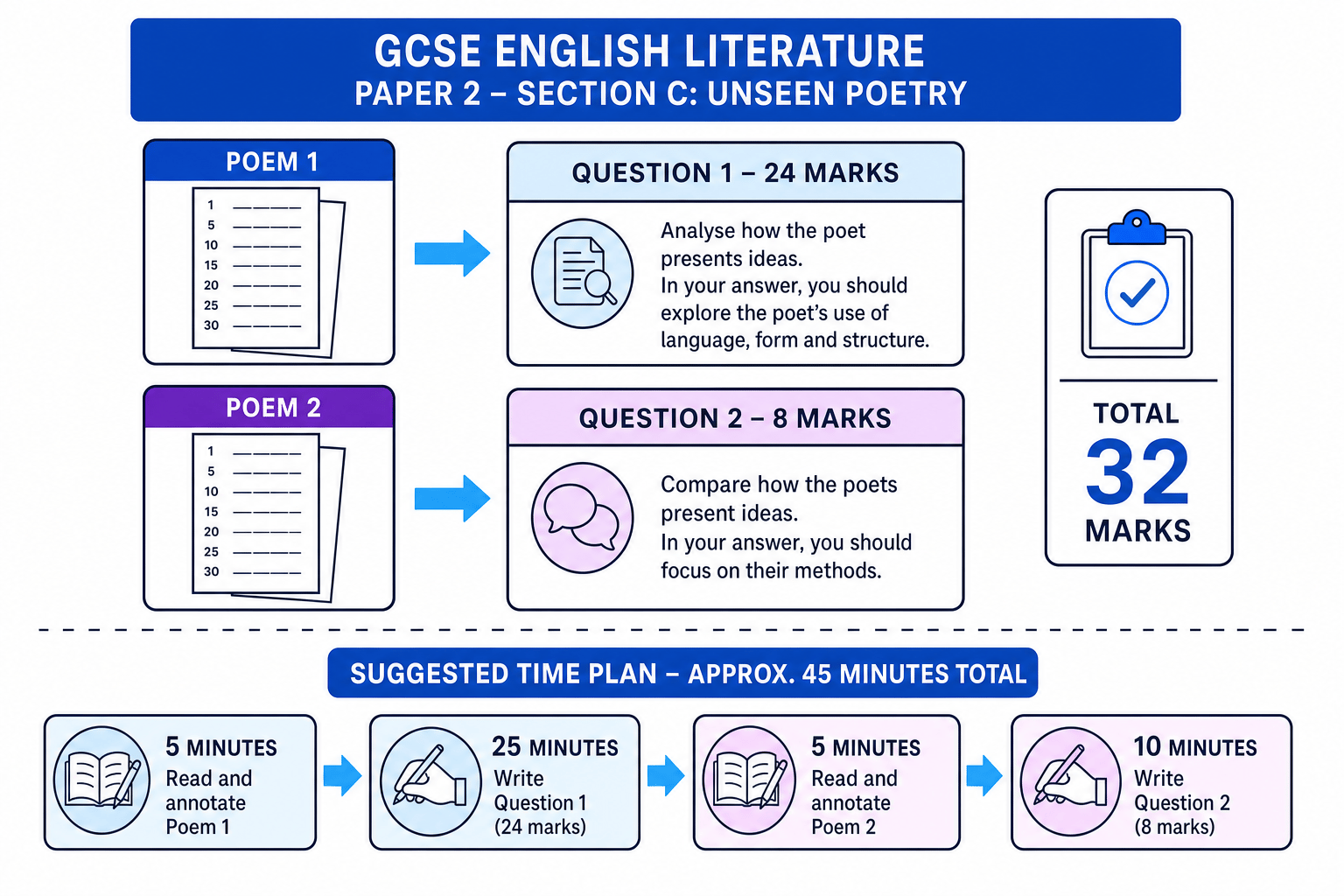
Timing
A sensible plan is about 45 minutes for unseen poetry: roughly 30 minutes on the 24-mark question and 15 minutes on the 8-mark comparison.
Your first task: understand the poem
Before analysing techniques, you need a secure basic understanding. Start with four simple questions:
- Who is speaking?
- What is happening or being described?
- What feelings or attitudes are present?
- Does anything change from the beginning to the end?
Speaker
The speaker is the voice in the poem. This is not automatically the poet. A poet can create a speaker, just as a novelist creates a narrator.
Theme
A theme is a bigger idea explored by a text, such as love, grief, power, memory, nature, childhood, conflict or identity.
Tone
Tone means the attitude or feeling created by the writing. A poem might sound joyful, bitter, nostalgic, anxious, calm, resentful or hopeful.
Separating subject, theme and tone
Imagine a poem begins: “The playground waits, its swings held still by rain.”
- The subject is the literal thing being described: an empty playground in wet weather.
- The theme may be larger than that: childhood, loneliness, memory, or the passing of time.
- The tone feels quiet and melancholic because “waits”, “held still” and “rain” suggest absence and sadness rather than energy or play.
- The phrase “swings held still” also suggests that something normally lively has been stopped, so the poem may be about loss or change.
Reading the poem in layers
A strong unseen response usually comes from reading the poem more than once. Do not try to understand everything instantly.
First read: get the basic meaning
Read the title and the whole poem. Do not annotate heavily yet. Ask: what is this poem broadly about?
Second read: track feelings and changes
Look for shifts. A shift is a change in mood, idea, time, focus or attitude. Many poems move from one feeling to another.
Third read: notice methods
A method is any deliberate choice the poet uses to create meaning. This includes language, form and structure.
Language, form and structure
Language means the poet’s word choices and images. Form means the type, shape or pattern of the poem, such as a sonnet, dramatic monologue or free verse. Structure means how the poem is organised, including beginnings, endings, stanza breaks, repetition and shifts.
Starting with techniques too early
Do not begin by hunting for “a simile” or “enjambment” before you understand the poem. First work out the meaning; then explain how the methods help create that meaning.
What to annotate
Annotation means marking brief, useful notes on the poem. Keep it focused. You are not decorating the page — you are preparing an answer.
Useful things to mark include:
- The title, because it often gives the topic or a clue to meaning.
- Repeated words or ideas.
- Contrasts, such as light/dark, past/present, freedom/control.
- Strong images.
- The beginning and ending.
- Any clear shift in tone or focus.
- Interesting line breaks or punctuation.
Image
An image is a description that creates a picture or sensory impression in the reader’s mind. It may involve sight, sound, touch, taste or smell.
Semantic field
A semantic field is a group of words linked by meaning. For example, “wound”, “battle”, “weapon” and “scar” create a semantic field of conflict.
Using annotation to find a pattern
Imagine a poem includes the words “locked”, “bars”, “chain” and “key”.
- These words belong to a semantic field of imprisonment or restriction.
- If the poem is about a person’s daily life, the pattern suggests they may feel trapped emotionally, socially or mentally.
- Instead of writing “there is a semantic field”, link it to meaning: the repeated language of confinement makes the speaker’s world feel controlled and limited.
Analysing language
Language analysis means zooming in on important words or phrases and explaining their effect.
Some common language methods include:
- A metaphor, where something is described as if it is something else.
- A simile, where something is compared using “like” or “as”.
- Personification, where something non-human is given human qualities.
- Symbolism, where an object, action or image represents a bigger idea.
- A semantic field, where several related words create a pattern of meaning.
The best answers do not just name methods. They explain why the poet’s choice matters.
Effect
The effect is what a method makes the reader think, feel or understand. In Literature, effect should always connect to the poem’s meaning.
Connecting a method to meaning
Imagine a poem says: “Winter bit my hands.”
- The verb “bit” gives winter a violent human or animal action, so this is personification.
- “Bit” suggests sharp pain, making the cold feel aggressive rather than simply uncomfortable.
- This could imply the speaker feels attacked by their environment, creating a harsh and hostile mood.
- A strong sentence might be: The personification in “Winter bit my hands” makes the cold seem violent, suggesting the speaker experiences the world as painful and threatening.
Device spotting
Avoid writing: “The poet uses personification, which is effective.” That does not explain anything. Always say what the method suggests and how it shapes the reader’s response.
Analysing form and structure
Form and structure can feel harder than language, but you do not need to force complicated comments. Start with what you can see.
Form
Form is the overall type or shape of the poem. For example, a poem might use free verse, meaning it does not follow a regular rhyme scheme or rhythm. A poem might also be a dramatic monologue, where a single speaker addresses someone directly.
Structure
Structure is the order and arrangement of the poem. Notice how it begins, develops and ends.
Useful structural terms include:
- A stanza: a group of lines, like a paragraph in a poem.
- Repetition: when a word, phrase or pattern is used more than once.
- Enjambment: when a sentence or phrase runs over from one line to the next without a full stop.
- Caesura: a pause in the middle of a line, often created by punctuation.
- Volta: a turn or shift in thought, feeling or argument.
Commenting on a structural shift
Imagine a poem begins with a speaker describing a peaceful garden, but ends with the line: “Still, I locked the gate behind me.”
- The beginning creates calm through the image of the garden, so the reader expects safety or comfort.
- The final line changes the mood because “locked” suggests separation, control or fear.
- The shift from peace to closure may imply that the speaker cannot fully trust the place, even if it seems beautiful.
- You could write: The ending creates a structural shift: after peaceful natural description, “locked the gate” introduces unease, suggesting that safety in the poem is fragile.
Writing Question 1: the 24-mark response
For the first question, you usually respond to one poem and explain how the poet presents an idea, feeling or experience.
You are rewarded for:
- A clear personal response to the poem.
- Relevant quotations or references.
- Analysis of language, form and structure.
- A well-organised answer.
You do not need a huge introduction. One sentence that gives your overall interpretation is enough.
A useful paragraph pattern is:
- Make a clear point about the poem’s meaning.
- Embed a short quotation.
- Name or describe the poet’s method.
- Explain the effect on the reader.
- Link back to the question.
Short quotations are powerful
For unseen poetry, quote tiny phrases: one to five words is often enough. It is easier to analyse “bit my hands” closely than to copy out a whole line and say very little about it.
Building an analytical paragraph
Imagine the question asks how a poem presents loneliness, and the poem includes: “one light trembled in the street.”
- Decide the idea: the poem presents loneliness as fragile and exposed.
- Choose the evidence: “one light” suggests isolation because it is singular and surrounded by darkness.
- Identify the method: “trembled” is personification, making the light seem frightened or vulnerable.
- Explain the effect: the reader senses that even the small source of comfort is unstable.
- Build the paragraph: The poet presents loneliness as fragile through the image of “one light” that “trembled”. The singular “one” emphasises isolation, while the personification of the light makes it seem vulnerable, as if the surrounding darkness is threatening it. This creates a tense, exposed mood and suggests loneliness is not just being alone, but feeling unsafe.
Writing Question 2: the 8-mark comparison
The second question asks you to compare the first poem with a second unseen poem. This answer is shorter, so be direct.
Comparison
A comparison explains similarities and differences between texts. In unseen poetry, you should compare both the poets’ ideas and their methods.
For the 8-mark question, aim for two focused comparative paragraphs. You can write about:
- A similarity in what the poets present.
- A difference in tone, imagery, structure or speaker.
- How each poet’s methods shape the reader’s response.
Useful comparison words include:
- Similarly
- Both
- However
- Whereas
- In contrast
- Alternatively
Comparing two poems briefly
Imagine Poem A describes loneliness as “a locked room”, while Poem B describes it as “an empty road.”
- Identify the shared idea: both poems present loneliness as separation from other people.
- Notice the difference: “locked room” suggests being trapped, while “empty road” suggests distance, movement or abandonment.
- Compare the methods: Poem A uses symbolism of confinement, whereas Poem B uses setting and space to create isolation.
- Turn this into comparison: Both poets present loneliness as isolating, but they create different effects. In Poem A, the symbolic “locked room” suggests the speaker feels trapped and unable to escape their own isolation. However, Poem B’s image of an “empty road” makes loneliness feel more open and endless, as if the speaker has no clear destination or support.
Do not ignore Poem 1 in Question 2
The comparison question is about both poems. Even though Poem 2 is new, you must keep linking it back to Poem 1.
What a strong unseen answer sounds like
A strong response does three things at once:
- It understands the poem’s ideas.
- It analyses the poet’s methods.
- It keeps linking methods to meaning.
Instead of writing:
The poet uses a metaphor and enjambment.
Write something more like:
The metaphor makes the speaker’s grief seem heavy and physical, while the enjambment allows the sentence to spill across the line break, suggesting that the emotion is difficult to control.
That second version is stronger because it explains the effect of the methods.
Meaning first, method second
Start with what the poem makes you think or feel. Then choose methods that help explain how the poet creates that response.
If the poem feels difficult
It is normal for an unseen poem to feel strange at first. You are not expected to understand every single word.
Focus on what you can work out:
- Is the poem mostly positive, negative, mixed or changing?
- What images stand out?
- Who or what seems important?
- What happens at the end?
- What words are repeated or emphasised?
A useful fallback
If you feel stuck, focus on the title, the first line, and the last line. Together, they often reveal the poem’s main movement.
In the exam
- Spend about 5 minutes reading and annotating the first poem before writing.
- Build your answer around ideas and feelings, not a list of techniques.
- Use short quotations and zoom in on individual words.
- For Question 1, cover language and at least one point about form or structure.
- For Question 2, compare both poems in each paragraph and focus on the poets’ methods.
Check yourself
- Can you explain the difference between subject, theme and tone?
- Can you analyse a quotation by linking method to meaning and effect?
- Can you write a short comparison that discusses both poems, not just one?
